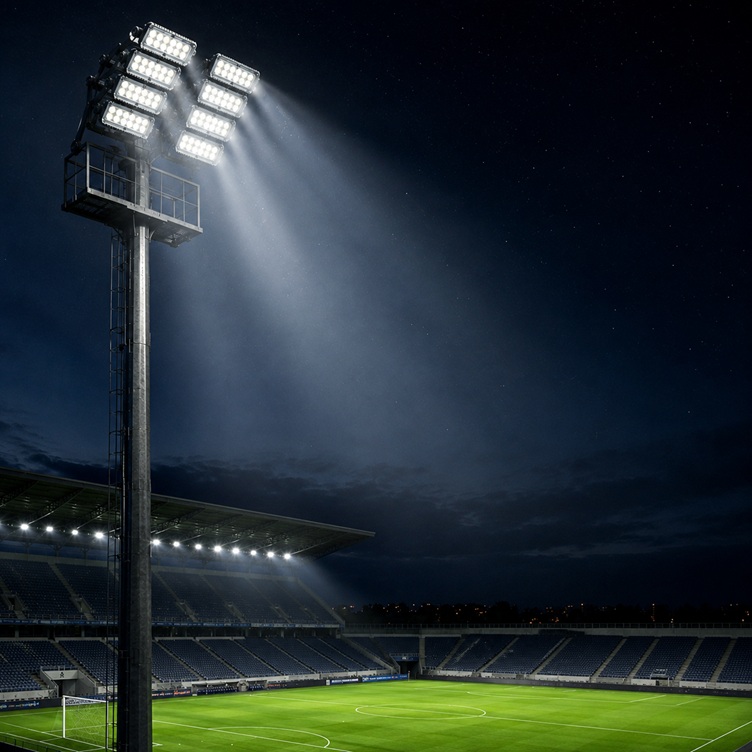
Stadium lighting lux levels are set by competition class, not venue size: EN 12193 requires 500 lx at 0.7 uniformity for Class I football, 200 lx at 0.6 for Class II, and 75 lx at 0.5 for Class III training pitches — with parallel tables for every major sport. Knowing your class answers most design questions before a single fixture is selected. This guide covers the class tables, the glare and spill limits, what television broadcast adds, and how flood light aiming turns targets into a buildable design.
Key Takeaways
- EN 12193 defines three classes: Class I (top-level/spectator), Class II (regional club), Class III (training and recreation). Lux and uniformity scale with class.
- Football needs 500/200/75 lx at the three classes; tennis holds higher training levels (200 lx minimum even at Class III).
- These are maintained values: apply a maintenance factor (commonly 0.8) or the venue drops below class as fixtures age.
- Broadcast changes the metric: cameras need vertical illuminance (often 800–2,000 lx toward main cameras), CRI targets, and flicker-free drivers.
- Glare is limited by the GR rating (≤ 50 typical outdoors); aiming discipline and asymmetric optics keep both players and neighbours protected.
The Three EN 12193 Classes
EN 12193 is the European sports-lighting standard, and like EN 13201 for roads, its first move is classification. The class expresses who is playing and who is watching:
| Class | Competition level | Typical venues |
|---|---|---|
| Class I | Top national / international | Stadia with large spectator areas, broadcast possible |
| Class II | Mid-level regional / club | Club grounds, municipal stadia, some spectators |
| Class III | Training, school, recreation | Training pitches, community courts, PE facilities |
Class drives everything downstream: the lux table, the uniformity floor, the glare ceiling, and ultimately pole heights and fixture counts. Specifying “Class II football” communicates more than three pages of prose.
Lux and Uniformity Targets by Sport
Horizontal maintained illuminance and minimum uniformity (Emin/Eavg) for outdoor venues under EN 12193 practice:
| Sport | Class I | Class II | Class III |
|---|---|---|---|
| Football | 500 lx · 0.7 | 200 lx · 0.6 | 75 lx · 0.5 |
| Tennis | 500 lx · 0.7 | 300 lx · 0.7 | 200 lx · 0.6 |
| Hockey | 500 lx · 0.7 | 250 lx · 0.6 | 200 lx · 0.6 |
| Athletics | 500 lx · 0.7 | 200 lx · 0.5 | 100 lx · 0.5 |
| Basketball (outdoor) | 500 lx · 0.7 | 200 lx · 0.6 | 75 lx · 0.5 |
| Multi-sport training | Design to the most demanding sport hosted |
Two details trip up first-time specifiers:
- These are maintained values. Divide day-one output by a maintenance factor (0.8 is the common default) so the installation still meets class after lumen depreciation and lens soiling. A venue that passes commissioning at exactly 200 lx fails its class two seasons later.
- Uniformity binds as hard as the average. A pitch averaging 250 lx with dark corners fails Class II: players judge ball flight through bright-dark transitions, and a 0.6 uniformity floor exists precisely to prevent them. Uniformity is also why fixture count rarely scales down linearly when targets drop.
Small-sided and five-a-side pitches follow the football table at Class III, though many commercial operators specify 100–200 lux for player comfort and CCTV coverage.
Broadcast Changes the Game: Vertical Illuminance
Horizontal lux lights the grass; cameras photograph players. Televised sport therefore specifies vertical illuminance (Ev) toward each main camera position, typically 800–2,000 lx for televised football depending on broadcast tier, along with:
- Color quality: CRI ≥ 80 as a floor, with Ra 90 and TLCI targets for HD production.
- Consistent color temperature across all fixtures — mixed CCTs read as patchwork on camera even when invisible to spectators. Tight binning (SDCM) matters here.
- Flicker-free drivers. Slow-motion replay at 300+ fps exposes any modulation an eye would miss. Specify high-frequency, low-ripple LED drivers with published flicker data for any venue that may host cameras.
The practical consequence: a broadcast-capable design is a different project from a Class I visual design, and the difference must be settled before poles are ordered, because vertical illuminance drives mounting height and aiming geometry.
Glare Control: The GR Rating
EN 12193 limits glare with the GR (Glare Rating) method; GR ≤ 50 is the usual outdoor ceiling. Glare is geometry, so the levers are geometric:
- Mounting height. Taller poles lift the fixture out of the direct line of sight; a common discipline keeps the aiming angle of the lowest fixtures at 25° or more below horizontal.
- Asymmetric optics. A forward-throw distribution lights the pitch with the glass face near-horizontal, instead of tilting a symmetric flood light skyward — which simultaneously controls glare and uplight.
- Shields and louvres where residential boundaries sit close; obtrusive-light limits (EN 12464-2 is the reference EN 12193 points to) cap spill into windows and sky glow.
Neighbour complaints and dark-sky compliance are design inputs, not after-thoughts: they belong in the aiming plan from day one.
Fixture Selection and Aiming Design
Layouts. Four corner masts suit athletics and larger stadia where the track keeps poles far from play; lateral (side-pole) layouts give football better uniformity at lower mounting heights and are the default for training grounds. Pole-height starting points: 12–16 m for training pitches, 18–25 m for Class II stadia, higher for Class I depending on geometry and spectator roofs.
Modular flood lights. Modern sports lighting is built from individually aimable modules — for example our modular SJTG-series flood lights, where 100–400 W units combine per pole and each module locks at its own aiming angle — see the 400W LED flood light page for the sports and high-mast class, or the measured 200W LED flood light for training pitches. The designer composes the photometric result from repeatable aiming blocks rather than one monolithic beam, which is also what makes future re-aiming (new sport, new camera position) affordable.
Electrical infrastructure. Pole-top fixtures on exposed feeders need surge protection sized accordingly (10 kV is a sensible floor), wide-input drivers, and — for venues billing peak demand — a power factor ≥ 0.95 across the array.
The deliverable to demand. From any supplier: a point-by-point calculation from real IES files showing horizontal lux, uniformity, GR, and (if televised) vertical illuminance at camera positions, at the declared maintenance factor. We produce these studies from your pitch dimensions and class at no cost, as part of quotation — the same workflow our sports and stadium lighting projects run.
From HID to LED at the Stadium Scale
Legacy 1,000–2,000 W metal halide stadium heads restrike slowly (a mid-match power dip means minutes of darkness), flicker on camera, and depreciate fast. LED conversion brings instant restrike, flicker-free replay, per-module aiming, and roughly one-third the wattage at equal class — the same physics covered in our high bay retrofit guide, applied at 25 m instead of 10 m. For venues, the operational win is dimmable classes: train at Class III output on Tuesday, switch to Class II for Saturday’s match, from the same installation.
Structure and Power: The Non-Lighting Deliverables
Sports lighting projects fail on civil and electrical details as often as on photometrics, so the specification should name them. Pole foundations and wind loading are structural calculations based on the total sail area of the fixture cluster — modular heads with individual die-cast housings publish per-module wind areas for exactly this purpose. Inrush current from dozens of drivers starting simultaneously needs breaker coordination, and long cable runs to remote poles deserve a voltage-drop check at full load. None of this is exotic, but all of it belongs in the tender so the poles that arrive can actually carry, power, and survive the lighting that was calculated.
Frequently Asked Questions
How many lux does a football pitch need? Maintained horizontal illuminance of 500 lx (Class I), 200 lx (Class II), or 75 lx (Class III training) with uniformities of 0.7/0.6/0.5 respectively under EN 12193. Televised matches add vertical illuminance requirements toward cameras.
How many lux for a five-a-side or training pitch? Class III football sets 75 lx at 0.5 uniformity as the floor; commercial operators commonly specify 100–200 lx for comfort and CCTV legibility.
Can one fixture family cover Class III through Class I? Yes, when it scales in output and optics: the same modular flood platform at different wattages, pole counts, and aiming plans is standard practice, which simplifies spares and future upgrades.
Do LED sports lights flicker on camera? Quality drivers do not. Ask for flicker data (percent flicker / flicker index at full and dimmed output) whenever broadcast or slow-motion recording is possible; treat missing data as a red flag.
What pole height does a training pitch need? Typically 12–16 m for full-size training pitches with lateral layouts — tall enough to hold GR ≤ 50 and aiming angles ≥ 25° below horizontal. Confirm with the photometric study; height is the cheapest glare control available at design time and the most expensive after.
Who verifies the design meets EN 12193? The photometric calculation proves the design; a commissioning measurement on the EN 12193 grid proves the installation. Both artifacts belong in the project file. Send your pitch dimensions and class and we return the calculation with fixture counts, pole loads, and aiming tables.
The Bottom Line
EN 12193 turns stadium lighting into a solvable specification: name the sport and class, read the lux and uniformity targets, cap glare at GR 50, and add vertical illuminance only if cameras demand it. Design to maintained values, insist on IES-file calculations and flicker data, and choose modular LED stadium flood lights whose aiming can evolve with the venue. Do that, and the pitch passes its class on commissioning day — and still passes when the broadcast van arrives three seasons later.