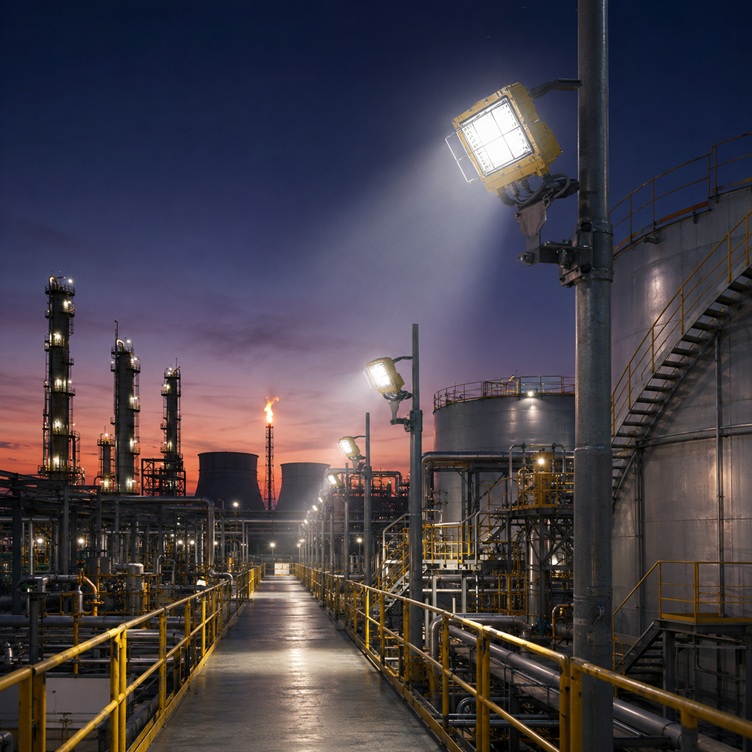
GB/T 3836-2021 is China’s national standard series for electrical equipment in explosive atmospheres, and it is technically aligned, part for part, with the international IEC 60079 series. If you source explosion-proof LED lights from China, this is the standard behind the certificate you will be shown. This guide explains what GB/T 3836 covers, how to read every element of an Ex marking, and exactly which documents a serious buyer should verify before payment.
Key Takeaways
- GB/T 3836-2021 mirrors IEC 60079: same zones, gas groups (IIA/IIB/IIC), temperature classes (T1–T6), and marking grammar.
- The two protection methods you will see on luminaires are Ex d (flameproof enclosure) and Ex e (increased safety), often combined as “Ex d e”.
- A valid certificate lists a verifiable number, the covered standard parts, the exact models, and the manufacturing site. Sunjoylight’s SJFB series carries certificate ZJEx25.1185.
- An IP65 rating is not explosion protection. Only Ex-certified equipment may be installed in classified zones.
- Most industrial LED fixtures reach T4 (135 °C max surface) or better, which is a core reason LED has displaced HPS in hazardous areas.
What Is GB/T 3836 and Why Does It Matter?
GB/T 3836 is the standard series that governs how electrical equipment must be built, tested, and marked for use in explosive gas and dust atmospheres in China. The 2021 edition replaced the 2010 edition and deliberately tightened alignment with IEC 60079, the international reference for hazardous-area equipment.
For international buyers the standard matters for two reasons. First, it defines the engineering bar: a luminaire that genuinely passes GB/T 3836-2021 testing has cleared the same physics-based requirements (over-pressure containment, temperature rise, impact, thermal endurance) as its IEC-certified equivalents. Second, it defines the paperwork: the Ex certificate, the marking string, and the test reports you should demand in procurement.
The parts most relevant to lighting are:
| Part | Scope | Protection letter | IEC counterpart |
|---|---|---|---|
| GB/T 3836.1 | General requirements | — | IEC 60079-0 |
| GB/T 3836.2 | Flameproof enclosures | d | IEC 60079-1 |
| GB/T 3836.3 | Increased safety | e | IEC 60079-7 |
| GB/T 3836.4 | Intrinsic safety | i | IEC 60079-11 |
| GB/T 3836.9 | Encapsulation | m | IEC 60079-18 |
| GB/T 3836.31 | Dust ignition protection | t | IEC 60079-31 |
A certificate that covers only 3836.1 is not an explosion-proof certification by itself. General requirements always combine with at least one protection-method part. For a deeper comparison of the Chinese and international frameworks, see our guide to IEC 60079 vs GB/T 3836 technical equivalence.
How to Read an Ex Marking, Character by Character
Every certified fixture carries a marking string. Take a typical luminaire marking under GB/T 3836-2021:
Ex db eb IIC T4 Gb
| Element | Meaning |
|---|---|
| Ex | Equipment certified for explosive atmospheres |
| db | Flameproof enclosure, EPL “b” construction level |
| eb | Increased safety, EPL “b” construction level |
| IIC | Gas group: suitable up to hydrogen/acetylene atmospheres |
| T4 | Maximum surface temperature 135 °C |
| Gb | Equipment Protection Level: gas atmospheres, Zone 1 suitable |
Each element is a contract. The letters after the protection code (db rather than d) were introduced in the modern editions to bind the protection concept to an Equipment Protection Level. If any element of the marking on the fixture differs from the certificate, treat the product as uncertified.
Dust atmospheres get a parallel marking, for example Ex tb IIIC T130°C Db, where IIIC denotes conductive dust and the temperature is stated directly rather than as a class.
Ex d vs Ex e: The Two Protection Methods on Luminaires
Ex d: flameproof enclosure
An Ex d enclosure does not try to prevent an internal explosion. Instead, it is engineered to survive one. If flammable gas enters the housing and ignites, the die-cast aluminum enclosure contains the pressure, and the escaping combustion gases are forced through long, narrow machined gaps called flame paths. By the time they exit, they have cooled below the ignition temperature of the surrounding atmosphere.
Design consequences you can inspect on a real product: thick cast walls, machined mating flanges, a specified number of bolts at specified torque, and no gasket in the flame path itself. Flame path surfaces must never be painted, scratched, or filled with sealant during maintenance.
Ex e: increased safety
Ex e takes the opposite approach: prevent any ignition source from occurring at all. There are no sparking contacts, temperatures are kept below ignition thresholds with margin, insulation is enhanced, terminals are vibration-secure, and creepage and clearance distances are enlarged.
Why luminaires combine both
A common industrial construction is a flameproof optical and LED driver compartment (Ex d) paired with an increased-safety wiring compartment (Ex e). The Ex e terminal box gives installers a safe termination space without opening the flameproof chamber, which speeds installation and reduces the chance of flame path damage in the field. That is the “Ex db eb” you see in the marking.
Gas Groups: Matching IIA, IIB, and IIC to Your Site
Group II covers surface industry. The subdivisions rank gases by how easily equipment can ignite them and how violently they explode:
| Group | Reference gas | Typical environments | Relative severity |
|---|---|---|---|
| IIA | Propane | Fuel storage, diesel areas, many petrochemical zones | Baseline |
| IIB | Ethylene | Chemical processing, solvent handling, some refinery units | Higher |
| IIC | Hydrogen, acetylene | Electrolysis, battery rooms, hydrogen service | Most severe |
Two practical rules follow. Equipment certified for gas group IIC may serve anywhere IIA or IIB is required, never the reverse. And because IIC construction demands the tightest flame paths and lowest ignition energies, it costs more to build. Specifying “IIC everywhere” as a blanket safety margin inflates project cost; match the group to the gases named in the site’s hazardous-area study.
Temperature Classes: T1 Through T6
The T-class caps the maximum surface temperature any part of the equipment can reach, under fault conditions included. It must stay below the auto-ignition temperature (AIT) of every gas present at the site.
| Class | Max surface temperature | Example gases it protects against |
|---|---|---|
| T1 | 450 °C | Methane (AIT ≈ 537 °C) |
| T2 | 300 °C | Butane (AIT ≈ 365 °C) |
| T3 | 200 °C | Diesel vapors, kerosene (AIT ≈ 210–260 °C) |
| T4 | 135 °C | Acetaldehyde (AIT ≈ 175 °C) |
| T5 | 100 °C | Rarely required |
| T6 | 85 °C | Carbon disulfide (AIT ≈ 90 °C) |
Here LED technology changed the hazardous-area equation. A 400 W HPS fixture runs hot and struggles to certify beyond T2 or T3. An equivalent LED fixture, drawing perhaps 150 W with distributed heat-sink design, routinely achieves T4 or better. That widens the range of gases the same fixture can serve and adds thermal margin that also extends L70 rated life.
Zones and Equipment Protection Levels
Zones classify where an explosive atmosphere may appear; the fixture’s EPL states which zones it may enter.
Gas zones
- Zone 0: explosive atmosphere present continuously or for long periods (inside tanks and vessels). Requires EPL Ga equipment; lighting is rarely installed here.
- Zone 1: likely during normal operation (pump seals, sampling points, vent surroundings). Requires EPL Gb, which in lighting usually means Ex d or Ex d e luminaires.
- Zone 2: unlikely, and short-lived if it occurs (the broader plant fringe). Accepts EPL Gc, including simpler Ex e constructions; Zone 1 equipment may also be used.
Dust zones
Flour mills, grain terminals, coal handling, and woodworking plants use Zones 20/21/22 with the “t” protection of GB/T 3836.31 and EPL Da/Db/Dc. Combustible dust ignites at layer and cloud temperatures that the T-marking must respect, so dust-rated fixtures state an explicit maximum surface temperature.
The zone map comes from the site’s hazardous-area classification study, not from the lighting supplier. Our guides for oil and gas facilities, chemical plants, and mining operations show typical fixture selections per area. If you are unsure which zones your project contains, ask the plant’s process safety engineer for the classification drawings before requesting quotes; see also our glossary entry on Zone 1 and Zone 2 definitions.
Why LED Transformed Hazardous-Area Lighting
Beyond temperature class, four properties make LED the default choice for new hazardous-area installations:
- Maintenance avoidance. Every re-lamping in a classified zone means a permit to work, gas testing, and often production interruption. A 50,000-hour LED fixture eliminates dozens of HID lamp changes over its life, and each avoided intervention is avoided risk.
- Instant restrike. After a voltage dip, HPS lamps go dark for 5–15 minutes. LED returns instantly, which matters where process areas must never lose illumination.
- Driver and surge engineering. Classified areas are often outdoors on exposed feeders. Quality fixtures integrate surge protection at 6–10 kV and wide-input drivers (AC100–277 V) for unstable grids.
- Optical control. Lensed SMD LED arrays put light on walkways and gauges without the glare and spill of a bare HID arc tube behind a glass globe.
Installation and Maintenance: Where Certifications Get Broken
A certified fixture only stays compliant if the installation preserves what the lab tested. Three field disciplines matter most for luminaires:
- Flame paths are sacred. On Ex d enclosures, the machined mating surfaces must close metal-to-metal at the specified bolt torque. Paint, grit, gasket sealant, or a single deep scratch across a flame path defeats the protection. During maintenance, lay the cover on a clean surface, never on gravel.
- Cable glands complete the enclosure. An Ex d luminaire terminated with an ordinary gland is no longer Ex d. Glands must carry their own Ex certification, match the cable type (armored vs unarmored), and be fitted with the correct sealing washers. Unused entries take certified blanking plugs, not tape.
- Inspection follows a regime, not a whim. International practice under IEC 60079-17 defines visual, close, and detailed inspection grades on a schedule set by the site. For lighting, the recurring checkpoints are flame path condition, external gasket state, gland tightness, bolt completeness and torque, and lens integrity. Record findings against each fixture’s ID; classified-area inspections are audit material.
The practical payoff of LED here is fewer interventions: every lamp change eliminated is one less opportunity for a flame path to be reassembled incorrectly at 3 a.m. under production pressure.
How Certification Actually Works in China
Understanding the process helps you judge the paper. A manufacturer submits the fixture design to an accredited Chinese explosion-protection certification body. The lab type-tests samples against the claimed parts of GB/T 3836: over-pressure tests for Ex d, temperature-rise mapping, impact and thermal-endurance tests on enclosures and glass, ingress protection, and marking durability. The certificate that results is tied to specific model numbers and to the audited manufacturing site.
What the certificate contains, and what you verify:
- Certificate number you can check with the issuing body. Sunjoylight’s SJFB series, for example, is certified under ZJEx25.1185.
- Covered standard parts. For an Ex d e LED luminaire expect 3836.1 plus 3836.2 and 3836.3; dust protection adds 3836.31, and encapsulated components add 3836.9.
- The exact model list. The models on your purchase order must appear on, or be clearly covered by, the certificate.
- The manufacturer’s name and site. It should match the factory you contracted, not a trading company alias. This is the same verification logic we recommend in our CE Declaration of Conformity checklist for the EU side of the paperwork.
- Validity dates and any special conditions of use (marked “X” suffixes in some schemes).
Copies of our certificates are available on the certifications page and in full PDF form with any quotation.
Documentation Checklist Before You Pay
Use this as a procurement gate for any explosion-proof lighting order from any supplier:
- Ex certificate PDF with verifiable number, in date, listing your exact models
- Full Ex marking on the datasheet, consistent with the certificate
- IP rating test evidence (IP65 minimum for outdoor process areas; IP66 for washdown)
- Photometric files (IES/LDT) so the lighting design can be validated in DIALux before installation
- Driver specification: input range, surge rating, power factor
- Installation and maintenance manual covering flame path care and torque values
- For EU-adjacent projects: clarity on whether ATEX or IECEx is legally required (see the FAQ below)
Common Specification Mistakes
- Treating IP65 as explosion protection. Ingress protection says nothing about ignition safety. The two ratings answer different questions and both must be stated.
- Buying “explosion-proof” without a certificate number. Marketing language is free; certificates are verifiable.
- Blanket IIC + T6 specifications. Over-specification can double fixture cost across a large plant. Specify from the gas study.
- Ignoring the dust parts. Grain, coal, and wood sites need 3836.31 “t” protection, not just the gas parts.
- Mismatched zones between study and order. A Zone 1 area fitted with Gc equipment is a compliance failure that surveys will catch.
- Forgetting the wiring compartment. Ex d-only fixtures force installers to open the flameproof chamber for termination; Ex d e construction avoids this.
Frequently Asked Questions
Is GB/T 3836 accepted outside China? The standard is technically aligned with IEC 60079, so the engineering is equivalent; formal acceptance depends on jurisdiction. Many projects across the Middle East, Africa, Southeast Asia, and Latin America accept GB/T 3836 documentation after an equivalence review. EU workplaces legally require ATEX, and some operators specify IECEx. Our equivalence guide walks through the acceptance review step by step.
Can a normal IP65 floodlight be used in Zone 2? No. Zone 2 still requires Ex-certified equipment at EPL Gc or better. An ordinary IP65 fixture has no ignition-safety evaluation and is illegal to install in any classified zone.
What does the “Gb” at the end of the marking mean? It is the Equipment Protection Level. Gb equipment is suitable for Zone 1 and Zone 2; Gc equipment for Zone 2 only; Ga for Zone 0. The dust equivalents are Da/Db/Dc for Zones 20/21/22.
What wattages do explosion-proof LED fixtures cover? Our SJFB series spans 20 W to 400 W across explosion-proof LED floodlights, high bays, and linear fixtures, covering walkway, process-area, and high-mounting applications in Zone 1/2 and Zone 21/22 environments — the workhorse wattage is covered in detail on our 100W explosion-proof LED light page, with the certificate and format guidance for process units.
How often must explosion-proof lighting be inspected? International practice (IEC 60079-17) uses grades of inspection: visual, close, and detailed, on a schedule set by the site’s inspection regime, typically with a detailed baseline at commissioning. Flame paths, gaskets outside flame paths, cable glands, and bolt torque are the recurring lighting checkpoints.
Do you provide the certificate before order? Yes. We send the Ex certificate, IP test evidence, and photometric files with the quotation so your engineer can complete the acceptance review before any deposit. Request the documentation pack here.
The Bottom Line
GB/T 3836-2021 gives buyers a verifiable, IEC-aligned framework for explosion-proof lighting from China: read the marking, match it to your zones, gas groups, and temperature class, then verify the certificate number, model list, and factory name before payment. Specify from the site’s hazardous-area study rather than from worst-case defaults, and demand the photometric files early so the lighting design is validated alongside the safety paperwork. Handled this way, sourcing GB/T 3836-certified explosion-proof LED lights is not a compromise; it is the same engineering standard the rest of the world builds to, documented under a different flag.