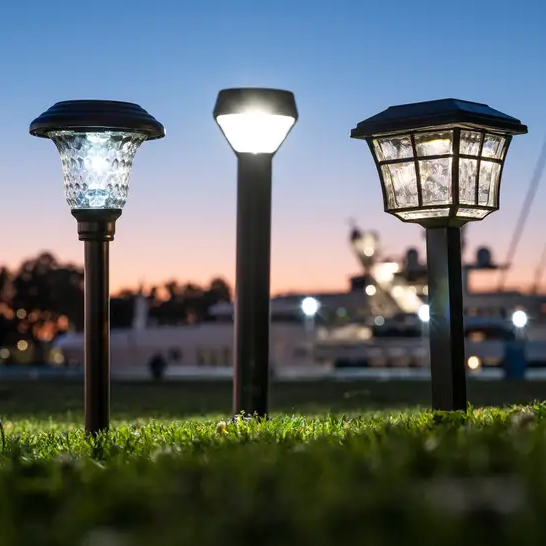
A solar street light is a self-contained lighting system: a photovoltaic panel charges a battery by day, and a controller releases that energy to an LED at night — no grid connection, no trenching, no electricity bill. The two architectures that dominate the market are all-in-one (AIO), where panel, battery, controller and LED share one sealed body, and split, where the panel and battery are mounted separately for larger capacity and flexible orientation. This guide is the full map: how each architecture works, what every component actually does, how to size a system for your site’s sun-hours, what lifespan to realistically expect from each part, and the checklist that separates a five-year fixture from a two-summer disappointment.
Key Takeaways
- All-in-one wins on installation speed and cost below roughly 100W; split wins when you need bigger batteries, higher output, or the panel aimed independently of the light.
- The battery is the component that decides system life. LiFePO4 chemistry typically survives 2–4× more charge cycles than ternary lithium or gel lead-acid.
- Sizing is arithmetic, not guesswork: nightly energy = LED watts × hours; panel and battery follow from your site’s peak sun-hours and required autonomy days.
- A “cheap” solar light usually hides its savings in the battery rating and panel wattage — the two numbers you must demand in writing.
- Always size against the worst month of solar radiation at your latitude, not the annual average.
The Two Architectures: All-in-One vs Split
Every solar street light on the market is a variation of one of these two layouts:
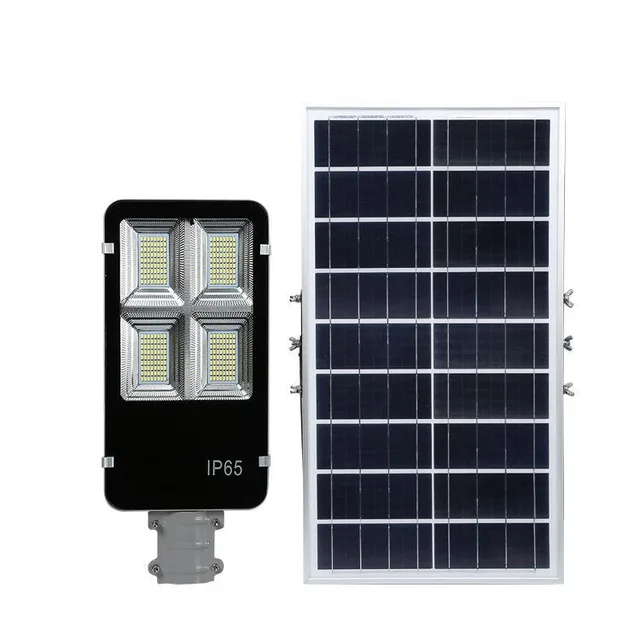
All-in-one (AIO) integrates the panel on the top face, the battery and controller inside, and the LED on the underside of a single sealed housing. Installation is one bracket and a few bolts — no wiring beyond nothing, which is why AIO dominates residential streets, parks, campuses, and any project where installation labor is the biggest cost line. The trade-off: the panel lies nearly flat and points wherever the fixture points, so it harvests less energy per watt of panel than a tilted, sun-aimed panel — and battery capacity is capped by the housing volume.
Split systems separate the parts: a panel tilted at the site’s optimum angle on top of the pole, a battery in a box on the pole (or buried), and a dedicated lamp head on the arm. That buys you three things — a panel aimed at the sun instead of at the road, room for a much larger battery, and the ability to service or replace each component independently. The cost is more installation work and more connections to seal.
| Criterion | All-in-One | Split |
|---|---|---|
| Installation | Minutes per pole, one bracket | Panel + battery + head, wired on site |
| Typical output | ~30–120W class | Up to high-mast class (our range reaches 800W) |
| Panel orientation | Fixed with fixture | Independently tilted & aimed |
| Battery capacity | Limited by housing | Sized to requirement |
| Servicing | Replace unit / integrated pack | Replace any component alone |
| Best for | Residential streets, parks, paths, perimeters | Arterials, wide roads, high-security sites, weak-sun latitudes |
Both architectures are covered in depth, model by model, on our solar lighting product page — and the glossary entries for all-in-one and split solar street lights give the one-paragraph versions.
How a Solar Street Light Actually Works
The daily cycle has four stages, and each maps to a component:
- Harvest. The photovoltaic panel — polycrystalline or monocrystalline silicon — converts daylight into DC current. Output depends on panel wattage, orientation, and crucially the site’s peak sun-hours (more on this in sizing).
- Store. The charge flows into the battery. Capacity (watt-hours) determines how many hours of light, and how many cloudy days of reserve, the system can deliver.
- Manage. The charge controller is the brain: it prevents overcharge by day, prevents deep-discharge at night, switches the light on at dusk via the panel’s voltage drop, and runs the dimming profile.
- Illuminate. The LED module converts stored energy back into light — and because LED efficacy is high, a modest battery can run a properly-sized fixture through a 12-hour night.
The controller’s dimming profile is the quiet hero of the economics. A typical municipal profile runs 100% output for the early evening, drops to 50–70% after midnight when traffic thins, and may hold a 30% floor until dawn — cutting nightly energy consumption by a third or more without a visible service compromise. Motion-sensor variants go further: a low idle level that ramps to full when a pedestrian or vehicle approaches.
The Components That Decide Quality
The Battery: Where Solar Lights Live or Die
Ask one question before any other: what chemistry, what capacity, and what cycle rating? Three chemistries dominate:
| Chemistry | Typical cycle life | Temperature tolerance | Notes |
|---|---|---|---|
| LiFePO4 (lithium iron phosphate) | ~2,000–4,000+ cycles | Good heat tolerance; charging below 0°C needs management | The industry’s quality default — stable, safe, long-lived |
| Ternary lithium (NMC) | ~500–1,000 cycles | More energy-dense but less heat-tolerant | Common in budget AIO units — lighter, cheaper, shorter-lived |
| Gel / lead-acid | ~300–600 cycles | Poor depth-of-discharge tolerance | Legacy split systems; heavy, buried boxes |
One cycle ≈ one night. At 2,000+ cycles, LiFePO4 credibly supports 5+ years of nightly service; a 500-cycle ternary pack is arithmetically finished in under two. When two quotes for the “same” 60W solar light differ sharply in price, the battery line is usually where the cheaper one saved the money. Demand the chemistry, the watt-hour capacity, and the rated cycles at a stated depth-of-discharge in writing.
The Panel: Watts Are Not Interchangeable
Panel wattage must be matched to the battery it needs to refill: a common engineering rule is panel watts ≈ 1.2–2× the nightly energy draw divided by peak sun-hours, with the multiplier growing at weaker-sun latitudes. Monocrystalline panels deliver more watts per square metre (relevant when AIO housing area is the constraint); polycrystalline delivers similar reliability at lower cost when area is not constrained. Either way, the number that matters is the rated wattage against your site’s sun — not the panel’s physical size.
The Controller: MPPT vs PWM
Two charging technologies exist: PWM (pulse-width modulation) is simple and cheap but wastes the margin between panel voltage and battery voltage; MPPT (maximum power point tracking) continuously finds the panel’s optimum operating point and typically harvests meaningfully more energy from the same panel — the advantage is largest in cold weather and weak light, exactly when you need it. For small AIO garden-class units PWM is acceptable; for road-class fixtures, MPPT earns its cost back in panel size alone.
The LED and Housing
Everything we’ve written about mains-powered street lights applies here: Lumileds-class SMD chips, lensed Type II/III distributions that put light on the road rather than in circles around the pole, IP65-sealed housings, and L70 lifespans of 50,000+ hours. The LED will outlive the battery in any honest system — which is exactly why the battery section above comes first.
Sizing: The Arithmetic That Prevents Dead Lights in January
Under-sized solar lights don’t fail loudly — they fade. They run brilliantly through the sunny commissioning month, then start dying at 3 a.m. in the worst month of winter. The prevention is a four-step calculation:
Three details make or break the calculation:
- Use worst-month sun-hours, not annual averages. A site averaging 4.5 peak sun-hours across the year may deliver 2.5 in December — and December is when nights are longest.
- Count the dimming profile. The 0.7 factor in the example reflects a typical midnight step-down; without dimming, every downstream number grows by ~40%.
- Autonomy days are a business decision. Three days of reserve covers most temperate cloud runs; monsoon and northern-winter sites may specify five.
We walk through this method with more scenarios — including battery temperature derating and panel tilt gains — in our dedicated spoke article on sizing solar street lights, and we run the calculation for your exact site (latitude, worst-month radiation, required hours, autonomy) free with every quotation. Send us your site parameters and the sizing comes back with the proposal.
Installation Geometry: Height, Spacing, Orientation
Solar street lights follow the same photometric rules as mains-powered fixtures — spacing at roughly 3–3.5× mounting height for residential-class uniformity, tighter than the 4× sometimes quoted for grid fixtures because solar heads run lower peak lumens. Three solar-specific rules stack on top:
- Shading kills sizing. A panel shaded 20% of the day was effectively down-sized 20% — survey tree lines and building shadows at winter sun angles before finalizing pole positions.
- Face the panel at the equator. Split systems: tilt at roughly the site latitude and aim true south (northern hemisphere) or north (southern). AIO fixtures: where the road runs east–west, the fixture’s own orientation already helps; on north–south roads accept the harvest penalty in the sizing math.
- Battery placement affects winters. In split systems at cold latitudes, in-pole or buried battery boxes moderate temperature swings that punish charge acceptance.
For the underlying road-class targets (how much light a residential street versus a collector actually needs), see our EN 13201 roadway lighting design guide — the standards do not change because the power source did.
Lifespan: What Realistically Wears Out, and When
| Component | Realistic service life | Failure mode |
|---|---|---|
| LED module | 50,000+ h (L70) ≈ 11+ years at 12 h/night | Gradual lumen depreciation, not sudden death |
| LiFePO4 battery | ~5–8 years (2,000–4,000 cycles) | Shrinking run-time, then early-morning shutdowns |
| Charge controller | 5–10 years | Electronics failure — quality driver-grade parts matter |
| PV panel | 20+ years to ~80% output | Slow output decline; glass/EVA degradation |
| Housing & seals | 10+ years (die-cast aluminum, IP65) | Gasket aging in extreme UV/heat if under-specified |
Read the table bottom-up and the procurement logic writes itself: the panel and housing outlast everything, the LED comfortably exceeds a decade, and the battery is the system’s true service interval. A well-designed fixture therefore makes the battery replaceable — and a well-written purchase order asks in advance what the replacement pack costs and how it is accessed.
Maintenance is otherwise minimal: panel cleaning in dusty climates (a dirty panel is a shaded panel), an annual visual on seals and brackets, and firmware-free controllers mean nothing to patch.
Climate Adaptation: The Same Fixture Is Not Right Everywhere
Solar street lighting is climate-coupled hardware, and the three big export climates each punish a different component:
- Hot-arid (Gulf, North Africa, inland Australia). Sun is abundant — panels can shrink — but battery calendar life is the casualty: sustained heat accelerates chemical aging in every lithium chemistry. Specify LiFePO4 (the most heat-tolerant mainstream chemistry), favor housings that shade and ventilate the battery cavity, and treat the cycle rating as a hot-climate number, not a lab number. Dust is the second enemy: schedule panel cleaning, because a month of desert dust can cost more harvest than a week of cloud.
- Cold-north (Northern Europe, Central Asia, high-altitude sites). The problem inverts: winter combines the weakest sun, the longest nights, and batteries that resist charging below freezing. Sizing must use December sun-hours, controllers must manage low-temperature charging, and split architectures earn their keep — steep panel tilt sheds snow and catches the low sun, while an insulated or buried battery box moderates the cold.
- Hot-humid coastal (Southeast Asia, West Africa, Caribbean). Radiation is decent but interrupted by monsoon cloud runs — autonomy days, not panel watts, are the binding constraint. Corrosion protection graduates from checkbox to core spec: salt-laden air attacks fasteners and gaskets first, so demand the coating system and stainless hardware in writing.
Tell us the deployment country with your inquiry and the configuration comes back climate-adjusted — it is the same arithmetic as the sizing section, just with honest local inputs.
What Solar Street Lights Cost — the Honest Framing
We keep monetary claims off this site as policy, but the cost structure is fair game and more useful anyway. A grid-powered street light’s lifetime cost = fixture + trenching/cabling + connection fees + metered energy + maintenance. A solar light’s = fixture (higher, because the battery and panel ride along) + bracket installation (dramatically lower) + zero energy + battery replacement around year 5–8. The crossover favors solar hardest where trenching is expensive or impossible — rural roads, riverside paths, heritage areas, parking lots far from a feed, and any site where the grid quote includes the word “excavation”. Where mains power is already at the pole base, grid fixtures usually remain the economic default.
Procurement Checklist: Eight Questions Before You Order
- Battery chemistry, capacity (Wh), and cycle rating at stated DoD — in writing, on the datasheet.
- Panel rated wattage — and whether sizing was run against your worst-month sun-hours or a brochure average.
- Autonomy days the configuration actually delivers at your latitude.
- Dimming profile — configurable? Motion-sensing option?
- Photometrics — is there an IES file, and does the distribution match your road geometry? (Type II/III matters as much as lumens.)
- Ingress and build — IP65+ sealing, die-cast housing, and the certifications behind them (FCC/CE/CCC on our range).
- Battery replacement path — cost, access, and availability in year 6.
- Sizing accountability — will the supplier put the calculation on paper? We do: site parameters in, full sizing and proposal back, free.
Frequently Asked Questions
How long do solar street lights stay on at night? A properly sized system runs the full night — typically configured around 12 hours — with a dimming step after peak hours. Run-time is a design output, not a fixed property: it follows from battery capacity, LED wattage, and the dimming profile, which is why the sizing calculation above matters more than any single spec number.
Do solar street lights work in winter or on cloudy days? Yes, if they were sized for it. The battery’s autonomy reserve (typically 3–5 nights) rides through cloud runs, and sizing against worst-month sun-hours covers short winter days. Systems that fail in January were sized against annual averages — an arithmetic error, not a technology limit.
Which is better, all-in-one or split solar street lights? Below roughly 100W on normal streets, all-in-one wins on installed cost and speed. Above that — wide roads, high-mast areas, weak-sun latitudes needing big batteries and tilted panels — split earns its extra installation effort. Most municipal portfolios end up using both.
How many years does a solar street light last? The fixture, panel, and LED are 10–20 year components. The battery sets the practical service interval: 5–8 years for quality LiFePO4, considerably less for budget ternary packs. Ask for cycle ratings, not just warranty years.
Can I retrofit solar onto existing poles? Often, yes — split systems suit existing poles well since panel, battery box, and head mount separately, and pole structural capacity is checked against the added panel wind load. Share your pole details and we will confirm feasibility model by model.
The Bottom Line
A solar street light is a small off-grid power station wearing a luminaire, and buying one well means buying it like a power system: battery chemistry and cycles first, panel watts against worst-month sun second, honest sizing arithmetic third — and only then the lumens and aesthetics that dominate brochures. Get those layers right and the technology is genuinely boring, in the best way: light every night, no trench, no bill, one battery service somewhere near year six. Send us your site parameters and we’ll return the sizing, the fixture match from our solar range, and the photometric file to prove it.