250W LED Flood Light
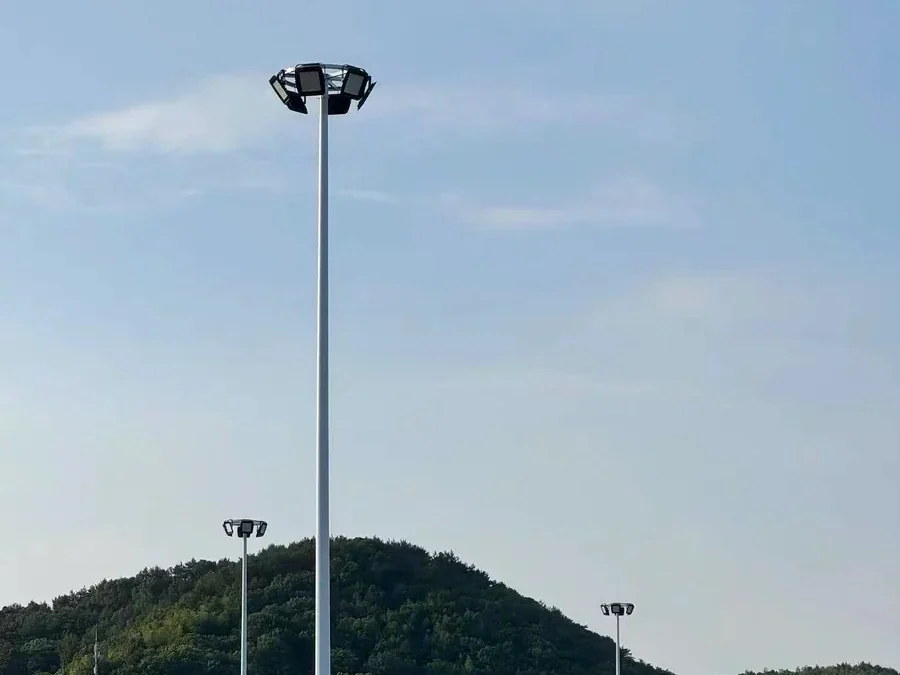
A 250W LED flood light sits in the band that project drawings reach for when 200W leaves the far edge of a yard thin and 300W puts more fixture on the pole than the position needs. It is a real catalogue rating rather than a marketing one — in our range it is built on the SJTG609 industrial housing, which covers 100W to 480W in a single die-cast body.
That single-housing span is the practical argument for specifying it. A site with gate positions, yard poles and façade brackets can run the whole scheme on one fixture family: one mounting pattern, one spares line, one appearance. What this page will not do is quote a lumen figure we have not measured — we publish full goniophotometer reports for our 150W, 200W and 300W units, and the IES file for your exact 250W configuration ships with the quotation.
Every Measured Unit, Published
All units tested on a calibrated HPG1800 goniophotometer. We publish the strong results and the modest ones — the economy build reads lower than the flagship, and both numbers are real.
Where 250W Fits
Selection guidance for the band between the 200W and 300W classes — confirmed with a free DIALux study for your site.
10–14 m: yard poles, compound boundaries, façade brackets and car park columns above the 200W band.
Factory yards, industrial compounds, building façades, cityscape and greening lighting, car parks, recreation areas and perimeters.
Below 10 m, or where the measured 35,309 lm of our tested 200W unit already holds the target level. Fewer watts on the same pole count is always the better answer when it works.
Above 14 m, or where the position must reach a pitch or a wide apron, move to 300W or 400W — or to the modular SJTG611 where each module can be aimed separately.
SJTG609 — The 250W Housing
| Series | Power in This Housing | Dimensions at 250W (L×W×H) | |
|---|---|---|---|
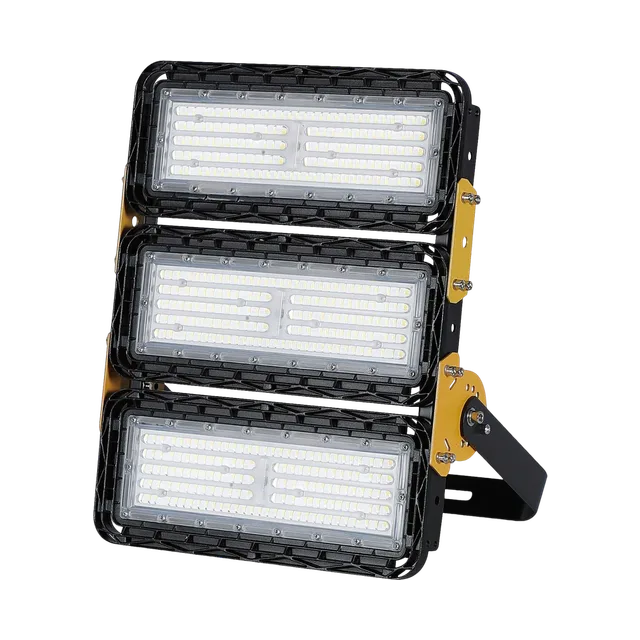 | SJTG609 | 100 / 200 / 250 / 300 / 480W | 275 × 402 × 720 |
Dimensions in mm from the factory catalog. Die-cast aluminum, IP65. 250W is one of five ratings in this housing, so a mixed-wattage scheme keeps one mounting pattern throughout. Full datasheet and IES/LDT files supplied with the quotation.
Where This Class Works
Three duties this wattage is specified for most often — and what changes in the specification for each.
Factory yards and industrial compounds
The 250W class covers the working yard positions where 200W leaves the far corner thin and 300W over-lights the near ground. On 10–14 m poles across a compound, it is often the rating that holds the level with the fewest pole positions.
- 10–14 m mounting band
- Die-cast body, IP65 sealed
- Beam distribution selected per layout

Façades, cityscape and area lighting
SJTG609 was built for façade and cityscape duty as much as for yards: an impact- and corrosion-resistant die-cast body on a fixture that stays on a building for a decade. For car parks and area lighting, several 250W heads distribute the load better than fewer large ones.
- Façade, sculpture and greening duty
- Lower pole loading than single large heads
- Photocell and dimming configurable at order
Recreation areas and perimeter security
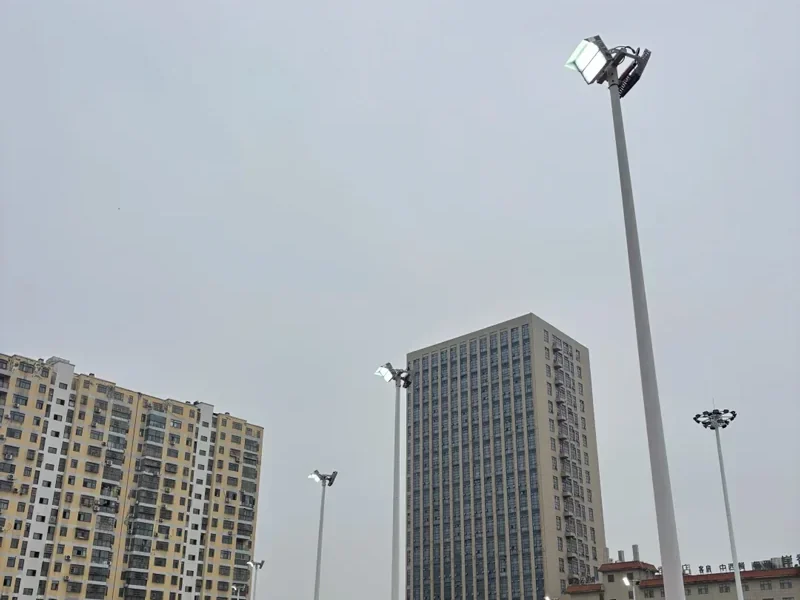
Between a court and a compound boundary, 250W is a practical building block: enough output per position to matter, small enough that re-aiming is a ladder job. Spill control matters more than raw output on any position facing a neighbour.
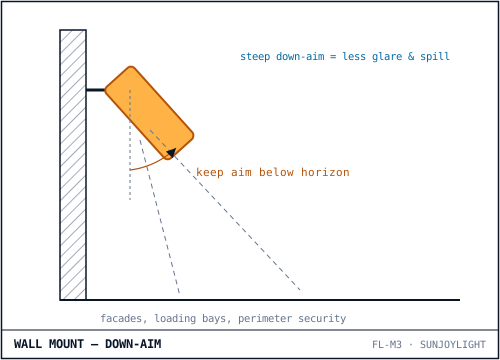
- Steep down-aim limits spill
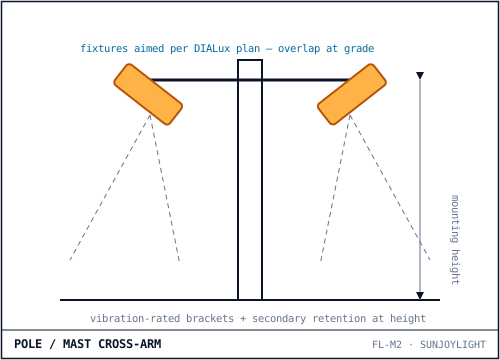
- Wall, pole and bracket mounting
- Surge protection specified per project
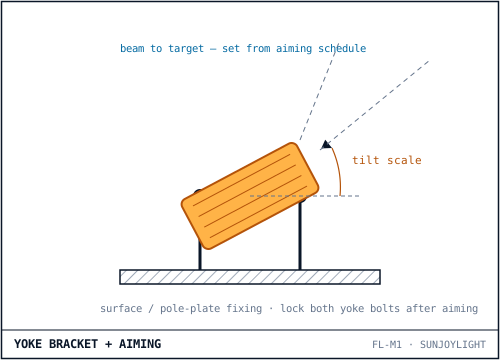
How It Goes Up
The mounting methods this fixture class is supplied for. Installation photographs from delivered projects are being catalogued and will be added alongside.
Every Order Ships With the Paperwork
The documents an engineer needs to verify the design and an importer needs to clear customs — supplied as standard, not on request.
IES / LDT files for the exact housing and optic quoted, so your designer models the fixture you are buying.
A free DIALux study from your dimensions — lux, uniformity and fixture count verified before you commit.
CE / FCC / CCC documentation with the type-test reports behind it, plus the Ex certificate where applicable.
Driver spares quoted with the order and an engineer contact who answers after the invoice is paid.
Straight Answers to the Questions Buyers Ask in Forums
What buyers report in sourcing forums and marketplace reviews — and how to check any supplier, including us.
We hold goniophotometer reports for our 150W, 200W and 300W units and publish them in full. There is no measured report for a 250W build, so this page does not quote one — the range-level figure of 120–160 lm/W applies, and the exact output comes with the IES file for the configuration you order. A supplier who can produce a precise lumen number for every rating on request has usually calculated it, not measured it.
Enquiries land on 250W because it sits neatly between two catalogue numbers. At 10–14 m the difference between the three is a spacing decision, not a brightness one — send the dimensions and the layout will say which rating needs fewer poles. Our measured 200W unit delivered 35,309 lm, which is frequently enough to make 250W unnecessary.
SJTG609 covers 100W to 480W in the same body. On a site with mixed positions, that means one mounting pattern, one spare-parts line and one visual language across the whole scheme — which matters more in year six than a few lumens per watt did at tender.
A 250W LED flood is a common replacement for 400W and some 600W metal halide floods once optics and real-world lumen depreciation are accounted for. Validate the swap with the IES file at your actual mounting geometry rather than the equivalence table — the table sizes a replacement, the calculation sizes a design.
250W LED Flood Light — Answered
How many lumens is a 250W LED flood light?
Our range runs 120–160 lm/W at fixture level, which brackets a 250W unit, but we do not publish a precise figure for a rating we have not measured. We hold and publish full goniophotometer reports for our 150W, 200W and 300W units — the tested 200W unit measured 35,309 lm at 175.4 lm/W — and the IES file for your exact 250W configuration ships with the quotation. Treat any supplier quoting an exact lumen number for every rating in the catalogue with caution; measured and calculated are not the same claim.
What does a 250W LED flood light replace?
Typically a 400W metal halide flood, and in some layouts a 600W unit, once directional optics and real-world lumen depreciation are accounted for. The replacement runs at roughly a third to a half of the connected load with no restrike delay. Validate the swap against the IES file at your mounting geometry rather than relying on an equivalence table alone.
Should I choose 200W, 250W or 300W?
It is a spacing decision rather than a brightness one. At 10–14 m the three ratings mainly change how many pole positions the scheme needs — send the site dimensions and target level and the photometric layout answers it directly. Our measured 200W unit delivers 35,309 lm, which frequently makes 250W unnecessary; above 14 m or for wide aprons, 300W usually earns the extra power.
Which housing is available at 250W?
SJTG609, our industrial die-cast housing, which spans 100W to 480W in the same body at 275 × 402 × 720 mm for the 250W build. Specifying one housing across a mixed-wattage site keeps a single mounting pattern, one spares line and a consistent appearance — worth more over a decade than a small efficacy difference at tender.
Send Us the Space, Not Just the Wattage
Share the dimensions, mounting height and the level you need to hold. Our engineers return a lighting layout with fixture count, aiming and the photometric files behind it — before you commit to anything.
Floor plan or site dimensions, mounting height, target lux or the standard you must meet.
A DIALux study with fixture count, layout, aiming and IES files — at no cost.
Your engineer checks the numbers against the standard. Only then does a quotation matter.
Manufacturing in Changzhou since 1999 · Shipping to 50+ countries · CE / FCC / CCC
Tell us about your project.
Get a quote within 24 hours.
Share your application — environment, requirements, quantity. A real engineer responds with a tailored quote, IES files, and timeline within one business day.