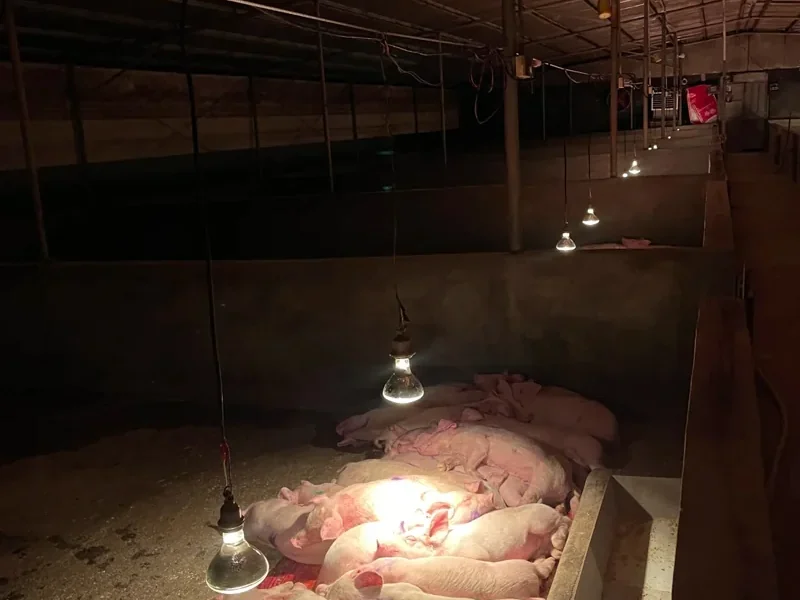
The expensive question on an agricultural project is usually asked in the first email: what lux level do I need for a livestock building?
There is no such number, and quoting one is how a scheme ends up non-compliant in the destination market. Under EU law a house of meat chickens must have at least 20 lux; a pig building must have at least 40 lux. Same shell, same contractor, same supplier — twice the requirement, because the occupant is a different species. A dairy barn in the same yard is governed by neither figure, and the level dairy advisers recommend answers to milk yield rather than to welfare law.
So the useful skill here is not knowing a lux table. It is knowing, of any number you are handed, whether it is law, a production recommendation, or something a vendor made up.
Key Takeaways
- No single agricultural lux target exists. Directive 2007/43/EC sets ≥20 lux for meat chickens, Directive 2008/120/EC ≥40 lux for pigs — legal floors for one species in one jurisdiction, not design levels.
- A lux reading is weighted to the human eye. Birds have four cone peaks plus UVA transmission, so two fixtures reading the same lux can present very different light to the bird.
- Photoperiod puts the control system inside the luminaire specification. The programme comes from the breeder; dimming deep, smoothly and on a ramp is a driver question.
- µmol and lux measure different quantities and are not interconvertible in general. Greenhouse work lighting and crop lighting are two product classes in one volume.
- The LED rarely fails first in a barn. Ammonia, humidity, dust and washdown take the gaskets, fasteners and driver first.
Three Kinds of Number
- Law is a welfare minimum in a statutory instrument, tied to a species, a production category and a territory. An inspector can enforce it, and it says nothing about whether the light is good.
- A production recommendation comes from a breeder, veterinary school, extension service or integrator that measured an output against light. Often more demanding than the law, and it belongs to whoever issued it, for the strain, herd and system it was written for.
- An unverified number is the large remainder: bands circulating between vendor pages, figures attributed to standards written for a different application, thresholds never tested at the value quoted. They get into specifications because they look like the other two.
Everything this article puts a number on, with its authority attached:
| Figure | Applies to | Authority | Status |
|---|---|---|---|
| ≥ 20 lux, at bird eye level, over ≥ 80% of usable area, during lighting periods | Chickens kept for meat production, holdings of 500+ birds, EU | Council Directive 2007/43/EC | Law (minimum) |
| ≥ 6 h darkness per 24 h, including ≥ 4 h uninterrupted | as above | Council Directive 2007/43/EC | Law (minimum) |
| ≥ 40 lux for ≥ 8 h per day | Pigs kept for rearing and fattening, EU | Council Directive 2008/120/EC, Annex I Ch. I pt 2 | Law (minimum) |
| 162–215 lux (15–20 fc), uniform, measured 0.9 m above the stall surface | Lactating dairy cows | OMAFRA (Ontario); The Dairyland Initiative, UW–Madison | Production recommendation |
| 16–18 h light with 6–8 h uninterrupted darkness | Lactating dairy cows | OMAFRA | Production recommendation |
| ≥ 12 h darkness per day (Dairyland: 6 h light : 18 h dark) | Dry cows | OMAFRA; Dairyland Initiative | Production recommendation |
| Milking parlour, feed room, wash-down bay, storage, packhouse, greenhouse walkway | — | — | Not stated here — see below |
| Any PPFD or DLI crop target | — | — | Not stated here — different quantity, different product class |
Two absences are deliberate. The poultry row stops at the legal floor because brooding intensities, pullet step-downs and layer levels are strain-specific and issued by the primary breeder; a generic set would be an invented programme. And no standard-backed figure for parlours, feed rooms, wash-down bays or packhouses was verified for this article. EN 12464-1 holds a table for agricultural premises and ASABE is the body most likely to publish an agricultural recommended practice; that, or the local code, is where the figure comes from. A band lifted from an industrial recommended practice and relabelled agricultural is how an unverified number acquires a respectable-looking citation.
Naming who owns an answer beats a number of unclear provenance. Every figure above is an educational design reference, never a compliance claim about a fixture, and each needs confirming against the real geometry with a photometric study.
Light as a Production Input, Not Just Visibility
In a warehouse, light exists so people can see. In an animal building it is an input to the animal’s endocrine system, and the schedule matters as much as the level.
Dairy is the clearest documented case. Ontario’s agriculture ministry reports that milking cows given 16–18 hours of light at 162–215 lux (15–20 foot-candles) increase milk production — 8–10%, with studies ranging 5–16%. That is a third-party production finding, not a result we measured, and it depends on the herd, ration and housing. The mechanism carries a hard condition: 6–8 hours of uninterrupted darkness are required for cows to detect and respond to the lengthened photoperiod. Light the barn 22 hours and there is no photoperiod at all — nothing to contrast the long day against.
Dry cows invert it: Ontario advises at least 12 hours of darkness daily, Dairyland 6 light : 18 dark against 18:6 for lactating. Two herd groups in one building on opposite schedules — a control problem before it is a fixture problem. Staff still need to see in the dark period, and both sources describe a separate dim red circuit at roughly 6–9 m (20–30 ft) intervals; they differ on wattage, so take the principle, not a part number.
Poultry has the same structure, but its content is not ours to publish: programmes are species-, strain-, age-, purpose- and house-system-specific, and the primary breeder issues them with the bird management specification. Ask the breeder or integrator for the strain being run. Directive 2007/43/EC sets the boundary that programme must respect — a 24-hour rhythm with at least six hours of darkness in total including four uninterrupted, from seven days after placement until three days before the foreseen time of slaughter, with temporary derogation on veterinary advice.
The engineering consequence is the part a lighting supplier can answer. A schedule requirement puts the control system inside the luminaire specification: a controllable day circuit and an independent dim night circuit that do not fight each other, and a fixture that executes the breeder’s programme rather than the one the driver happens to be capable of.
What the Animal Sees That the Meter Does Not
A lux reading is radiometric energy weighted by the human photopic response curve, which peaks in the green around 555 nm. It measures how bright something looks to a person — the right instrument for a warehouse aisle, a partial one in a poultry house.
Zootecnica International, writing with authors from Ontario’s agriculture ministry and from a lighting manufacturer, sets out the physiology: birds carry pigmented oil droplets on their cone cells corresponding to peak sensitivities at 415, 460, 510 and 560 nm in young birds, shifting toward 580 nm in adults, and the avian lens is transparent to UVA in the 320–400 nm range. Four cone channels, plus a band the human eye does not receive at all.
Two consequences follow, and only the first is usually stated:
- Two fixtures with the same lux reading can present very different light to a bird. The meter weights for the wrong observer. The source’s conclusion is blunt: a farmer cannot use measurements of human light perception to set lighting programmes, and should use photometers designed to reflect the animal’s perception.
- Light on the head matters, not only light on the feed line. Poultry detect day length partly through extra-retinal photoreceptors — the pineal gland above the brain, and deep brain photoreceptors at its base. One reason the directive names bird eye level as the measurement plane rather than the floor.
None of this licenses a spectrum claim. Nothing here supports saying a particular spectrum raises yield, and the animal-weighted photometric units sold under proprietary names could not be verified against a published definition — do not treat one as an SI unit. Our fixtures are specified in ordinary human units: CRI ≥ 80, 2700–6500 K, illuminance in lux. No source here established how pig or cattle spectral sensitivity compares with human, so for mammals specify to the illuminance requirement rather than carrying the avian evidence across. Colour temperature for the people in the building is a separate human-vision question, covered in our colour temperature guide.
Flicker: A Real Difference, on Thinner Evidence Than You Will Be Told
Human critical flicker fusion sits around 50–60 Hz, which is why warehouse practice tolerates driver ripple nobody can see and why flicker is treated there as a comfort issue rather than a specification input.
Birds resolve faster. Raabe et al. (2023), in Poultry Science, state that although chickens cannot consciously perceive flickering above 87 Hz, ERG-derived values above 100 Hz indicate an unconscious perception, and note that passerine birds resolve light–dark cycles up to 145 Hz. Ripple that is invisible in a warehouse is not automatically invisible to the occupant of a poultry house — a real engineering difference, and a driver question rather than an LED question.
Now the discipline. That study tested male fattening turkeys at 165 Hz, 500 Hz and 16 kHz and found no differences in live weight, injury or mortality rates, or feather corticosterone, concluding that 165 Hz and above had no detrimental effect and suited fattening turkey houses. Read the design: 165 Hz was the lowest arm tested. A trial that never went below a value cannot establish that value as a threshold. It supports “165 Hz and above showed no detriment in male fattening turkeys” and nothing further — not a minimum, not a chicken result, not a standard. You will nonetheless see “165 Hz industry standard” repeated across supplier pages as though a body had published it. No such standard was verified for this article; if a specification cites one, ask which document.
What the evidence does support is a habit: treat driver ripple as something you ask about rather than assume, and ask for it at the dimmed operating points, not only at full output. A driver can be clean at 100% and severe at 5%, and deep dimming is exactly what a photoperiod programme demands. Three things a barn driver must do that a warehouse driver need not:
- Dim deep. Programmes call for very low levels at some stages; a driver with a 10% floor cannot deliver them.
- Dim smoothly and monotonically. No visible steps, no snap-off at the bottom of the range, and no flicker introduced by the act of dimming.
- Ramp. Dawn and dusk simulation over minutes is a control-system capability, not a dimmer setting.
Whether a given LED driver meets those is answered configuration by configuration. Tell us the programme the house runs and the control protocol on site, and we will confirm what the build supports rather than quote a dimming range that flatters the datasheet.
Space by Space
Every agricultural space carries two independent requirements, and reading them as one produces most of the bad specifications in this sector. The right-hand column is where a warehouse specification quietly fails.
| Space | What the occupant needs | What the room does to the fixture |
|---|---|---|
| Poultry house | The breeder’s programme, run inside the legal envelope Directive 2007/43/EC sets — see the table above | Ammonia, dust, high humidity, full pressure-wash and disinfection between flocks |
| Pig building | The minimum in Directive 2008/120/EC — double the broiler floor, from a different instrument | Same corrosive atmosphere, more abuse at low level, a washdown regime at least as hard |
| Dairy barn | The production recommendation above, dark period protected, dry cows on a separate programme. No EU minimum illuminance for kept cattle was identified — yield figures, not law | Moisture, manure gases, splash, cleaning chemicals |
| Milking parlour | A human task space with animal traffic; take the figure from EN 12464-1 or the local code, not from a barn number carried across | Continuous wet cleaning, chemicals, condensation |
| Greenhouse / packhouse | Two requirements in one volume, in different units — see below | Humidity, condensation, fertiliser and pesticide aerosols; wet food handling in the packhouse |
| Grain store, feed room, tall shed | An ordinary task figure from the applicable code | Dust; and where an area is classified as a dust zone, that is a different equipment class set by the site’s classification drawing |
Two things cut across the table. Mounting height picks the fixture family first — linear sealed fixtures over feed lines, walkways and parlours; high bay fixtures in tall sheds, grain stores and packing halls, where our catalogue guidance runs 100–150 W on a wide 90–120° beam at 4–6 m, 150–200 W at 6–8 m, 200–300 W at 8–12 m and 300–500 W at 12–16 m.
And design to a maintained figure. The Dairyland Initiative is unusual among these sources in saying so outright, recommending 20 foot-candles (215 lux) because intensity falls as lamps age and collect dust and dirt. In a dusty building with a corrosive atmosphere the maintenance factor is not a rounding adjustment — it decides whether a scheme that complies at handover still complies in year three.
µmol Is Not Lux
If you specify greenhouses, this is the distinction worth carrying away.
- Lux and lumens are weighted by the human photopic curve and describe perceived brightness; our lumens, lux and candela guide covers how they relate.
- PAR (photosynthetically active radiation) is the 400–700 nm band plants use.
- PPFD (photosynthetic photon flux density) counts photons, in µmol·m⁻²·s⁻¹, at a point on the crop plane. Photosynthesis is driven by photon count rather than perceived brightness, which is why the unit is a count and not a lumen.
- DLI (daily light integral) is PPFD accumulated over the day, in mol·m⁻²·d⁻¹. In horticultural practice DLI is the target and PPFD the means of hitting it.
Lux and PPFD are not interconvertible in general. A conversion factor exists only for a known, fixed spectrum; change the source and the factor changes. Any “lux to PPFD” calculator is spectrum-specific, and carried across sources it produces a number with no meaning.
So a greenhouse holds two lighting problems in one volume: a photosynthetic one in µmol on the crop plane, and a human task one (walkways, grading benches, headhouse, packhouse) in lux at working height. Quoting lux for a grow scheme, or PPFD for a walkway, is the tell of a supplier who has done neither job.
We supply the illuminance side. Our catalogue holds no PPFD, PAR or spectrum data and none of these fixtures is a horticultural grow luminaire, so we will not publish a µmol figure for them — and you should be sceptical of any general-purpose white fixture presented as one. Greenhouse and packhouse work lighting is a legitimate application for a sealed industrial fixture; supplemental crop lighting is a different product class.
What the Building Does to the Fixture
In a livestock building the LED is rarely what fails. The atmosphere is.
Housing atmospheres contain ammonia (NH₃) and hydrogen sulphide (H₂S) from manure, at humidity that keeps surfaces wet or close to it. That combination attacks metal hardware, fasteners, gasket compounds and driver components, and the failure is mechanical or electrical long before the light source has degraded — a corroded gland, a hardened seal, a driver that took in moisture through a path that opened up.
The aluminium mechanism is counter-intuitive. Aluminium is protected by a passive oxide film, and that film is amphoteric — stable at neutral pH, attacked at both acidic and alkaline extremes, and a wet ammonia-laden building is not neutral. Textbook materials chemistry rather than a test result, and the reason coating quality and fastener metallurgy are specification questions here, not finish preferences.
Washdown is a thermal and chemical shock event, not a water test. Pressure washing and disinfection between flocks puts hot water or chemicals onto a fixture that may be warm, then cools it fast, on a cycle. An IP rating is a standardised laboratory condition, not a warranty against a lance held close. Our sealed fixtures are IP65 — a useful rating, and not a statement about chemical compatibility or about a jet at 100 mm. How a sealed fixture breathes across a thermal cycle and condenses moisture internally is covered in the tri-proof lighting guide; it applies squarely to a barn washed down and closed up.
Dust costs output before it costs reliability. Feed and bedding dust settle on covers and reduce delivered illuminance with nothing having failed, and they decide cover choice: a smooth, low-relief lens gets cleaned in a time-pressured turnaround, a deeply ribbed diffuser does not. Temperature is a stated range, not an assumption: ours is −20 °C to 45 °C, and an unheated barn in a cold climate or a chilled packhouse can sit outside it — send the ambient and the mounting position.
Now what the catalogue does and does not say, plainly, because this is where the sector’s marketing gets loose. Our sealed tri-proof range is a die-cast aluminium or ABS+PC body depending on series, with an anti-glare PC or tempered glass cover, a silicone waterproof seal and a built-in driver, IP65, −20 °C to 45 °C, CRI ≥ 80, 2700–6500 K, AC100–277 V, at 120–160 lm/W with rated LED life above 50,000 hours.
What it does not contain is ammonia exposure testing, material compatibility data or corrosion test results. So we will not describe these fixtures as ammonia-resistant, and we would read that phrase carefully wherever it appears on a datasheet — it needs a test method and an exposure condition behind it, and is usually printed with neither. The narrower answer is more useful: tell us the housing type, ventilation regime, cleaning regime and chemicals used, and we will confirm which series suits that duty and what material changes it needs.
What to Send Us With an Enquiry
Agricultural schemes go wrong through missing information more often than through bad fixtures. Six things answer most of it:
- Species and production category — meat chickens, layers, pigs for fattening, lactating dairy, dry cows. This decides which requirement governs before anything else does.
- Destination market, so the applicable welfare instrument and local code can be identified. The two EU directives here show how one jurisdiction regulates; they are not a global rule.
- The light programme, if the breeder or integrator has issued one, with dimming levels and ramp times.
- Building dimensions, mounting height and structure, and whether the measurement plane is bird eye level, a stall surface, or working height for people.
- The environment — ventilation, humidity, ambient temperature range, and the cleaning regime with chemicals and frequency.
- For a greenhouse, which problem you mean — crop or task. Only one of them is ours.
With that, a photometric layout answers fixture count, positions and whether the uniformity criterion is actually met. For the wider set of applications we cover in this sector, start at the agricultural lighting page. For these fixtures we quote the range-level 120–160 lm/W, and the IES file for the ordered configuration ships with the quotation — a supplier able to produce an exact lumen figure for every rating in a catalogue has calculated it, not measured it.
Send us the building and the occupant and we will return a DIALux layout with IES files.
The Bottom Line
Ask of every number in front of you where it came from. The legal floors belong to a species and a jurisdiction and are not design targets; the dairy figures are production recommendations, where the dark period is as much of the requirement as the level; poultry programmes come from the breeder, and task-space figures from EN 12464-1, ASABE or the local code. A fair amount of what circulates as agricultural lighting guidance, the 165 Hz threshold included, has no document behind it at all.
Then specify twice: for what the occupant needs, and for what the building will do to the fixture over a decade of ammonia, dust and washdown. Those two rarely point at the same product for the same reason, and a supplier who answers only one has answered half the question.
FAQ
What is the minimum lux level for a livestock building? There is no single figure; it depends on species and jurisdiction. In the EU, Council Directive 2007/43/EC requires at least 20 lux measured at bird eye level over at least 80% of usable area for chickens kept for meat production on holdings of 500 or more birds, with at least 6 hours of darkness per 24 including 4 uninterrupted. Council Directive 2008/120/EC requires at least 40 lux for a minimum of 8 hours a day for pigs kept for rearing and fattening. Both are legal minima rather than design levels — confirm the instrument that applies in your destination market, and confirm delivered levels with a photometric study.
Is there a legal lighting requirement for dairy barns? No EU-level minimum illuminance for kept cattle was identified for this article. The commonly quoted dairy figures — 162–215 lux (15–20 foot-candles) measured 0.9 m above the stall surface, with 16–18 hours of light and 6–8 hours of uninterrupted darkness — are production recommendations from OMAFRA and the Dairyland Initiative at UW–Madison, aimed at milk yield rather than compliance. Treat them as guidance owned by your herd adviser, and check what your own market requires.
What flicker frequency is safe for poultry lighting? There is no verified standard, despite “165 Hz” being widely repeated as one. Raabe et al. (2023) in Poultry Science reported that chickens cannot consciously perceive flicker above 87 Hz while electroretinogram values above 100 Hz indicate unconscious perception, and their turkey trial found no detrimental effect at 165 Hz, 500 Hz or 16 kHz — but 165 Hz was the lowest frequency tested, so it cannot be established as a threshold. Ask a driver supplier for ripple performance at the dimmed operating points the programme actually uses, not only at full output.
Can I use lux to specify greenhouse grow lighting? No. Lux is weighted to human vision; photosynthesis responds to photon count in the 400–700 nm PAR band, measured as PPFD in µmol·m⁻²·s⁻¹ and accumulated as DLI in mol·m⁻²·d⁻¹. The two convert only for a known fixed spectrum, so any factor is source-specific. A greenhouse holds both problems at once: crop lighting in µmol, and task lighting for walkways, benches and packhouses in lux. Our fixtures serve the second; supplemental crop lighting is a different product class and we do not publish PPFD figures for general-purpose white fixtures.
Are your fixtures ammonia-resistant? That is not a claim we make, because our catalogue holds no ammonia exposure test, material compatibility data or corrosion test result to support it. What it does state is the construction: die-cast aluminium or ABS+PC body by series, anti-glare PC or tempered glass cover, silicone waterproof seal, built-in driver, IP65, −20 °C to 45 °C. Ammonia and hydrogen sulphide in a humid building genuinely do attack metals, coatings and gasket compounds, which is why gasket compound and fastener metallurgy matter more here than in a dry warehouse. Send the housing type, ventilation and cleaning regime and we will confirm the right series and any material changes for that duty.