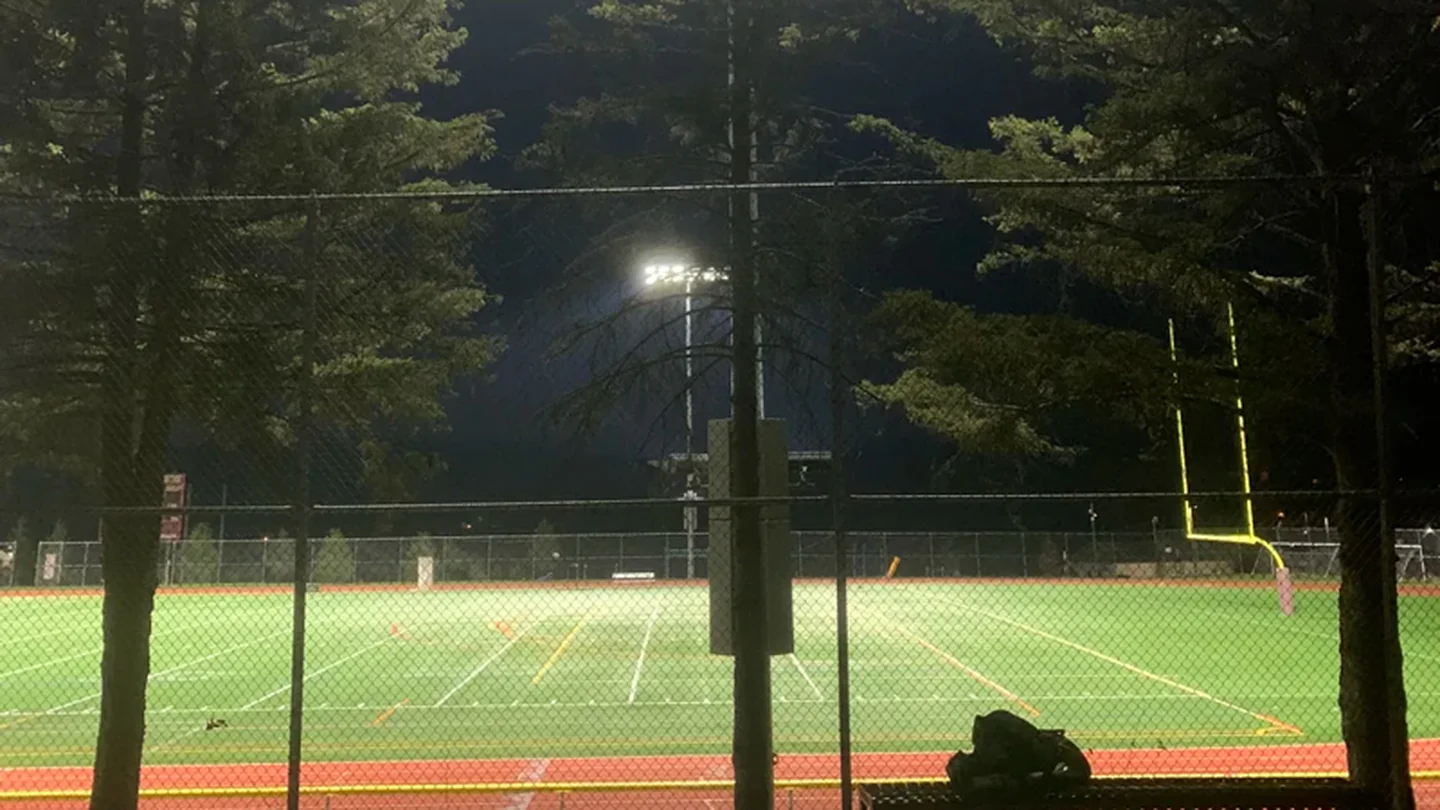
Almost every football pitch enquiry arrives as a fixture question. How many floodlights for a full-size pitch? It cannot be answered in that form, because the fixture count is the last thing the design produces, not the first.
What decides a pitch lighting scheme, in order: the competition class you must hold, the pitch dimensions, the pole positions available, and only then the wattage and count. Change the class from training to competition and the fixture count can double before anyone has discussed a product.
This guide runs that order, then ranks the cost drivers by how much they actually move a quotation.
Key Takeaways
- Class decides everything. Training play, club competition and televised football are three different projects, not three grades of the same one.
- Uniformity is usually the binding constraint, not average lux. Hitting the average with poor uniformity fails the class.
- Mounting height is set by the pitch geometry and glare limits, not by budget. Poles that are too short cannot be fixed with more wattage.
- Four-pole layouts suit training and many club installations. Six and eight-pole layouts exist because uniformity and glare demand them at higher classes.
- The largest cost driver is the class, and the second is the poles. The fixtures are rarely where a pitch project is won or lost.
Step 1: Fix the Class
Sports lighting standards define classes by what the lighting has to support: recreational play, competition, or broadcast. EN 12193 is the reference cited in most international tenders, and the class sets both the illuminance and the quality requirements.
| Class | Typical use | Horizontal illuminance (maintained) |
|---|---|---|
| Class III | Training, recreational play | ≈ 75 lx |
| Class II | Club competition, non-televised | ≈ 200 lx |
| Class I | Higher-level competition | ≈ 500 lx |
| Broadcast | Televised matches | Higher still, plus vertical illuminance and camera-specific criteria |
Two things this table does not show, and both matter more than the headline number.
Uniformity requirements tighten with class. A scheme can meet 200 lx average and still fail Class II because the minimum-to-average ratio is out of specification. In practice, uniformity is the constraint that drives pole count and fixture positions, which is why a pitch with the “right” number of fixtures in the wrong places still fails.
Vertical illuminance appears at broadcast level. Cameras see players, not grass. Once television is involved, the design has to deliver light on vertical planes toward defined camera positions, and that changes both aiming and pole positions. If broadcast is a future possibility, say so at design stage, because retrofitting it is close to a rebuild.
Our stadium lighting lux levels guide covers the class structure and glare limits in full.
Step 2: The Pitch, and Where Poles Can Stand
A full-size pitch is roughly 100 to 105 m by 64 to 68 m, and the lit area is larger than the playing surface because run-off areas need light too. From there, three geometric facts govern the design.
Poles sit outside the run-off, not on the touchline. The setback affects the aiming angles and therefore the glare, and it is often fixed by the site boundary rather than by preference.
Mounting height is set by the geometry. A practical rule for perimeter installations is that the mounting height should be at least a quarter of the distance from the pole to the far side of the area it serves. Too short, and fixtures must be tilted up to reach across, which throws light into players’ and neighbours’ eyes. Wattage cannot compensate for a pole that is too short. It makes the glare worse rather than better.
Corner poles serve two touchlines. This is why four-pole layouts work at all, and also why they struggle at higher classes: the light arrives at the far corners at a shallow angle, which is exactly where uniformity fails first.
Step 3: Choose the Layout
| Layout | Typical class | Why it is used |
|---|---|---|
| 4 poles (corners) | Class III, some Class II | Fewest foundations and cable runs; simplest and cheapest |
| 6 poles (corners plus midfield) | Class II | Fills the midfield uniformity dip that four poles leave |
| 8 poles (four per side) | Class I | Shallower aiming angles, better uniformity, lower glare per fixture |
| Side-mounted rows | Stadia with stands | Fixtures on the roof structure; a different design problem |
The progression is not about brightness. It is about where light can come from. More positions mean each fixture works at a shallower angle to its target, which simultaneously improves uniformity and reduces glare. That is the physical reason higher classes need more poles rather than simply bigger floodlights.
A common compromise on club projects: build the four or six poles at a height suitable for future upgrade, and fit fewer fixtures now. Poles are the expensive, disruptive part; adding heads to an existing pole later is a straightforward job.
Step 4: Fixtures, Aiming and Optics
Only now does the product enter.
Beam angle is chosen per position, not per project. Corner positions throwing across the pitch need narrower optics; positions serving the near half need wider ones. A pitch lit entirely with one beam angle is a pitch that was never calculated. See the flood light selection guide for the geometry.
Aiming is a deliverable. Each fixture gets a tilt and rotation from the photometric model, recorded so it can be reproduced after maintenance. A ring of identically aimed floods produces bright pools and dark seams, which is the visual signature of a pitch commissioned by eye.
Fixture count falls out of the calculation. With the class, geometry, pole positions and optics fixed, the candela distribution and the target level determine how many heads each position needs. The number is an output. Any supplier who offers a fixture count before seeing the pitch dimensions and pole positions is guessing.
Colour and flicker matter above Class III. Higher colour rendering helps players and officials distinguish kit and ball against the surface, and low-flicker drivers matter wherever slow-motion replay or any camera work is involved.
Glare and Spill: The Constraint Neighbours Enforce
A pitch is usually near housing, a road, or both, and this is where projects get blocked after installation rather than before.
- Glare toward players is limited by the class requirements and controlled through mounting height, aiming and shielding.
- Spill toward residential boundaries is what generates complaints and, in some jurisdictions, planning conditions with numerical limits.
- Upward light is limited on environmental grounds in many areas.
The controls are the same three every time: mounting height, cut-off optics and correct aiming, with external shields where a specific boundary needs protection. Retrofit shielding after complaints costs more than designing it in and usually performs worse. See light trespass and glare.
Where a pitch sits inside a residential area, the honest advice is to model the boundary illuminance during design and put the figure in the planning submission, rather than discovering the limit after commissioning.
What Actually Drives the Cost
Ranked by how much each moves a quotation, largest first.
- The class. Going from training to club competition raises the target level and tightens uniformity, which multiplies fixture count and often forces more poles. This single decision outweighs every product choice downstream.
- Poles and civil works. Foundations, poles, trenching and cabling are typically the largest single line on a pitch project, and they scale with pole count and height. Fixtures ride on top of infrastructure that was priced before anyone chose a brand.
- Pole count driven by uniformity. Six poles instead of four is a civil-works decision, not a lighting-product decision.
- Fixture count and wattage. Real, but usually smaller than the two above.
- Controls and future-proofing. Dimming drivers, zone switching and a control interface add little at manufacture and are expensive to add later.
- Broadcast readiness. If televised play is a genuine future requirement, designing the pole positions for it now is far cheaper than moving poles later.
Two corollaries worth stating plainly. Cheaper fixtures rarely rescue a pitch budget, because the fixtures are not the dominant cost. And the most effective cost reduction is usually an honest conversation about the class: many clubs specify Class II when the actual use is training and occasional local matches, and Class III with good uniformity plays better than a marginal Class II scheme.
The Specification Checklist
Before a pitch lighting order is placed, the file should contain:
- The class the scheme must hold, and whether broadcast is a future requirement.
- Pitch dimensions and the lit area, including run-off.
- Available pole positions and setbacks, plus any boundary constraints.
- The photometric study with average and minimum illuminance, uniformity, and glare against the class.
- The aiming table, tilt and rotation per fixture, as a recorded deliverable.
- Boundary spill figures where housing or a road adjoins the site.
- Electrical detail — supply capacity, surge protection, dimming protocol.
- Maintenance access — how fixtures will be reached, and whether poles are hinged or need a lift.
The Bottom Line
Football pitch lighting is decided before anyone opens a catalogue. Fix the class honestly, establish where poles can physically stand, then let the calculation return the mounting height, the optics and the count. Projects that go the other way round — starting from a fixture price and working backwards — produce pitches that measure adequately at the centre spot and fail at the corners, with neighbours complaining about the parts of the beam that missed.
Send us the pitch dimensions, the class you need to hold and the available pole positions, and our engineers return the DIALux study with the layout, the aiming table, uniformity figures and the IES files behind them. Our LED flood lights cover 50 W to 1200 W with the beam angles a pitch needs across corner and midfield positions. The 200W flood is the usual building block for club-level perimeter poles and the 400W flood covers higher masts and larger throws, and the sports and stadiums page shows how the same fixtures are deployed by venue type.
FAQ
How many lux does a football pitch need? It depends on the class. Roughly 75 lx maintained for training and recreational play, 200 lx for club competition, and 500 lx for higher-level competition, with televised football requiring more again plus vertical illuminance toward camera positions. The average is only half the requirement: uniformity tightens with class and is usually the constraint that decides the layout.
How many floodlights does a football pitch need? The count is an output of the calculation, not an input. It follows from the class, the pitch and lit-area dimensions, the available pole positions, the mounting height and the beam angles chosen per position. Any figure quoted before those are known is a guess. Send the dimensions and pole positions and the photometric study returns the number.
Is a four-pole or six-pole layout better? Four poles suit training and many club installations and cost the least in civil works. Six poles add midfield positions that fill the uniformity dip four poles leave across the centre, which is why higher classes generally need them. The choice is driven by the uniformity requirement of your class rather than by brightness.
How high should football pitch floodlight poles be? High enough that fixtures do not need steep upward tilt to reach across the pitch. A practical starting rule for perimeter poles is a mounting height of at least a quarter of the distance to the far edge of the area that pole serves. Short poles cannot be compensated with more wattage; the extra output goes into glare rather than onto the grass.
What causes glare complaints on pitch lighting? Usually poles that are too short, fixtures tilted too far up to compensate, or aiming done by eye instead of from a photometric model. The remedies are mounting height, cut-off optics, correct aiming and shields on the specific boundary that needs protection. Modelling boundary illuminance during design is far cheaper than retrofitting shields after complaints.
What is the biggest cost in a pitch lighting project? The class you specify, followed by poles and civil works. Foundations, poles, trenching and cabling typically outweigh the fixtures, and both scale with the pole count that the uniformity requirement forces. Choosing cheaper fixtures rarely rescues a pitch budget, whereas an honest review of the required class often does.
Can a pitch be upgraded to a higher class later? Sometimes, and it depends almost entirely on the poles. If pole positions and heights were designed for the higher class, adding fixtures is straightforward. If they were not, an upgrade means new foundations and poles, which is most of the project cost again. Where an upgrade is plausible, build the infrastructure for it now and fit fewer fixtures.