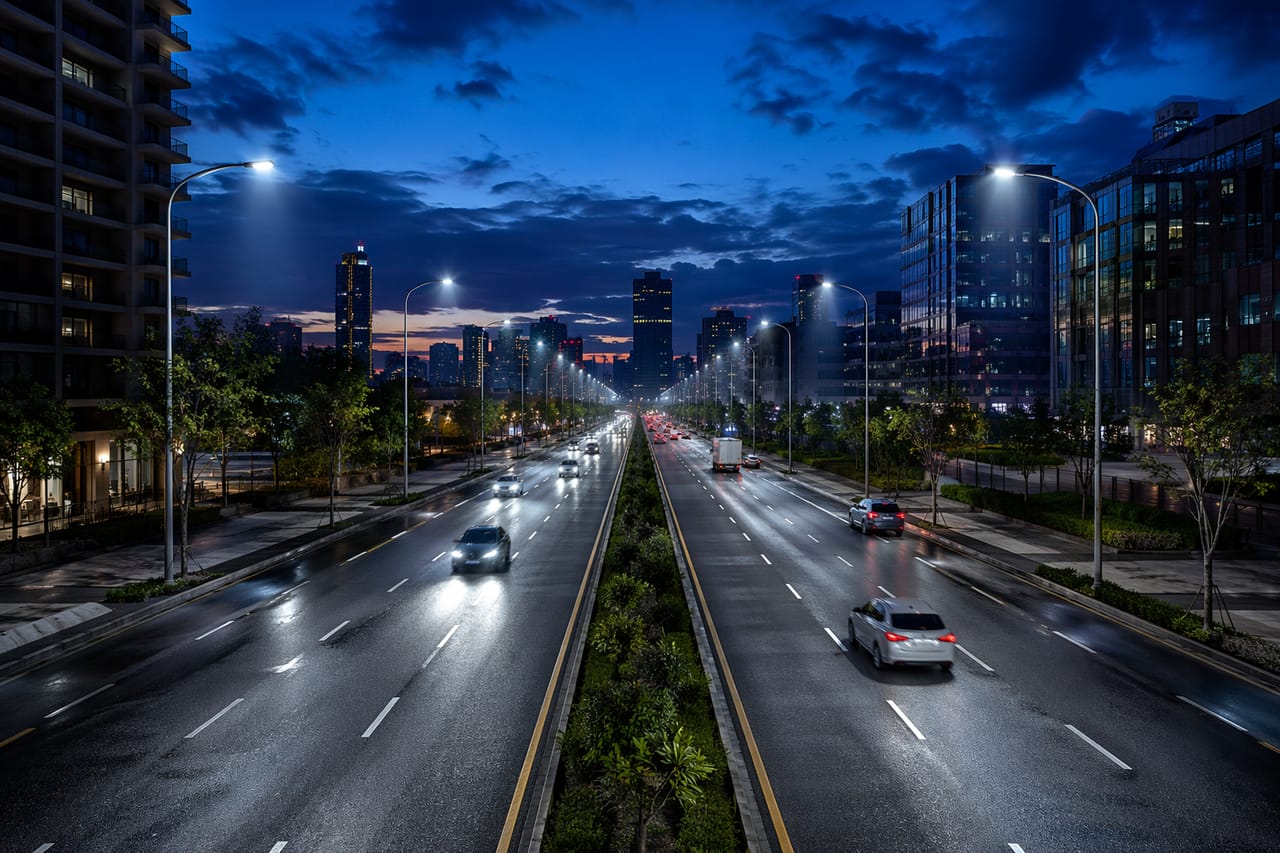
For 3000K vs 4000K street lights, the working answer is 3000K where people live and 4000K where traffic, commercial activity or cameras dominate. Residential streets, footpaths, parks and wildlife-sensitive roads go warm. Arterials, highways, industrial estates and car parks stay neutral. Anything cooler than 4000K needs a specific, written justification.
Our LED colour temperature guide gives that rule in one paragraph. This article is the full decision: what physically changes, the case for each, a road-by-road table, and the step most CCT debates skip. Changing colour temperature changes lumen output, so the lighting calculation must be rerun at the CCT you order.
Key Takeaways
- Use 3000K on residential streets, footpaths, parks and ecologically sensitive routes; use 4000K on arterials, highways, industrial roads and car parks. Anything cooler than 4000K on a public road needs a stated reason.
- The same luminaire usually emits fewer lumens at 3000K than at 4000K. Take both figures from that model’s own datasheet or LM-79 report rather than trusting a generic percentage.
- At a fixed layout, lower flux lowers average luminance roughly in proportion, while uniformity barely moves. A design with thin margin at 4000K can fail its class at 3000K.
- The mesopic argument for 4000K is real but is not credited by EN 13201-2, which uses photopic metrics. Treat it as a design consideration, not a compliance lever.
- “3000K” alone is not a specification. Write the ANSI C78.377 nominal CCT, an SDCM tolerance, and a rule against mixed CCT on one street into the tender.
The Short Answer, With Its Conditions
The default split is simple. Each side has conditions that move a road across the line.
Choose 3000K when the road has homes along it, the class is P-class or M5–M6, the route passes parks, rivers, coastline or woodland, the authority operates a dark-sky or ecological policy, or the local specification caps CCT. In most municipal tenders that last condition settles it before any engineering starts.
Choose 4000K when the road is an arterial, highway or distributor with commercial or industrial frontage, when CCTV coverage is a stated requirement, when the site is a car park, depot or industrial estate, or when an existing 4000K network is being extended and matching it matters more than changing it.
Revisit the default when a collector road is residential on one side and commercial on the other. The deciding factor is usually who sits in the light for longest: residents at their windows, or drivers and camera operators on the carriageway.
What Actually Changes Between 3000K and 4000K
Correlated colour temperature describes the appearance of white light. Behind the number, three physical properties change when you move from 4000K to 3000K.
Blue content
A white LED is a blue chip under a phosphor that converts part of the blue to longer wavelengths. A 3000K source converts more, so its spectrum carries a smaller share of short-wavelength energy. Sky glow, wildlife, perceived glare and night-time vision all trace back to that difference.
Efficacy
Converting more blue to longer wavelengths loses more energy in the phosphor, so the 3000K version of a luminaire generally emits fewer lumens per watt than the 4000K version of the same luminaire. How large the gap is depends on the LED package, the phosphor, the CRI grade and the driver current. It varies enough between manufacturers and product generations that any single percentage quoted without a source should be ignored.
The only figure that matters is the one for the model you are buying. Put the datasheet or LM-79 report for that model at 3000K next to the one at 4000K, at the same wattage, optic and CRI, and read the two lumen values. Our guide to reading an LED lighting datasheet covers where those figures sit and which test conditions they assume.
S/P ratio
The S/P ratio compares a source’s scotopic (rod-weighted) output with its photopic (cone-weighted) output. Photopic lumens are what datasheets, lux meters and EN 13201 calculations use. Scotopic response peaks at shorter wavelengths, so a bluer source has a higher S/P ratio. At the same photopic output, 4000K has a higher S/P ratio than 3000K, and both are far above high-pressure sodium. The measured value for a given luminaire comes from its spectral data, and it is a reasonable thing to ask a supplier for.
The Case for 3000K
Sky glow
Short-wavelength light scatters more in the atmosphere, so for the same lumens a bluer source adds more to sky brightness. Even a full cut-off luminaire sends reflected light up from the road surface, and CCT decides how much of it scatters. DarkSky International recommends warm-white sources for outdoor lighting, and its approved-luminaire programme caps CCT at 3000K.
Perceived glare and resident complaints
At equal intensity, bluer light is commonly reported as more glaring, and residents at first-floor windows see the luminaires far longer than passing drivers do. Complaints about early LED conversions usually combined cool CCT with poor shielding, and a 3000K luminaire with the wrong optic still throws light trespass into bedrooms, so fix the distribution and back-light control first, then choose the CCT.
In 2016 the American Medical Association adopted community-lighting guidance (report CSAPH 2-A-16) recommending 3000K or lower for outdoor installations such as roadways, together with proper shielding, citing glare and night-time blue-light exposure. The Illuminating Engineering Society disputed parts of the report, arguing that CCT alone is an inadequate basis for judging health outcomes and that glare depends on luminance and distribution. Present both positions when a client asks. The AMA guidance is a real influence on municipal specifications, and the engineering objection to treating CCT as the only lever is also sound.
Wildlife
Many insects are strongly attracted to short-wavelength light, and bats, migrating birds and other nocturnal animals respond to artificial light at night. Warmer sources reduce, but do not remove, that effect. Authorities often mandate 3000K along rivers, coastlines, parks and rural edges on these grounds. Some habitats need specialist long-wavelength or amber sources, which is a separate specification. If a route crosses a designated habitat, get the ecologist’s requirement in writing before anyone designs the lighting.
The Case for 4000K
Mesopic vision
Night-time roads sit in the mesopic range, where rods and cones both contribute. There a higher-S/P source can give better peripheral detection per photopic lumen, the strongest technical argument for 4000K on traffic routes; CIE 191 provides a system to quantify it.
The limit is regulatory. EN 13201-2 classes are photopic, so the calculation does not credit a mesopic benefit. Some national codes of practice have used the S/P ratio to adjust P-class levels on subsidiary roads (BS 5489-1 in the UK is the usual example), but the rules differ by edition and country. Take the benefit only where the governing document explicitly grants it. The EN 13201 roadway design guide treats it the same way.
Colour recognition
Colour recognition of vehicles, clothing and signs depends mainly on colour rendering index, not CCT. At the same CRI, 3000K and 4000K render colours comparably, and both far outperform the high-pressure sodium they usually replace. The 4000K advantage is appearance: neutral white looks the way people expect from daylight, which is one reason commercial streets tend to stay at 4000K. If colour recognition is the concern, tighten the CRI requirement first.
CCTV
Cameras are the most concrete argument for 4000K. Neutral light gives natural colour in footage without relying on white-balance correction. Camera performance still depends first on illuminance, uniformity and glare into the lens, so a patchy 4000K road records worse than a well-designed 3000K one. Where CCTV is a written requirement, ask the security consultant what the cameras need and specify to that.
Decision Table by Road Type and EN 13201 Class
The geometry and wattage columns are the site’s standard starting points for LED street lights, confirmed by EN 13201 calculation. The CCT column applies the split above. Pole height and spacing are worked through in the street light pole height and spacing chart.
| Road | Class | Pole height | Spacing | LED power | Default CCT | Move away from the default when |
|---|---|---|---|---|---|---|
| Footpaths, cycle paths, estate access | P-classes | 4–6 m | 18–24 m | 20–40 W | 3000K | Path runs through a commercial precinct under CCTV: consider 4000K |
| Car parks | P-classes | 4–6 m | 18–24 m | 20–40 W | 4000K | Car park borders housing or habitat: 3000K |
| Residential street | P3–P4 / M5–M6 | 6–8 m | 24–32 m | 30–60 W | 3000K | Rarely; a local CCT cap usually fixes it |
| Collector / distributor | M4–M5 | 8–10 m | 30–40 m | 60–120 W | Frontage decides | Residential frontage 3000K; commercial or industrial frontage 4000K |
| Arterial | M3 | 10–12 m | 35–45 m | 120–250 W | 4000K | Passes through a dark-sky area or along a sensitive habitat: 3000K |
| Highway / dual carriageway | M1–M2 | 12 m | 40–50 m | 200–400 W | 4000K | Ecological designation on the route: 3000K |
| Interchange / port | High-mast | 20–40 m | Per study | Project-specific | 4000K | Adjacent residential or coastal habitat: warmer, with strict aiming |
Two rules apply to every row. Spacing is roughly 3.5–4 × mounting height with a quality optic. Arrangement follows road width: single-side where the road is no wider than the pole height, staggered up to about 1.5 × height, opposite on wider roads, and twin-central on dual carriageways. Conflict areas such as junctions normally take the CCT of the more important road through them.
Where a 4000K arterial meets a 3000K residential street, change colour temperature at the junction, not partway along a block. A junction is a natural visual boundary, while a change mid-block reads as a fault.
Does Changing CCT Change the Lighting Calculation?
Yes, and this is where CCT decisions quietly cause class failures. The optic and wattage stay the same, but the lumen output changes, so the road luminance changes with it.
What scales and what does not
With the geometry fixed and the same optic, cutting flux scales every point on the calculation grid by roughly the same factor. That has three consequences:
- Average luminance or illuminance falls roughly in proportion to the flux ratio. This is the metric that fails.
- Uniformity (Uo and Ul) is a ratio of values that all scale together, so it stays essentially unchanged, provided the light distribution really is identical.
- Threshold increment (TI) moves only slightly, because veiling luminance and road luminance both fall together.
The caveat on distribution matters. Some manufacturers use a different LED package for warm CCTs, which can alter the photometric shape as well as the flux. That is why the check should run on the IES file for the ordered CCT, not on a 4000K file with its output scaled down.
Worked example: switching an M4 collector road to 3000K
Inputs, taken from the collector-road example in the EN 13201 guide:
- 7.5 m two-lane collector road, class M4: average luminance ≥ 0.75 cd/m², Uo ≥ 0.40, Ul ≥ 0.60, TI ≤ 15%
- 9 m poles, single-side, 33 m spacing, R3 surface, maintenance factor 0.85
- 90 W luminaire, Type III optic, originally designed at 4000K
For this example, assume the 4000K calculation returned an average luminance of 0.82 cd/m², with Uo and Ul passing. The authority then imposes 3000K.
Step 1: find the flux ratio. Read the rated lumens for the same model, wattage and optic at 3000K and at 4000K from the datasheet or LM-79 report. Call the ratio r = lumens at 3000K ÷ lumens at 4000K.
Step 2: estimate the new average. At the same layout, the new average luminance ≈ 0.82 × r cd/m².
Step 3: find the break-even ratio. The layout holds the class only while 0.82 × r ≥ 0.75, which means r ≥ 0.75 ÷ 0.82 ≈ 0.915. If the 3000K variant keeps at least about 91.5% of the 4000K flux, the 33 m layout still passes on average luminance. If it keeps less, it fails, even though nothing else about the road has changed.
Step 4: choose the fix if it fails. In order of preference: step up to the next wattage in the same optic, move to a longer-throw distribution, or tighten spacing. On a new-build road, tighter spacing means more poles. On a retrofit, the poles are fixed, so only the first two options exist.
Step 5: rerun and document. Run the full EN 13201-3 calculation with the 3000K IES file and file it with the tender. The estimate in Step 2 tells you whether there is a problem. It does not replace the calculation.
If a warmer CCT is likely later in approval, build that margin in from the start.
Specifying It in a Tender
A tender that says “3000K” leaves the colour open to interpretation. Four clauses close the gap.
1. State the nominal CCT and the tolerance standard
ANSI C78.377 defines nominal CCTs and a tolerance area around each one on the chromaticity diagram. Nominal 3000K covers roughly 3045 ± 175K, and nominal 4000K covers 3985 ± 275K. Those tolerance areas are wide, so two luminaires can both be compliant “3000K” products and still differ visibly side by side. Cite the standard to define the nominal value, then tighten the tolerance with the next clause.
2. Specify SDCM consistency
Colour consistency is measured in SDCM (MacAdam ellipse) steps. Along a street, the eye compares one luminaire with the next in a row, which makes mismatches easy to spot. Write the tolerance in steps as a contract requirement, and require consistent LED binning across the whole order rather than per production batch.
| Clause | Weak wording | Tender wording |
|---|---|---|
| CCT | ”Warm white" | "Nominal 3000K per ANSI C78.377” |
| Consistency | Not stated | ”Within a stated SDCM step tolerance across the whole order” |
| CRI | ”High CRI" | "CRI ≥ 80” (or the stated project minimum) |
| Photometry | ”IES file available" | "IES/LDT file at the ordered CCT, with LM-79 report” |
| Calculation | ”Meets EN 13201" | "EN 13201-3 calculation at the ordered CCT and declared maintenance factor” |
3. No mixed CCT on one street
State that a single street, meaning one visual field between junctions, uses one nominal CCT from one binning specification. That rules out the common problem where a contractor tops up a short delivery with stock from another CCT or supplier.
4. Plan for phased retrofits
Phased programmes are where colour mismatches build up over time.
- Record the original specification. Log model, nominal CCT, bin code and batch from phase one, and name them in every later order.
- Hold a reserve. Keep spares from the first batch for failures on converted streets.
- Allow for ageing. Phosphors shift over life, so a new luminaire may not match a ten-year-old one in the same bin.
- Convert street by street. An LED street beside an HPS street is acceptable during the programme; alternating LED and HPS poles on one street is not.
Our SJLD street light range is configured per order from 3000K to 6500K with CRI ≥80 across eight series from 20 W to 480 W, with IES/LDT files for DIALux, Relux and AGi32. That lets the calculation run at the CCT the tender actually specifies.
The Bottom Line
Decide CCT road by road, not city-wide. Use 3000K where residents, parks and habitats sit in the light, and 4000K where traffic, commerce and cameras dominate. Then treat the choice as a photometric input, not just a colour preference: take the lumens and the IES file for the ordered CCT, confirm the class still passes at the spacing you have, and write nominal CCT, SDCM and a no-mixing rule into the tender.
The next step is to send us the road cross-section, class and the CCT your authority requires. Our engineers will return the EN 13201 DIALux study calculated with the IES file for that CCT, free with the quotation, so any lost margin shows up on paper and not after installation.
FAQ
Is 3000K or 4000K better for street lights? Neither is better on every road. 3000K suits residential streets, footpaths, parks and wildlife-sensitive routes, where sky glow, perceived glare and resident comfort weigh most. 4000K suits arterials, highways, industrial roads and car parks, where traffic, commercial activity and CCTV dominate. Check the local authority’s specification first, because many now set a CCT cap that decides the question.
Are 3000K street lights less efficient than 4000K? Usually yes, by an amount that depends on the specific product. Converting more blue light into warmer wavelengths loses energy in the phosphor, so the 3000K version of a luminaire typically emits fewer lumens at the same wattage. Compare the same model’s datasheet or LM-79 report at both CCTs instead of relying on a generic percentage, then check the road still meets its class.
Do I need to change pole spacing if I switch from 4000K to 3000K? Not necessarily, but you need to check. At a fixed layout, average luminance falls roughly in proportion to the lumen ratio between the two versions, while uniformity stays close to unchanged. If the 4000K design had little margin above the class minimum, the 3000K version can fail, and the fix is more wattage, a longer-throw optic or tighter spacing. Rerun the calculation with the IES file for the ordered CCT.
Why are cities switching street lights to 3000K? Sky glow, resident glare complaints, effects on nocturnal wildlife, and guidance from bodies such as the AMA and DarkSky International recommending warmer outdoor sources. Early conversions that paired cool CCTs with poor shielding drew public objection, and many authorities responded with 3000K caps for residential streets.
Does 4000K street lighting help CCTV cameras? It can, because neutral white gives footage natural colour without relying on white-balance correction. Illuminance, uniformity and glare into the lens matter more than CCT, so confirm what the cameras need with the security consultant before fixing the colour temperature.
Can one street use both 3000K and 4000K? Avoid it. A change within one visual field reads as a fault. Change CCT at a natural boundary such as a junction, so an arterial can run at 4000K and the residential streets off it at 3000K. In phased retrofits, convert whole streets at a time and name the original model, CCT and bin in every later order so the phases match.