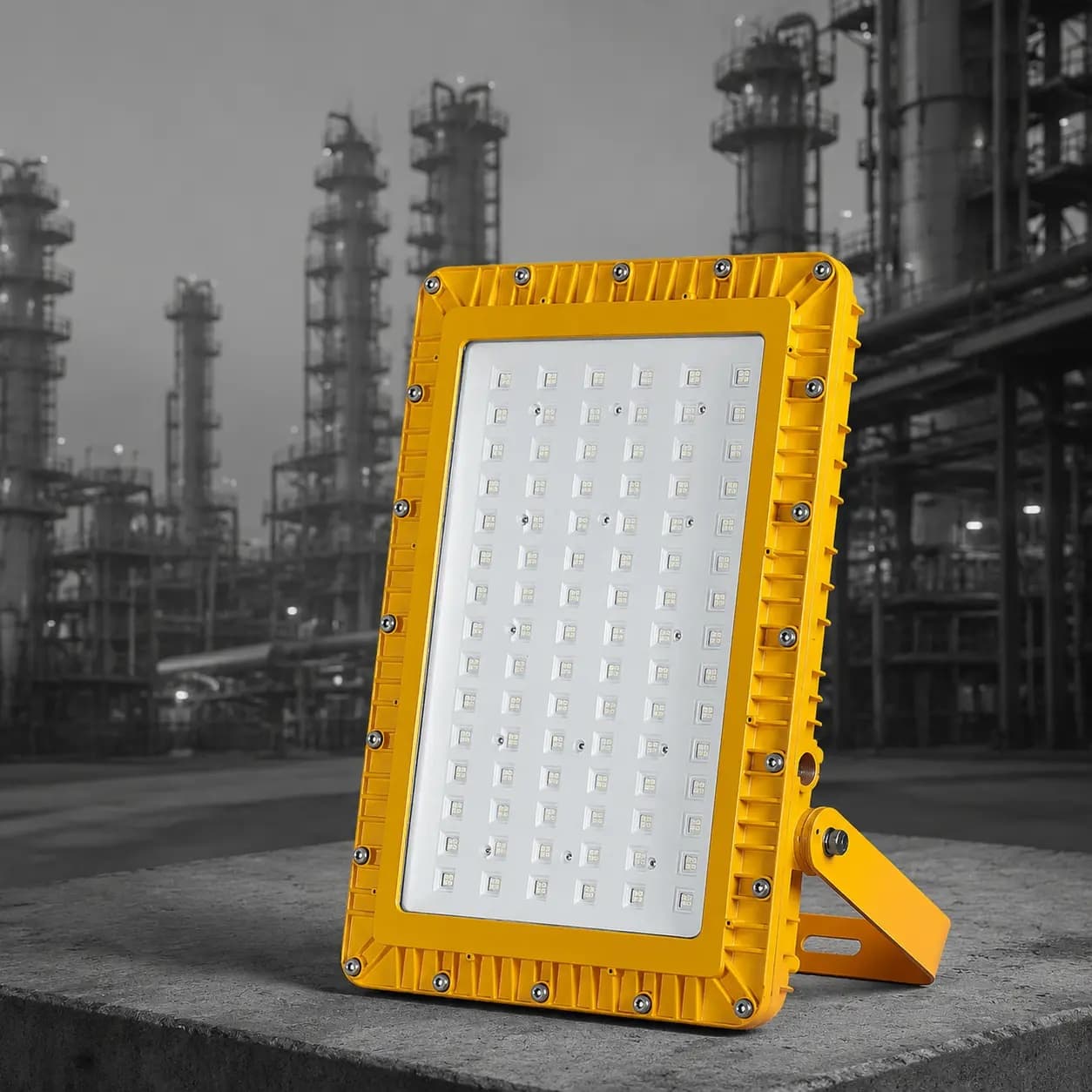
Every certified explosion-proof luminaire carries a coded string on its nameplate — something like Ex db eb IIC T5 Gb. Those five segments answer, in order: how the fixture prevents ignition, which gas atmospheres it may face, how hot its surface is allowed to get, and which zones it may be installed in. Learn to parse the string once and you can audit any datasheet, any nameplate, any bid submission in under a minute — and catch the mismatches that get equipment rejected at site inspection. This decoder walks through each segment with the diagrams, then puts it to work on real examples.
Key Takeaways
- The marking string reads left to right: Ex (certified for explosive atmospheres) → protection type(s) (db, eb, …) → gas group (IIA/IIB/IIC) → temperature class (T1–T6) → equipment protection level (Ga/Gb/Gc).
- IIC covers IIB covers IIA — a IIC fixture is acceptable in any gas group; the reverse is not true.
- Higher T number = cooler surface: T6 (≤85°C) is the strictest class, T1 (≤450°C) the loosest. The fixture’s class must sit at or below the gas’s auto-ignition temperature.
- EPL maps to zones: Ga → Zone 0, Gb → Zone 1, Gc → Zone 2 — the fastest cross-check on any submission.
- The format is shared by GB/T 3836 and IEC 60079, so one decoding skill reads nameplates from both systems.
The Anatomy of a Marking String
Here is the full string from a typical SJFB-class luminaire, dissected:
Sixty seconds, five questions answered. Now each segment in enough depth to use professionally.
Segment 1 — “Ex”: The Entry Ticket
The Ex prefix declares the equipment is designed and type-tested for explosive atmospheres under the applicable standard family. In China that family is GB/T 3836; internationally it is IEC 60079 — and the two are technically harmonized, sharing protection concepts, groups, classes, and this exact marking grammar, as we unpack in GB/T 3836 vs IEC 60079. Regional certification schemes wrap their own paperwork around the same string — the EU’s ATEX framework, for instance, prepends additional directive codes — but the Ex string itself reads the same everywhere, which is what makes this decoding skill portable.
One practical audit habit: the marking is only as good as the certificate behind it. A nameplate is a claim; the type-test certificate number is the evidence. Our SJFB range is certified under GB/T 3836-2021, certificate ZJEx25.1185, and we hand the certificate copy over with every quotation — any legitimate manufacturer will do the same.
Segment 2 — Protection Types: How Ignition Is Prevented
The lowercase letters after Ex name the protection concepts, and a fixture may combine several:
| Code | Name | How it works | Typical use in a luminaire |
|---|---|---|---|
| d | Flameproof enclosure | The enclosure contains an internal explosion; flame paths cool escaping gas below ignition temperature | The lamp housing itself |
| e | Increased safety | Prevents arcs, sparks, hot spots from occurring at all (creepage distances, secured terminals) | Terminal and wiring compartments |
| i (ia/ib/ic) | Intrinsic safety | Limits circuit energy below the minimum ignition energy | Sensors, control circuits |
| m (ma/mb/mc) | Encapsulation | Potting compound seals ignition sources | LED drivers, small electronics |
| n | Non-sparking | Normal operation produces no ignition source | Zone 2-only equipment |
| p | Pressurization | Positive internal pressure keeps gas out | Large enclosures, analyzers |
The letter suffixes (da/db/dc, ea/eb/ec…) grade each concept to an equipment protection level — b-suffixed protection suits EPL Gb, hence Zone 1. So Ex db eb reads: flameproof main enclosure plus increased-safety wiring compartment, both engineered to the Zone 1 protection level. That combination is the workhorse architecture of hazardous-area lighting, and it is exactly how our SJFB fixtures are built — the flameproof chamber contains the LED and driver, the increased-safety chamber takes the site wiring, so an electrician never opens the flameproof joint to connect power.
Segment 3 — Gas Groups: What Atmosphere the Fixture May Face
Group II covers surface industry gas atmospheres (Group I is mining-specific; Group III covers dusts), subdivided by how easily each gas family ignites and how violently it transmits an internal explosion:
| Group | Reference gases | Where you meet them |
|---|---|---|
| IIA | Propane, petrol vapor, natural gas | Fuel storage, refineries, gas stations |
| IIB | Ethylene, town gas | Chemical and petrochemical process units |
| IIC | Hydrogen, acetylene | Electrolysis, battery rooms, acetylene plants — the toughest class |
The containment rule is strictly hierarchical: IIC equipment is certified for IIB and IIA atmospheres too, because hydrogen’s tiny ignition energy and fierce flame transmission make IIC the worst case. That is why specifying IIC across a mixed-gas site is a legitimate simplification strategy — one fixture SKU, every unit, no matching errors — and why our SJFB series certifies to IIC. The full gas-group background lives in the gas groups glossary entry.
Segment 4 — Temperature Class: How Hot the Surface May Get
An explosion-proof fixture must never become the ignition source itself — so its maximum surface temperature is classified and must sit below the auto-ignition temperature (AIT) of the surrounding gas:
Two things trip people up. First, the counter-intuitive direction: T6 is the strictest class, T1 the loosest — higher number, cooler surface. A T5 or T6 fixture therefore covers almost every industrial gas list. Second, temperature class and gas group are independent axes: hydrogen is the hardest gas to contain (IIC) but has a high auto-ignition temperature, while some heavy vapors ignite on a surface barely hotter than boiling water. You must satisfy both axes separately against your site’s gas inventory. Thermal design is where LED helps enormously — our SJFB fixtures hold T5–T6 classification because die-cast thermal paths keep surfaces cool at full load, something a 400W metal halide predecessor could never claim.
Segment 5 — EPL: Which Zone It May Enter
The equipment protection level is the marking’s bottom line — it maps directly onto the zone classification of your site:
Read it downward and one audit shortcut appears: an EPL always covers the zones below it. Gb equipment (like the SJFB series) installs in Zone 1 and Zone 2; Gc equipment is Zone 2 only. The most common submission error we see in tenders is exactly this — a cheaper “Ex ec/nA”-style Zone 2 fixture quoted against a Zone 1 area schedule. The nameplate catches it in five seconds if you know where to look.
Putting It Together: Three Worked Examples
Ex db IIB T4 Gb — Flameproof enclosure only; IIB gases (ethylene-class and easier — not hydrogen); surfaces up to 135°C; Zone 1 and 2. Fine for many petrochemical process areas, insufficient for a hydrogen electrolyzer hall (needs IIC) or a carbon-disulphide plant (needs T6).
Ex db eb IIC T5 Gb — Our SJFB baseline decoded above: flameproof body + increased-safety wiring, every Group II gas, surface ≤100°C, Zone 1 and 2. The “specify once, deploy anywhere on site” configuration.
Ex ec IIC T5 Gc — Increased-safety-only construction to the “c” level: all gas groups, cool surface, but Zone 2 only. The IIC and T5 look impressive; the Gc is the segment that quietly restricts it. This is why you read all five segments, always.
The 60-Second Audit Routine
- Zone first: does the final letter pair (Ga/Gb/Gc) cover the zone in your area classification drawing?
- Gas group: is the group at or above your worst gas (IIC covers all)?
- T-class: is the surface limit below the lowest auto-ignition temperature on your gas list?
- Protection types: do they make sense for a luminaire (d/e combinations are the norm)?
- Certificate: ask for the certificate number and match it to the nameplate — marking without paper is marketing.
For the standards machinery underneath — how GB/T 3836-2021 parts map to IEC 60079 parts, what a type-test involves, and what the certificate actually attests — continue with our hub guide to GB/T 3836-2021 explained.
Frequently Asked Questions
What does Ex db eb IIC T5 Gb mean in plain words? A luminaire whose main enclosure contains any internal explosion (flameproof, “db”), whose wiring compartment prevents sparks from occurring at all (increased safety, “eb”), certified for every surface-industry gas group up to hydrogen/acetylene (IIC), with a surface that never exceeds 100°C (T5), installable in Zone 1 and Zone 2 (Gb).
Is a IIC fixture always better than IIB? It is always broader: IIC certification covers IIB and IIA atmospheres too, so it can standardize a mixed-gas site on one SKU. If a site will only ever see IIA gases, IIB or IIA equipment is equally compliant — IIC simply removes the matching risk.
Which is stricter, T4 or T6? T6. The scale runs backwards from intuition: T1 permits up to 450°C surface temperature, T6 only 85°C. A T6 fixture automatically satisfies T1–T5 requirements.
Do GB 3836 and IEC 60079 markings read the same way? Yes — the marking grammar, protection-type letters, gas groups, temperature classes, and EPLs are aligned between the two systems. A nameplate decodes identically; what differs is the certification scheme and paperwork behind it, which we compare in GB/T 3836 vs IEC 60079. SJFB fixtures are certified under GB/T 3836-2021 (certificate ZJEx25.1185), with the certificate copy provided at quotation.
Where is the marking physically located? On a permanent nameplate on the fixture body — typically laser-etched or riveted metal, since adhesive labels don’t survive hazardous-area service. The same string must appear on the certificate and the datasheet; any disagreement between the three is a red flag worth escalating before installation, not after.
The Bottom Line
Five segments, one reading order: certified (Ex) → how it protects (db eb) → against which gases (IIC) → staying below what temperature (T5) → in which zones (Gb). Master that sentence and every nameplate in every bid becomes a sixty-second verification instead of an act of faith. When you want the string checked against a real area classification — zones, gas list, temperature requirements — send the drawing to our engineering team and we will return the matching SJFB configuration with the GB/T 3836 certificate to back the nameplate.