Search for coal handling and processing plant lighting and almost everything that comes back is about underground coal mining. Cap lamps, mine-duty luminaires, Group I equipment. It reads as adjacent, so people specify from it.
It is the wrong scheme. The boundary between mining equipment and surface equipment is not drawn at coal, and not at dust. It is drawn at firedamp — the methane liberated by working a seam. A power station coal yard, a port coal berth, an independent preparation plant, a coke works: none is a mine susceptible to firedamp, so all of them sit in the surface scheme, where dust is handled by Group III and its subdivisions and any gas hazard separately by Group II.
Nor is Group I a safe superset you can specify into by accident. Different scope, different tests, no Group III dust subdivision. Specifying against it does not over-engineer the problem; it answers a different one — and the temperature marking, the equipment protection level and the enclosure concept all follow from that boundary.
Key Takeaways
- The equipment-group boundary is firedamp, not coal. A surface coal plant is a Group III dust problem, plus Group II where a gas hazard exists separately — not a Group I mining problem.
- A combustible dust imposes two surface-temperature ceilings, not one, and the lower governs. In a coal plant the dust layer limit is usually the one that bites.
- That layer limit assumes a depth of up to 5 mm, which couples the fixture specification to the cleaning schedule.
- No named plant area “is” a zone. The site’s classification study assigns zones from that plant’s dust properties, ventilation and housekeeping.
- Illuminance comes from EN 12464-1 and EN 12464-2 in the applicable edition plus the project specification, confirmed by a photometric study. A lux figure quoted with no standard and no task area is a vendor assertion.
What a Coal Handling Plant Actually Is
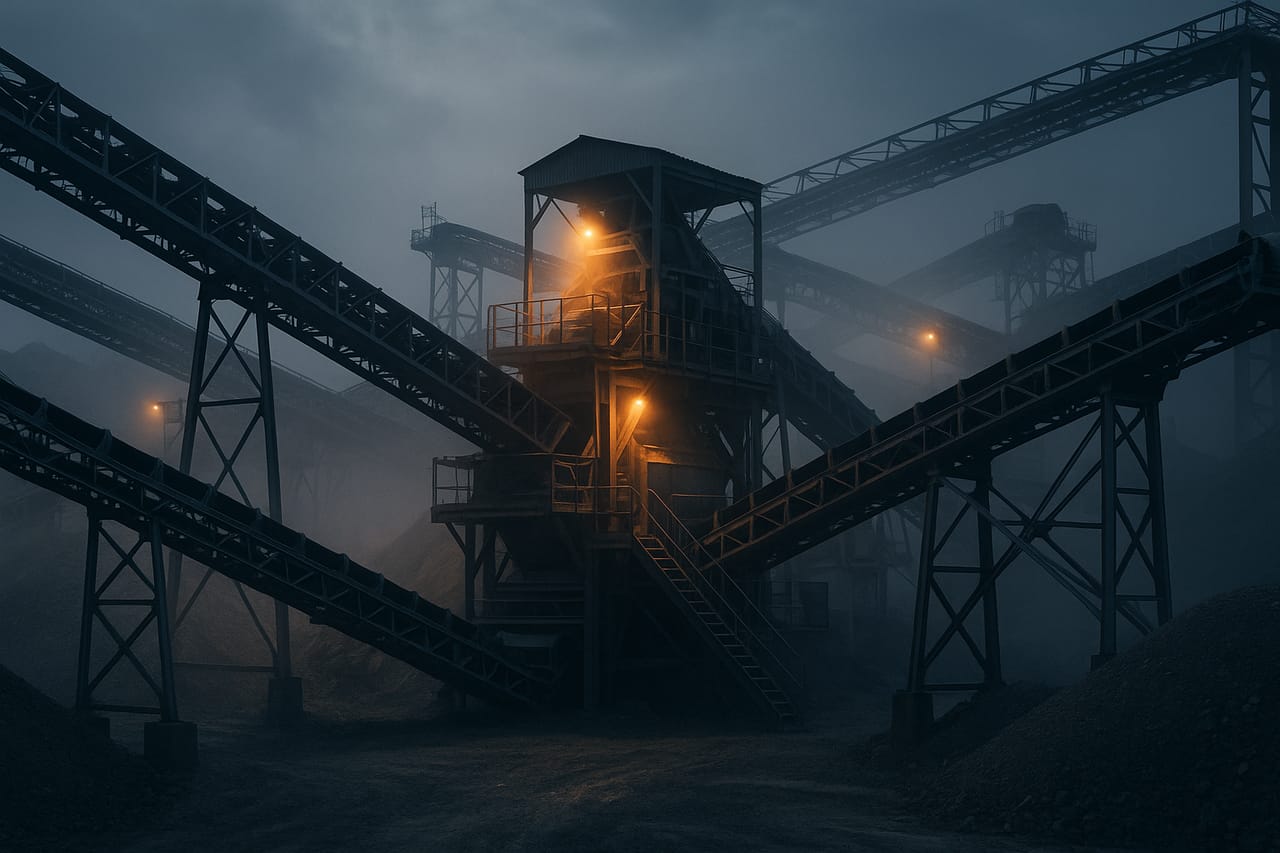
The reader here is usually not a mine operator. They are specifying a coal path: the route the fuel takes from arrival to consumption or shipment — receiving, stockyard, reclaim tunnel, conveyor runs, transfer towers, crusher and screening house, silos and chutes, loadout, and the roads between them.
The lighting problem is a property of that path, not of the owner’s industry. Underground is a genuinely different project; our mining site lighting guide treats surface operations, the processing plant and underground as three separate schemes. This article stays above ground and follows the coal.
Who Classifies, and What the Study Decides
Nothing in a catalogue can tell you the classification of your transfer tower. The operator or their engineering contractor classifies the plant before equipment is chosen, and documents it in a drawing that belongs to the site. For combustible dust that runs under IEC 60079-10-2 in IEC jurisdictions and NFPA 499 under the North American framework. Both weigh the same inputs: where dust is released, how much, how readily it forms a cloud, how the space is ventilated, and — this matters more for coal than for most dusts — how much settled material housekeeping allows to build up.
| IEC framework | North American traditional | |
|---|---|---|
| Dust areas | Zones 20 / 21 / 22 | Class II, Divisions 1 / 2 |
| Classification standard | IEC 60079-10-2 | NFPA 499 |
| Dust equipment grouping | Group III, subdivided IIIA / IIIB / IIIC | Class II Groups E / F / G |
| Marking carries | Equipment protection level plus an absolute maximum surface temperature | Temperature marking under the Division scheme |
US coal-fired plant practice is typically NEC and Class/Division framed — NEC 500/504/505 and the NFPA 70/79/496 family. The export and IEC world uses zones. Neither translates cleanly into the other, and the zone assignment guide sets out the dust zones 20/21/22, the equipment protection levels and the approximate Class/Division mapping in full. This article assumes them.
Four things the study decides and a supplier cannot:
- Whether each lighting position is classified at all.
- If classified, which zone or division.
- The Group III subdivision for that plant’s dust — IIIA, IIIB or IIIC. Carbonaceous dusts can be electrically conductive depending on material and moisture, so this is a measured property of your coal, not a lookup.
- The dust’s minimum ignition temperature as a cloud, and the ignition temperature of a settled layer.
If a project cannot answer those four, nothing downstream of them is defensible. That is not a delay in the specification; it is the specification.
Walking the Coal Path
What follows is not a list of zones. It is the list of conditions your classification study will argue about, area by area.
| Area | What moves the answer |
|---|---|
| Wagon tippler / receiving | Degree of enclosure, extraction and suppression at the tipping point, coal moisture as delivered |
| Stockyard and stacker-reclaimer | Wind exposure, whether the pile is covered, suppression coverage, the machine’s own transfer points |
| Reclaim tunnel | Ventilation rate and whether it interlocks with running plant, feeder enclosure, cleaning frequency |
| Enclosed conveyor gallery | Whether the belt is covered, gallery ventilation, belt speed and drop height, cleaning interval |
| Transfer tower | Chute design and skirt sealing, extraction or suppression at each hand-off, whether floors are open to each other |
| Crusher and screening house | Enclosure of the machines, extraction capacity, whether screens are hooded |
| Silo, bunker, chute interiors | Filling and discharge regime; whether the fixture is inside the containment or looking in through a window |
| Ship or rail loadout | Enclosure of the loading spout, telescopic chute with skirt, wind, water spray |
| Plant roads and gates | Proximity to a classified envelope; whether trucks track coal out and it dries |
The pattern underneath that table comes with its limits attached. Dust zone definitions are written around presence, not around area names. The inside of containment is where a cloud is present continuously or for long periods, and studies commonly place containment interiors in the highest dust zone for that reason. Enclosed transfer and discharge points, where a cloud arises in normal operation, trend one step below. The wider enclosed volume around them, where a cloud is unlikely and would be short-lived, trends lower again. Open outdoor areas are frequently unclassified — frequently, not automatically.
That is a tendency, not a mapping. Two plants with identical layouts can classify the same gallery differently, because one runs a covered belt with active extraction and a weekly wash-down and the other does not. Coal-plant engineering literature names the locations typically brought into classification — conveyor galleries, transfer towers, head chutes, bunkers, the crusher house, silos and feed systems, enclosed and below-grade conveyor sections, chutes and dust collectors (POWER magazine gives that list in a US coal-fired context) — but it names them as candidates for classification, not as zone assignments. Anyone handing you a table that says a conveyor gallery is a particular zone has skipped the study.
Two areas are under-specified more often than the rest, for the same reason: they are hard to reach. The reclaim tunnel is confined, below grade and dust-laden, and it is where the study’s ventilation assumptions are most likely to have drifted from what the fans now do. The transfer tower stacks several dust-generating hand-offs into one structure, so conditions differ floor by floor, and it is where the temperature question below is least forgiving.
The Two Temperature Limits, and the 5 mm Assumption
This is where a dust specification parts company with a gas one. Most competing pages compress it into a single sentence about keeping surface temperature below the ignition temperature. There are two ceilings, from two different measured properties of the dust:
- From the cloud — two-thirds of the minimum ignition temperature of a dust cloud of that material.
- From the layer — the ignition temperature of a settled layer, minus a 75 K margin, for layers up to 5 mm deep.
The permitted maximum surface temperature is the lower of the two. Industry guidance on dust explosion protection sets it out in that form — ecom instruments states both limits and the instruction to examine which gives the greater safety — and attributes it to the installation standard for explosive atmospheres, IEC/EN 60079-14. Sources naming a specific clause are secondary; the rule is consistent across them.
So you cannot choose a temperature marking in the abstract. It is derived from your coal’s own measured cloud MIT and layer ignition temperature. We are not printing a number for coal dust here: coal is not one material — ignition behaviour varies with rank, volatile content, particle size and moisture — and no figure we supplied would be a property of your feedstock. That measurement belongs in the same package as the classification study.
And the layer limit usually governs, resting on an assumption about housekeeping. The 75 K margin is stated against a layer of up to 5 mm, and transfer towers, crusher houses, reclaim tunnels and galleries are exactly where settled coal exceeds 5 mm between cleans. When it does, the installed condition is no longer the one the margin describes: a deeper layer insulates the surface it sits on, so that surface runs hotter than assumed, while more fuel sits on it.
That couples a fixture decision to an operating practice, which is worth saying out loud to whoever owns the cleaning schedule. If the plant cannot hold the assumed depth — because the fixtures are high in a gallery over a running belt and nobody cleans them — then either the cleaning regime changes or the assumption behind the limit does.
One distinction to keep clean while doing this: a fixture’s ambient operating range and its maximum surface temperature marking are different quantities. Our catalogue states a standard operating range of −20 °C to 45 °C, describing the air the fixture may sit in. A surface-temperature figure describes how hot the enclosure’s outer face may become.
The two marking families state that second quantity differently. A gas-side temperature class uses a letter code — T5 is 100 °C, T6 is 85 °C. Dust markings print an absolute temperature, so a dust marking string reads, generically, Ex tb IIIC T90 °C Db: dust group, an explicit 90 °C surface limit, and the equipment protection level.
What the IP Rating Tells You, and What It Does Not
Briefly, because the site covers this at length twice already. An IP rating comes from IEC 60529, whose scope is ingress of solid objects and water into an enclosure. A dust-zone certification under the protection-by-enclosure concept — IEC/EN 60079-31, “Equipment dust ignition protection by enclosure ‘t’” — additionally constrains the enclosure’s maximum surface temperature against the dust’s cloud and layer ignition temperatures, assesses the equipment as an ignition source, and carries an equipment protection level tied to the zone, under third-party assessment.
An enclosure can therefore be genuinely dust-tight and still present a surface hot enough to ignite what settles on it. Ingress protection is a necessary property of a coal-plant fixture; it is not the certification.
The Failures That Have Nothing to Do With Ignition
Most of a coal plant’s lit area is unclassified, and most of its lighting maintenance budget goes on failures with no ignition dimension at all.
Dust on the lens and the heatsink. The mechanism is not catastrophic ingress but progressive loss of transmittance, and two things degrade together: delivered light falls as the lens dulls, and heat dissipation falls as the cooling surfaces blanket over. The second matters doubly where a surface-temperature limit applies. That makes the maintenance factor — and the cleaning interval it silently assumes — a real design variable. Size the scheme for the dirtiest state the plant will be allowed to reach.
Water, deliberately introduced. Suppression bars, fogging and periodic hosing of galleries put water where the lighting is, often onto a hot fixture: thermal shock at the gasket line, and pressure-driven moisture exchange as the housing cools — the mechanism the tri-proof guide works through. The useful questions are seal material, gland and cable-entry detail, and whether the fixture sits in a spray path at all, not the IP digit alone.
Vibration, driven rather than incidental. Conveyor stringers, transfer towers, screen decks and crusher floors are continuously excited structures. The LED die is rarely the casualty: fasteners loosen, solder joints and driver components fatigue, gasket compression relaxes — reinstating both failures above — and aiming drifts off target. Screening and crusher houses are worst, because there the excitation is a design feature of the machine. Corrosion fails at the same details: moisture, suppression water, sulphur-bearing dust and salt air at marine loadout take the fasteners and the coating at edges and gland entries long before the casting.
Access, which should drive the design. In an enclosed gallery the fixture sits above a moving belt in a confined walkway, and relamping may need a belt stop, a permit and possibly a confined-space procedure. On a stockyard mast it needs a lowering device or a platform reaching across an active pile. The cost of touching the fixture dominates the cost of the fixture, which reframes fixture count, spacing, how far ingress and vibration resistance are over-specified, and whether the scheme is sized clean or dirty. The port terminal lighting guide covers the stockyard and shiploader side of the same problem.
Illuminance: What Governs, and What We Will Not Print
A coal path straddles two standards. EN 12464-1 covers indoor work places — galleries, transfer towers, crusher and screening houses, control and MCC rooms. EN 12464-2 covers outdoor work places, and its scope enumerates the types a coal path lives in: ports, loading and unloading zones, industrial outdoor locations, access roads and railway yards. The outdoor part also constrains obtrusive light, which matters at a berth or a boundary near housing. Both specify illuminance together with uniformity, glare and colour rendering; the maintained values for each task area come from the applicable edition and from your project specification, and should be confirmed for your geometry by a photometric study before anyone orders fixtures.
We are deliberately not printing a lux figure. Nearly every page offering coal-plant lux targets gives a number with no standard named, no edition, no task-area definition, and no statement of whether it is maintained or initial. A figure like that cannot be checked and cannot be contested.
Fixtures by Area, and the One Question We Need Answered
Sunjoylight has manufactured industrial lighting in Changzhou since 1999 and supplies 50+ countries. The ranges that fall along a coal path:
| Plant position | Series | What the catalogue states |
|---|---|---|
| Classified positions | SJFB explosion-protected, 16 models | Die-cast aluminium, threaded and plane flameproof joints; 304 stainless exposed fasteners; IP65; −20 °C to 45 °C. One model uses a sealed light-source chamber isolating the heat source from the surrounding atmosphere. Certified to GB/T 3836-2021, certificate ZJEx25.1185, type-test report 25133F41180: Ex d and Ex e, gas groups IIA/IIB/IIC, Zone 1 and Zone 2, T5–T6. |
| Galleries, walkways, damp and washdown areas | SJSF tri-proof | Die-cast aluminium or ABS+PC body by series, silicone seal, built-in driver; IP65; −20 °C to 45 °C; 120–160 lm/W; LED life > 50,000 h. SJSF501 at 50/60 W, SJSF508 at 18 W or 2×18 W in a 1,265 mm linear body. |
| Crusher house, screening building, workshops | SJGK high bay | Die-cast aluminium with integral cooling fins; IP65; −20 °C to 45 °C. |
| Stockyard, ship loader, high masts | SJTG flood | SJTG610 at 50/100/200/300/480/800/1200 W, matrix glass lens up to 95 % transmittance; SJTG609 at 100/200/250/300/480 W. |
| Plant roads and gates | SJLD street | Roadway optics for the unclassified perimeter. |
One output figure there is measured rather than calculated: the 200 W flood produces 35,309 lm at 175.4 lm/W, peak intensity 34,444 cd, beam 60.1° × 59.3°, on our own HPG1800 distributed goniophotometer. Reports for the 150 W and 300 W units are published too, and all three download from the flood lights product page rather than the certificates section. For every other rating we cite the range figure of 120–160 lm/W and ship the IES file for the ordered configuration with the quotation. A supplier who can produce an exact lumen number for every rating in a catalogue has calculated it, not measured it. The GB/T 3836-2021 scope above is quoted from the certificate rather than paraphrased, for the same reason.
Because the dust side of a coal path is settled by your classification study rather than by a catalogue page, we handle it per project: tell us the dust zone classification for the area and the governing requirement at enquiry stage and we will confirm the certification route for that model. One jurisdictional note while you are asking — a GB/T 3836 certificate is not a legal substitute for ATEX where ATEX is legally required, a constraint on paperwork rather than engineering and cheaper to resolve before design than after. The explosion-protected range and the tri-proof range are the two lines most of a coal path draws on.
What to Send a Supplier
A request containing these gets an engineered answer. One without them gets a guess, and the guess is what ends up in the specification.
- The hazardous area classification drawing, or the classification per lighting position, with its revision date. A plant reclassified after a process change may still be circulating an old one.
- Which framework the drawing uses — IEC zones or NEC Class/Division — and the destination market’s certification scheme.
- The dust group determined for that plant’s dust, and the gas group if a gas hazard is separately present.
- The maximum permitted surface temperature, with a note on which of the two limits governed.
- The assumed dust layer depth and the cleaning interval behind it. A mismatch between design assumption and real housekeeping is better resolved on paper.
- Ambient temperature range at each position, and whether suppression spray or wash-down reaches it.
- Mounting positions and heights, the structure they attach to, and whether it vibrates.
- Access method and realistic cleaning frequency per position — this changes the fixture count and often the fixture choice.
- The illuminance standard and edition the project cites, plus any client specification overriding it.
Bottom Line
A coal handling specification is derived, not selected: from a classification study you commission, from measured ignition properties of your own coal, from the lower of the two temperature limits those properties produce, and from an honest account of how dirty the fixtures will be allowed to get before anyone reaches them.
Everything a supplier can legitimately contribute sits downstream of those four inputs. Send us the plant layout, the classification drawing and the lighting positions, and our engineers will return a photometric layout with the IES files behind it, a fixture schedule by area, and a plain statement of which positions we believe are unclassified — rather than quoting hazardous-area fixtures across a whole site.
FAQ
Is a coal handling plant Group I or Group III? A surface coal handling and processing plant is not a mine susceptible to firedamp, so it sits in the surface scheme: Group III for the dust hazard, Group II separately where a gas hazard is present. Group I covers underground mining, and it is not a superset that safely covers a surface plant — different scope, different tests, no IIIA/IIIB/IIIC subdivision.
What zone is a conveyor gallery or a transfer tower? Only your site’s classification study can answer that, under IEC 60079-10-2 or NFPA 499. Both are commonly identified as candidates for classification, but the zone that results depends on belt enclosure, ventilation, drop height, suppression and cleaning frequency at your plant. Treat any table assigning a zone to an area name as a hypothesis for the study, not an answer.
What surface temperature is allowed for a fixture in coal dust? It is derived, not looked up. Two limits apply: two-thirds of the dust cloud’s minimum ignition temperature, and the settled layer’s ignition temperature minus 75 K for layers up to 5 mm. The lower governs. Both inputs are measured properties of the dust at that plant, varying with coal rank, particle size and moisture, so no general figure substitutes for testing yours. The layer limit also assumes a depth the cleaning regime has to hold to: a deeper layer insulates the surface underneath, so it runs hotter than the assessment assumed while carrying more fuel.
What lux level should a coal handling plant be lit to? EN 12464-1 governs the indoor areas and EN 12464-2 the outdoor ones, and both specify illuminance with uniformity, glare and colour rendering. The values for each task area come from the applicable edition and your project specification, confirmed for your geometry by a photometric study. Be wary of any figure quoted without a named standard, edition and task area.