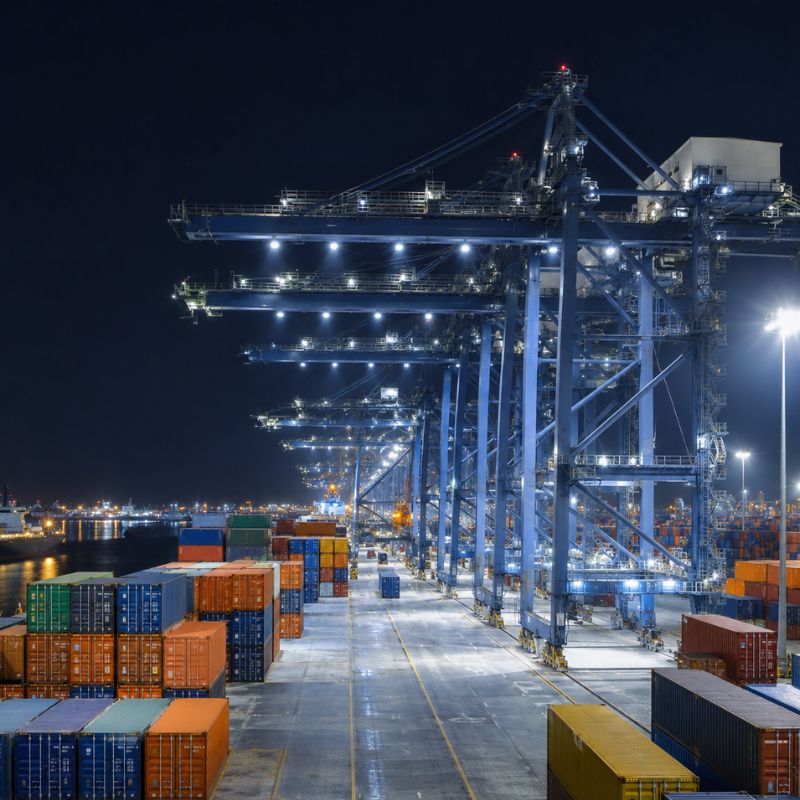
A port is the hardest ordinary lighting problem in industry. It runs twenty-four hours, it operates machines that move containers over people, it sits in the most corrosive atmosphere a fixture will ever see, and it is watched by two audiences with incompatible needs: cameras that want more light, and ship’s officers who need less of it in their eyes.
It is also a place where the fixture is a small part of the cost. Access to a 35-metre mast head is a crane hire; a failed light on a quay crane boom is a lost operating shift. That asymmetry should drive every specification decision — and usually does not.
This guide covers the zones a terminal is actually divided into, what each needs, and the four constraints that separate port lighting from generic outdoor area lighting.
Key Takeaways
- Terminals are lit zone by zone, not as one yard. Quay operations, stacking areas, ro-ro ramps and gates have different levels and different fixture strategies.
- Glare toward the water is a safety issue, not an aesthetic one. Light that reaches a bridge wing or a pilot’s eyeline degrades the vessel’s ability to navigate.
- Corrosion, not light output, ends most port fixtures. Salt aerosol travels on wind, not just spray, and 316 stainless is not the same specification as “stainless”.
- CCTV wants vertical illuminance and uniformity, not peak lux. A camera in a high-contrast scene sees less than a camera in an evenly lit one.
- Access cost dominates. Every specification decision should be tested against “what does it cost to reach this fixture in year six?”
The Zones
Lux targets are maintained values. Local port authority standards, insurer requirements and terminal operating manuals may impose higher figures — these are the working ranges international terminal designs are usually built around.
| Zone | Operation | Maintained lux | Fixture strategy |
|---|---|---|---|
| Quay / berth apron | Crane operations, lashing, mooring | 50 – 100 lx | High mast + crane-mounted |
| Container stacking yard | RTG/RMG and straddle carrier movement | 20 – 50 lx | High mast, wide spacing |
| Ro-ro ramps and decks | Vehicle movement on gradients | 100 – 200 lx | Pole and structure mounted |
| Reefer racks | Plug/unplug, monitoring at height | 100 – 150 lx | Local fixtures on the rack structure |
| Gate and inspection lanes | Document check, plate/OCR reading, scanning | 200 – 300 lx | Canopy fixtures, high uniformity |
| Transit sheds and warehouses | Storage and handling | 100 – 200 lx | Interior high bay or tri-proof |
| Workshops and CFS | Maintenance, stuffing/stripping | 300 – 500 lx | Interior scheme, higher CRI |
| Internal roads and circulation | Vehicle and pedestrian traffic | 20 – 30 lx | Street optics on poles |
| Bunkering and fuel areas | Fuel transfer | Per classification | Certified fixtures — see below |
| Security perimeter | Detection and CCTV | 20 – 50 lx vertical | Aimed for camera performance |
Note the pattern: the highest levels in a terminal are not on the quay. They are at the gate, where documents are read and plates are recognised, and in the workshop. The vast open areas run at levels that surprise people used to warehouse figures — because what matters there is uniformity and the absence of deep shadow, not absolute brightness.
High Mast, Crane-Mounted, or Both
Terminals almost always use both, and confusion about which does what produces the two classic failures: dark patches between mast pools, and glare from crane-mounted heads aimed to compensate.
High masts — typically 20–45 m carrying 4–16 heads — do the bulk coverage. They light the yard from above with minimal ground obstruction, which matters enormously where straddle carriers and terminal tractors need clear running lanes. Coverage from a mast is a circle whose useful radius is on the order of 1.5–2× the mast height, so layouts are built from overlapping circles and the overlap is where uniformity is won. Our high mast lighting guide covers the heights, spacing and aiming method in full, and on the tallest terminal masts the head itself is usually drawn from the 800–1200W flood class, where fewer, better-aimed units beat a crowded crown.
Crane-mounted fixtures light what the masts cannot: under the spreader, inside the container cell, along the lashing platform, and the immediate work area that the crane structure itself shadows. These are the fixtures that fail most often — vibration, flexing structure, and constant salt exposure — and they are also the hardest to reach. Specify for vibration resistance explicitly, and confirm the mounting bracket is rated for the crane’s duty cycle rather than for a static pole.
The interface between them is the design problem. A mast layout is calculated for an empty yard; a stacked yard is full of six-metre steel walls that cast hard shadows. Terminals that light well are designed with the stacking plan in mind, accepting that a mast which performs beautifully on the empty-yard model may leave a canyon dark when the yard is full. Where the operator’s stacking pattern is known, the photometric study should model it.
Lighting the Cranes Themselves
Crane lighting deserves separating out, because it is the part of a terminal scheme that is specified last, fails first, and costs the most to put right.
Three crane types, three different problems.
| Crane | What its lighting has to do | Where fixtures mount |
|---|---|---|
| Ship-to-shore (STS) | Light the cell being worked, the lashing platform and the backreach — all of which the crane’s own structure shadows | Boom underside, backreach, portal beam, machinery house, trolley area |
| RTG / RMG yard cranes | Light the stack lane and the truck lane beneath a machine that straddles both | Sill beams, legs, spreader area, drive-lane ends |
| Mobile harbour cranes | Move with the crane and light wherever it sets up, with no fixed infrastructure to rely on | Boom, superstructure, outrigger area |
What they share is that the crane moves through its own light. A fixture aimed at a fixed point is aimed correctly for one trolley position and wrongly for every other. This is why crane lighting is specified by task area rather than by average illuminance over the machine, and why copying a mast aiming plan onto a crane produces a scheme that works during commissioning and nowhere else.
Why crane fixtures fail before mast fixtures
The environment is genuinely harsher, and not for the reason most specifications assume.
Vibration is structure-borne and continuous. A gantry under load flexes, the trolley accelerates and stops, and the whole frame rings. This is not the intermittent road vibration a pole fixture sees; it works on solder joints, terminal blocks, gland seals and fixings for the crane’s entire duty cycle. A fixture rated for pole mounting is not rated for this, and the datasheet will not usually say so — ask directly whether the vibration rating covers crane duty, and get the answer in writing.
Salt arrives driven, not settled. Quayside fixtures live in salt spray carried by wind rather than in still marine air. That reaches into gaps a static test never probes, which is why the gasket line, the gland selection and the fastener metallurgy matter as much as the housing alloy. Specify stainless external fixings; mixed metals at a quayside joint corrode faster than either metal alone.
Access is the real cost. A failed light on an STS boom is not a maintenance ticket — it is rope access, or a crane out of service, or waiting for a planned outage. That asymmetry should drive the whole specification: on a crane, the fixture that costs more and lasts longer is almost always the cheaper one, and group replacement during a scheduled outage nearly always beats individual call-outs.
What to specify, and what it means in practice
- Vibration-rated construction and mounting, confirmed for crane duty rather than for a static pole, with the bracket treated as part of the fixture rather than an accessory.
- Secondary retention on every fixture and every bracket. Hardware dropping from a boom lands on an operation with people in it.
- IP66 sealing and impact-resistant glass — the IP rating covers water and dust, and the IK rating covers the impact side; they are separate specifications and a fixture needs both stated.
- Surge protection sized for the position. Crane electrics are electrically noisy and exposed, and driver failure from surge is the most common non-mechanical fault.
- Aiming that does not compensate for the masts. The most frequent glare complaint in a terminal comes from crane heads tilted up to fill a gap the mast layout left. Fix the gap in the mast layout; keep the crane fixtures aimed at the work.
Our high-power LED flood lights are configured per position for this duty — bracket, gasketing and fixings specified for structure-borne vibration rather than supplied as a standard mast fixture. Tell us the crane type and the mounting position and we build the specification around it.
The Four Constraints That Make Ports Different
1. Glare toward the water
This is the constraint that generic area lighting design misses entirely, and it is a genuine navigation-safety matter rather than a courtesy.
A ship approaching or working a berth relies on its officers’ dark adaptation and on distinguishing navigation lights and marks against the shore. A terminal that throws light seaward puts a wall of glare behind the marks, and can dazzle a bridge wing directly during berthing — precisely when precision matters most.
Practical rules:
- Aim landward. Fixtures on the quay edge should be aimed into the terminal, not out over the water.
- Limit tilt and use cut-off optics so little light is emitted above the horizontal. See light trespass.
- Check the bridge eyeline. A large vessel’s bridge may sit 30–45 m above the water, which is level with or above many mast heads. A fixture aimed downward for the yard can still be looking straight into a bridge window.
- Coordinate with the harbour master. Many ports impose their own limits on seaward light, and discovering them after commissioning is expensive.
2. Corrosion
Salt aerosol is carried by wind well beyond the splash zone, so “not directly exposed to spray” is not protection. What ends port fixtures is rarely the LEDs:
- Fasteners and clips. Ordinary 304 stainless pits in marine atmospheres. Specify 316 where salt is present, and specify it for every fastener, not just the visible ones.
- Housings. Marine-grade aluminium alloy with a proper coating system, or the coating fails at the edges first and corrosion works underneath.
- Gaskets and glands. Silicone across the temperature range; a hardened gasket admits salt-laden moisture, and salt water inside a fixture is conductive.
- Dissimilar metals. A steel bracket bolted to an aluminium housing in salt air is a galvanic cell. Isolate or match.
Ask for salt spray test results with a stated duration — the marine and offshore lighting guide covers the corrosion, vibration and certification specification in full, and treat IP66 as the floor rather than IP65 — wind-driven salt spray is closer to a jet than to rain.
3. CCTV and security
Security cameras are a second client for the lighting scheme, and their requirements are different from the human eye’s:
- Vertical illuminance matters more than horizontal. A camera identifies a face or a plate from light on the vertical plane, not from a bright floor.
- Uniformity beats level. Cameras have limited dynamic range; a scene with 200 lx pools and 10 lx shadows is harder for a camera than a uniform 40 lx. High contrast makes anything in shadow effectively invisible.
- Never aim a fixture toward a camera. A luminaire in frame drives the camera’s auto-exposure down and blinds everything else in the scene.
- Agree the colour temperature with the security team. Recognition performance and colour-based identification depend on it, and the decision is easiest before installation.
4. Access and life-cycle cost
Everything above is negotiable. This is not: what does it cost to reach this fixture in year six?
- On masts, a working lowering system — winch, ring, cable — is worth its cost several times over. Where fixed head frames are used, the crane hire becomes the maintenance budget.
- On cranes, group replacement during a planned outage is nearly always cheaper than individual call-outs, which means the specification should favour fixtures with predictable, documented L70 behaviour over marginally cheaper ones.
- Surge protection deserves specification attention on a site with large inductive loads, long feeders and lightning exposure. Transient damage, not LED wear, ends many outdoor fixtures — see surge protection.
- Keep the fixture families few. A terminal running three fixture types across all zones holds a smaller spares inventory and trains one maintenance procedure.
Bunkering and Fuel Handling
Any area where fuel is transferred, stored or handled may be classified, and in a classified area the fixture must be certified for the zone, gas group and temperature class — this is a compliance requirement determined by the site’s area classification drawing, not a preference.
An IP66 marine-grade floodlight is not an explosion-protected fixture: sealing against water and salt is a different engineering problem from preventing ignition of a flammable atmosphere, and an IP rating makes no statement about ignition risk. Where the classification boundary runs through the terminal, it decides which fixture goes where.
Our explosion-proof range is certified to GB/T 3836-2021 for the relevant zone and gas group, and the Ex marking decoder explains how to read and verify what any nameplate claims. For the wider hazardous-area selection method, see how to choose explosion-proof LED lights.
Controls
Terminals rarely go dark, but they rarely need full output everywhere either:
- Zone by operational area. A yard block that is not being worked can run at a reduced level and lift when equipment enters it.
- Align profiles to the vessel schedule. Berths without a ship alongside do not need working-level light.
- Photocell plus profile, not photocell alone. Dusk-to-dawn switching is the floor; the saving comes from what happens between those two events.
- Confirm the dimming protocol with the order — 0–10 V or DALI — because retrofitting control into a sealed marine-grade fixture means opening its gasket.
The Specification Checklist
Before a terminal lighting order is placed, the file should contain:
- A zone plan with maintained lux and uniformity per operational area — quay, stacking, ro-ro, reefer, gate, roads, perimeter.
- The stacking plan, so the photometric study models a full yard rather than an empty one.
- Mast and structure schedule — heights, positions, head counts, and who owns the structural design.
- The seaward glare limit and any harbour-authority requirement, in writing.
- CCTV requirements — camera positions, vertical illuminance targets and colour temperature, agreed with the security team.
- Corrosion specification — housing alloy and coating, fastener grade (316 where salt is present), gasket material, and salt-spray evidence.
- The maintenance strategy — lowering systems, planned outage windows, group-replacement policy, spares holding.
- The area classification drawing for bunkering and fuel-handling areas.
- The photometric calculation with real IES files and a stated maintenance factor — 0.7 rather than 0.8 in a dusty, salty terminal.
The Bottom Line
Port lighting is decided by the constraints around the light, not by the light itself. Almost any competent flood light will hit 30 lx on a container yard on day one. What separates a ten-year terminal installation from a three-year one is whether the fasteners survive the salt, whether the aiming keeps glare off the bridge wings, whether the cameras can actually see, and whether anyone can reach the fixture without hiring a crane.
Send us the terminal layout, mast positions and stacking plan, and our engineers return a photometric study with per-zone levels, uniformity, a fixture schedule and the IES files behind it — including the corrosion specification for your exposure and an honest statement of where a certified fixture is required instead of a marine-grade one. Our LED flood lights cover 50 W to 1200 W for mast and structure mounting, and where trenching to a remote gate or perimeter costs more than the fixture, the solar flood light range removes the cable run entirely; see the ports and terminals overview for the fixture families we deploy across each zone.
FAQ
How many lux does a container terminal need? It varies by zone rather than across the terminal. Container stacking yards typically run 20–50 lx maintained, quay and berth aprons 50–100 lx, ro-ro ramps 100–200 lx, and gate and inspection lanes 200–300 lx — the highest level in most terminals, because documents and plates are read there. Local port authority and insurer requirements can raise these, so confirm them before designing.
Should port lighting use high masts or crane-mounted fixtures? Both, for different jobs. High masts of 20–45 m provide bulk coverage with minimal ground obstruction, which matters where straddle carriers need clear lanes. Crane-mounted fixtures light what the masts cannot reach — under the spreader, inside the cell, along the lashing platform. The design problem is the interface: a mast layout calculated for an empty yard leaves canyons dark when the yard is stacked.
Why does glare toward the water matter in port lighting? Because it degrades navigation. Officers on an approaching or berthed vessel rely on dark adaptation and on distinguishing navigation marks against the shore; seaward light puts glare behind those marks and can dazzle a bridge wing during berthing. A large vessel’s bridge can sit 30–45 m above the water — level with many mast heads — so fixtures should be aimed landward with cut-off optics and tilt limits, coordinated with the harbour master.
What IP rating and materials do marine-area fixtures need? IP66 as the floor, since wind-driven salt spray behaves more like a jet than rain. Materials matter as much as the rating: 316 stainless fasteners rather than 304, marine-grade aluminium with a proper coating system, silicone gaskets, and isolation between dissimilar metals to prevent galvanic corrosion. Ask for salt-spray test results with a stated duration.
How should lighting be designed for terminal CCTV? Prioritise vertical illuminance and uniformity over peak level. Cameras identify faces and plates from light on the vertical plane, and their limited dynamic range means a uniform 40 lx scene often outperforms one with 200 lx pools and deep shadows. Never allow a luminaire in the camera frame, and agree colour temperature with the security team before installation.
Do fuel and bunkering areas need explosion-proof lighting? Where the area is classified, yes — and the site’s area classification drawing determines that, not preference. A marine-grade IP66 floodlight is not an explosion-protected fixture; sealing against water is a different engineering problem from preventing ignition, and an IP rating says nothing about ignition risk. Certified fixtures must match the zone, gas group and temperature class of the classified area.
What maintenance factor should a port lighting calculation use? Use 0.7 rather than 0.8. Terminals combine airborne dust, salt deposition and long intervals between cleaning, all of which reduce delivered light faster than a clean-environment assumption allows. A study run at 0.8 in a terminal will overpromise by more than 10%, and the shortfall shows up in the second year rather than at handover.