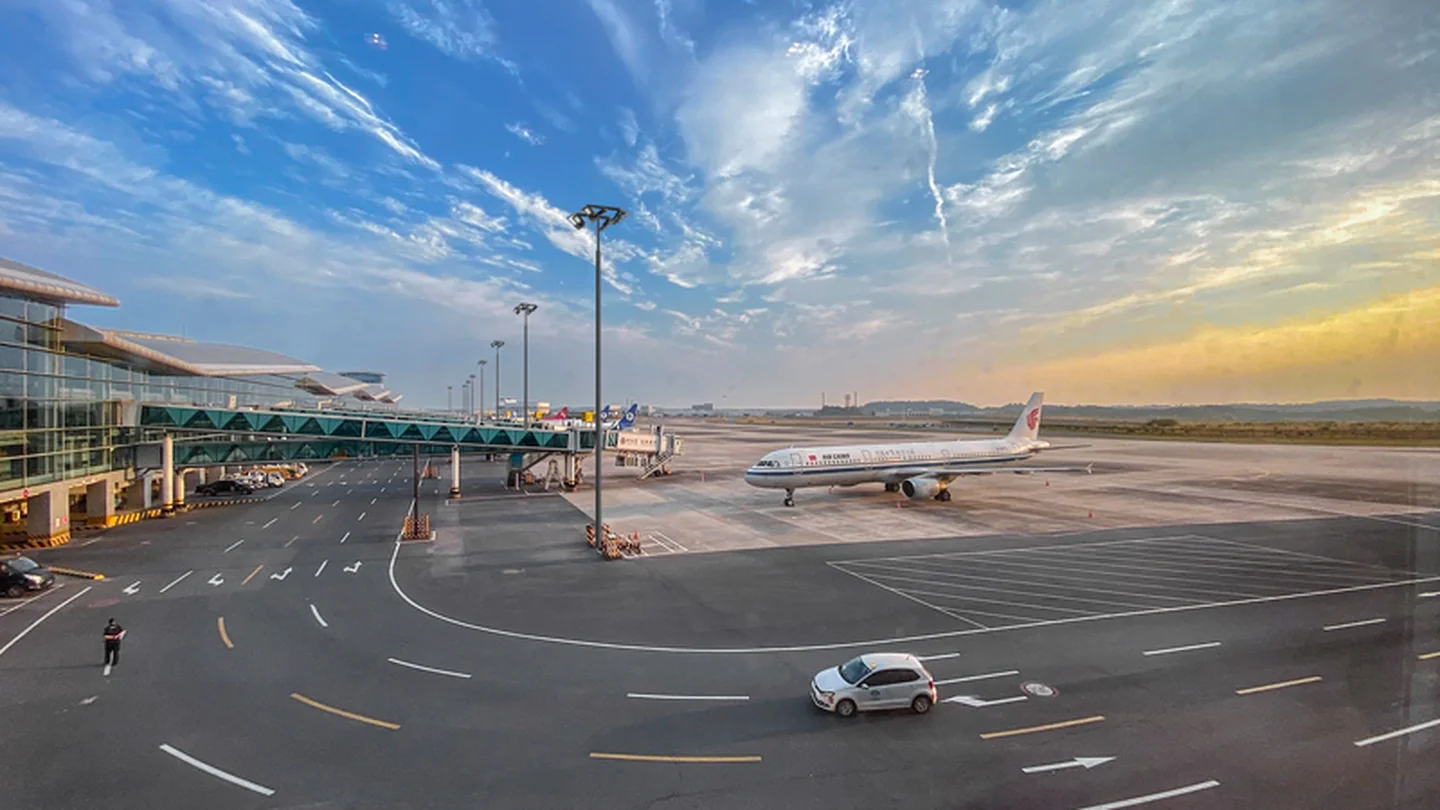
A high mast light is not just a taller street light — it is a different lighting strategy. Instead of many fixtures at 8–12 m marching along every lane and aisle, a high mast concentrates a ring of high-power floodlights at 20–40 m and covers hectares from a handful of points. Ports, container yards, highway interchanges, rail depots, airports aprons, mines and large parking areas all reach for it for the same reasons: fewer foundations, fewer cable runs, less ground clutter for vehicles to hit, and light that arrives at a steep, glare-friendly angle. This guide covers when high mast is the right call, the geometry and spacing math that size a scheme, what to mount at the top, and what to check before buying.
Key Takeaways
- High mast makes economic sense when the area is large and open: one 30 m mast replaces many low poles, trading fixture count for mounting height.
- Coverage radius is roughly 2–2.5 × mast height for workable uniformity; a 30 m mast covers a circle of about 60–75 m radius depending on optics and targets.
- Fixtures per mast typically run 4–12 high-power LED floods, aimed in a designed pattern — the photometric layout, not wattage, decides the result.
- Specify the lowering system (raise-lower carriage or ladder access), wind load rating, and surge protection with the same care as the luminaires.
- Demand IES/LDT files and a DIALux calculation before ordering; high mast mistakes are expensive to fix at 30 m.
When High Mast Beats Conventional Poles
The crossover is driven by area and obstruction. Conventional 8–12 m poles win on narrow roads and small lots because each fixture is cheap and the light does not have far to travel. But as the area grows — a container yard measured in hectares, a toll plaza, a stockyard — the pole count explodes, and every pole is a foundation, a cable trench, and a collision risk for the vehicles working around it.
High mast flips the economics. Mounting at 20–40 m:
- Covers area from few points. A single 30 m mast with a well-aimed fixture ring can serve the ground a dozen low poles would, with two or three masts covering an entire terminal apron.
- Clears operations. Cranes, reach stackers and haul trucks manoeuvre freely; there is no forest of poles to protect with barriers.
- Improves the light’s angle of arrival. Steeper incidence reduces the long shadows and direct-view glare that low, far-throwing floods produce, which matters to crane and vehicle operators working at night.
- Simplifies maintenance planning. Fewer points to service — provided the mast has a proper lowering system, covered below.
The trade-offs are real: each mast is a significant civil structure with a designed foundation and wind-load calculation, and any error in the photometric plan is multiplied across the huge area each mast serves. High mast is engineering-led lighting; it rewards the projects that treat it that way.
The Geometry: Height, Radius, and Spacing
Three numbers size a high mast scheme before any software opens.
1. Coverage radius ≈ 2–2.5 × height. Below 2 × height, uniformity is comfortable; stretching toward 2.5 × height and beyond, the light arrives at a shallow angle, uniformity decays and glare rises. A 25 m mast therefore owns a circle of roughly 50–60 m radius; a 35 m mast, 70–85 m.
2. Mast-to-mast spacing ≈ 3–4 × height where multiple masts share an area, so their coverage circles overlap enough to hold the minimum-to-average ratio. Container terminals commonly land near 3.5 × height between masts along the stack rows — the port and terminal lighting guide covers how that layout interacts with a stacked yard, seaward glare limits and salt corrosion. Converting an existing HID mast rather than designing a new one? See the high mast retrofit guide.
3. Height from the task. The mast must be tall enough that its circle covers the operational area from the positions available — mast positions in a working terminal are constrained by stacks, rails and roads — and short enough that the fixture output can still deliver the target lux at ground level. Typical selections: 20–25 m for truck parking, toll plazas and mid-size yards; 25–30 m for interchanges and rail depots; 30–40 m for container terminals and large port aprons.
Target levels come from the application’s standard — EN 12464-2 for outdoor workplaces, port-authority specifications for terminals, roadway standards at interchanges. Yard surfaces commonly design to a few tens of lux with uniformity floors; working areas at berths and gates go higher. The mast simply has to deliver those numbers at its radius — which the photometric calculation, never the brochure, confirms.
What Goes on Top: Fixtures and Aiming
A high mast crown carries a ring of individually aimed high-power floods — typically 4 to 12 fixtures of 300–1200 W class, depending on height, radius and target. Above roughly 30 m the count starts working against you — every extra head is more sail area at the crown and another aiming line to maintain — which is the real argument for the 1000W flood light class rather than a larger number of smaller units. Three selection rules do most of the work:
Optics before wattage. The fixture mix usually combines narrow beams thrown to the coverage edge with wider beams filling the core. A symmetric wattage list with no beam plan is the classic high mast failure: a bright ring under the mast, gloom at the edge. This is the same beam-angle geometry that governs all flood lighting, stretched to its limits by the mounting height.
Aim in a designed pattern. Fixtures are locked at individual tilt and rotation angles from the DIALux model — commonly a staggered two-ring pattern with outer fixtures at higher tilt. Every degree of tilt above ~65° from vertical sends intensity toward the horizon, so glare and light trespass control mean keeping aiming as steep as the radius allows.
Respect the environment. At 30 m over a port, fixtures live in driven salt spray and permanent vibration: marine-grade housings validated by salt spray testing, stainless fasteners, IP66 sealing, vibration-rated brackets with secondary retention, and surge protection sized for the most exposed electronics on the site. Our high-power LED flood lights are engineered around exactly this duty — the 400W LED flood light is the standard high-mast ring fixture — with IES/LDT files supplied for the aiming plan; for the 10–16 m band below true high mast, the SJLD street light range covers approach roads and gate lanes from the same supplier.
The Mast Itself: Lowering Systems, Wind, and Power
Luminaires get the attention, but the structure carries half the specification.
Lowering system. At 20–40 m, every maintenance visit is an event. The standard answer is a raise-lower carriage: the fixture ring sits on a mobile crown that a winch (portable or integrated) lowers to ground level, so lamps, drivers and surge devices are serviced by one technician at 1.5 m instead of a crane crew at 30 m. Fixed-crown masts with ladders or platforms cost less up front and more at every service interval — a lifecycle decision to make consciously, not by default.
Wind load. The mast, foundation and crown must be engineered for the site’s design wind speed with the actual fixture count and projected area installed — every added fixture is sail area. This is structural engineering with a stamped calculation, not a catalogue lookup; LED’s advantage is that its lower fixture count and weight relative to the HID rings it replaces often relaxes the load on existing masts in retrofit projects.
Electrical. Long vertical cable runs on the most exposed structure on the site argue for generous surge protection (10 kV class at the fixture is a common specification), quality glands sealing the crown junction box, and — where the site dims overnight — drivers on a 0-10V or DALI control line so the yard can drop to a security level in quiet hours.
Retrofit: LED on Existing Masts
Most high mast projects today are retrofits of 1000–2000 W HID rings, and the arithmetic is friendly: LED floods typically deliver comparable ground-level results at a fraction of the connected load, with L70 lifetimes that stretch the lowering-service interval from yearly relamping toward decade-scale electronics checks. The engineering discipline, though, is identical to new build: photometric recalculation with the LED fixtures’ actual IES files, a wind-load check with the new projected area (usually favourable), and driver surge ratings verified. A one-for-one wattage-equivalence swap without the calculation wastes most of what the retrofit paid for — the same lesson as high bay retrofits, multiplied by the mounting height.
Procurement Checklist
Before a high mast order goes out, the file should contain:
- DIALux (or equivalent) calculation for the actual mast positions and heights, showing average lux, uniformity and glare against the applicable standard — built from the supplier’s IES/LDT files, not typical curves.
- Aiming schedule — fixture-by-fixture tilt and orientation, deliverable to the installation crew.
- Fixture documentation — photometric files, LM-80/TM-21 lumen maintenance data, surge rating, salt-spray evidence for coastal sites, and certification (CE and applicable regional marks).
- Structural documentation — mast wind-load calculation with the specified fixture array, foundation design, and lowering-system service procedure.
- Spares and service plan — drivers and surge devices are the service items; confirm availability across the project’s life.
Frequently Asked Questions
What height counts as high mast lighting? Common usage starts around 18–20 m and runs to 40 m and beyond. Below that, 10–16 m poles with area or roadway optics are conventional pole lighting — a different fixture class and design method.
How many fixtures does one high mast carry? Typically 4–12 high-power LED floods, set by the coverage radius, target lux and the beam mix. The photometric calculation decides the count; symmetrical guesses produce bright cores and dark edges.
How much area does one 30 m mast light? Design coverage of roughly a 60–75 m radius circle — on the order of 1–1.5 hectares to workable uniformity, more where spill toward lower-requirement surroundings is acceptable. Optics, target level and uniformity class move the figure.
Can existing HID high masts be converted to LED? Yes, and usually favourably: lower connected load, longer service intervals, and often reduced wind load. The conversion still needs a photometric recalculation with the LED fixtures’ IES files and a structural check of the new array.
What maintenance does a high mast installation need? With LED, the routine shifts to periodic optical cleaning and electrical inspection of drivers, glands and surge devices — serviced at ground level where a raise-lower carriage is fitted. The lowering system itself needs its winch and wire ropes inspected on the structural side.
Do you provide the photometric design? Yes. Send the yard plan, mast positions (or the area to cover) and the target standard, and we return the DIALux study with fixture counts, the aiming schedule and IES/LDT files — verified before any commercial commitment.
The Bottom Line
High mast lighting trades many small decisions for a few big ones: get the height, the fixture ring and the aiming plan right, and hectares of port, interchange or yard are lit from a handful of serviceable points; get them wrong and the error is multiplied across everything the mast serves. Size the height from the coverage radius (2–2.5 ×), space masts at 3–4 × height, choose the beam mix from the photometric model, and specify the lowering system and wind-load calculation with the same seriousness as the high-power LED flood lights at the top. The calculation is cheap; work at 30 m is not.