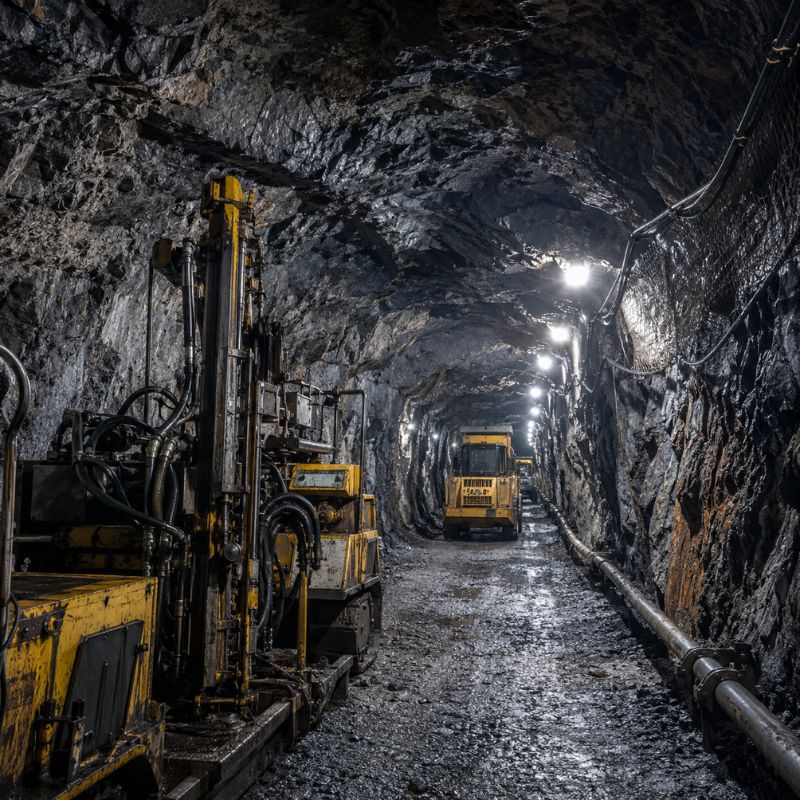
A mine is not one lighting project. It is three, and they share almost nothing except the client.
Surface operations are an area lighting problem at scale: haul roads, benches, stockpiles and workshops, lit from high masts and poles across distances that make a warehouse look intimate. The processing plant is an industrial interior problem complicated by combustible dust, washdown, vibration and corrosive process chemistry. Underground is a different regulatory world entirely, and the reason is a distinction most suppliers gloss over.
Getting the three confused is how mines end up with fixtures that fail in eighteen months, or with equipment that cannot legally be installed where it was delivered.
Key Takeaways
- Surface, plant and underground are three different specifications. Do not let one fixture family be quoted across all of them.
- Combustible dust is the mine hazard that gets ignored. Coal dust and many sulphide ore dusts form explosive atmospheres, and that is a Zone 20/21/22 question, not an IP rating question.
- Underground mines subject to firedamp require Group I equipment. Group II certification, which covers surface industry gas groups IIA/IIB/IIC, is a different equipment group.
- Impact and vibration are primary failure modes. Specify IK rating explicitly; it is absent from most industrial datasheets.
- Power quality on remote sites is poor. Wide input voltage and real surge protection matter more here than on a grid-connected building.
Surface Operations
The largest area, the fewest structures, and the longest distances between them.
| Area | Maintained illuminance |
|---|---|
| Haul roads | 10 – 20 lx |
| Loading and dumping points | 50 – 100 lx |
| Working benches and faces | 50 – 100 lx |
| Stockpiles and ROM pads | 20 – 50 lx |
| Workshops and maintenance bays | 300 – 500 lx |
| Fuel and lubrication bays | Per area classification |
| Site roads and circulation | 10 – 20 lx |
| Perimeter and security | 20 – 50 lx vertical |
Three things decide whether a surface scheme works.
Dust is a maintenance factor, not a footnote. Haul road dust coats fixtures continuously, and a scheme designed at 0.8 will be short within a year. Use 0.7 or lower, and be honest about how often anyone will actually clean a mast head. The high mast lighting guide covers the geometry; the cleaning interval is what decides the factor.
Glare toward haul truck operators is a safety matter. A loaded haul truck cab sits high, and mast-mounted fixtures aimed to fill a bench can end up level with the operator’s eyeline. Aim from the photometric model, limit tilt, and record the aiming angles so they survive maintenance.
Access dominates life-cycle cost. A failed mast head on a remote site is a crane, a permit and a shift. That inverts the specification priorities toward reliability and serviceability over marginal efficacy, the same logic covered in the high mast retrofit guide.
The Processing Plant
This is where mining lighting stops resembling any other outdoor project. Crushers, screens, conveyors, mills and flotation circuits combine several hostile conditions at once.
Combustible dust. This is the hazard most often missed. Coal dust is the obvious case, but many sulphide ore dusts, and dusts from some processing additives, can form explosive atmospheres. Where they can, the area is classified into dust zones 20, 21 or 22 by the site’s hazardous area assessment, and the fixture must be certified for that dust zone with an appropriate maximum surface temperature.
A dust-tight IP66 fixture is not the same thing as a fixture certified for a dust zone. IP66 describes ingress; dust-zone certification describes ignition risk, including surface temperature limits set against the dust’s ignition temperature. Conflating the two is a specification error with real consequences.
Coal handling deserves its own treatment, because the surface temperature limit turns out to have two halves and the equipment group is decided by firedamp rather than by coal: the coal handling and processing lighting guide walks a coal path area by area, from wagon tippler to loadout.
Vibration and impact. Crusher houses and screen decks vibrate hard and continuously. Conveyor galleries carry moving material that throws rock. Specify vibration resistance and an IK rating — IK08 or higher where impact is plausible — and check how the driver and internal connections are secured.
Water and slurry. Washdown is routine in processing plants, and flotation circuits are wet by design. IP66 is the practical floor, and sealed linear fixtures are the workhorse format. Our tri-proof range covers those; the tri-proof selection guide explains why the gasket and breather matter more than the IP digit.
Corrosive chemistry. Acid mine drainage, flotation reagents and sulphide-bearing dust all attack fixtures. Material selection here is a chemistry question: stainless fastener grade, housing coating, and gasket compound chosen against what is actually in the air and the wash water.
Typical maintained levels: 100–200 lx for general plant areas, 200–300 lx around crushers, screens and conveyor transfer points where inspection happens, and 300–500 lx at maintenance and control positions.
Underground: The Group I Distinction
This is the part worth reading carefully, because it is where specifications go wrong in a way that cannot be fixed on site.
Explosion-protection standards divide equipment into groups by the atmosphere it is built for:
| Equipment group | Intended atmosphere |
|---|---|
| Group I | Mines susceptible to firedamp (methane and coal dust) |
| Group II | Explosive gas atmospheres other than mines, subdivided IIA / IIB / IIC |
| Group III | Explosive dust atmospheres, subdivided IIIA / IIIB / IIIC |
Group I is not simply “Group II applied underground”. It carries its own requirements, including tighter surface temperature limits where coal dust may deposit, and construction requirements reflecting the mechanical realities of a mine.
The practical consequence: an underground coal mine subject to firedamp needs equipment certified for Group I. Certification covering gas groups IIA, IIB and IIC is Group II certification, which is what surface industry — refineries, chemical plants, fuel handling, processing facilities — requires.
Our SJFB explosion-proof series is certified to GB/T 3836-2021 for gas groups IIA, IIB and IIC, which covers surface mining infrastructure, processing plant classified areas, fuel and lubrication bays, and similar duties. Where a project involves underground workings subject to firedamp, tell us the mine type and the governing requirement at enquiry stage and we will confirm the certification route for that application rather than assuming one certificate covers every part of the site.
Two further underground realities worth stating:
Not all underground mining is gassy. Many hard-rock metalliferous mines are not subject to firedamp, and their classification depends on the site’s own hazardous area assessment. The assessment governs, not the general category “underground”.
Fixed lighting is only part of underground lighting. Cap lamps, machine-mounted lights and self-contained emergency units are separate product categories with their own approvals, usually sourced through mining equipment suppliers rather than through a fixed-luminaire manufacturer.
For how zones themselves are assigned and what changes between them, see Zone 1 vs Zone 2 lighting; for reading what a nameplate actually claims, the Ex marking decoder.
Power Quality on Remote Sites
Mines run long feeders from generation or a distant grid connection, often with large motor loads starting and stopping on the same network. That produces conditions a building never sees.
- Wide input voltage. Specify fixtures that hold output across a wide AC range rather than assuming a stable nominal voltage.
- Surge protection. Long exposed feeders plus lightning exposure plus inductive switching make transients the realistic end-of-life cause for an outdoor fixture. Specify the rating in writing and confirm whether the protection device is replaceable. See surge protection.
- Generator-supplied sites. Frequency and voltage can wander more than on grid supply. Say so at enquiry, because it changes driver selection.
- Power factor. Poor power factor across hundreds of fixtures loads a constrained supply unnecessarily.
Temperature, Altitude and Climate
Mines sit in deserts, in the tropics and at altitude, and each changes the specification.
High ambient temperature shortens driver life and reduces output. Confirm the ambient rating of the complete fixture, not of the driver as a component, and remember that a steel plant-room roof runs far hotter than the shaded air temperature.
Altitude reduces air density and therefore convective cooling, and it affects creepage and clearance requirements in electrical equipment. High-altitude mines in the Andes and elsewhere should state site elevation at enquiry.
Cold affects driver starting and gasket flexibility. A fixture that lights at −20 °C on a bench may not start reliably after a night at −35 °C.
The Specification Checklist
Before a mining lighting order is placed, the file should contain:
- Which of the three environments each position belongs to — surface, plant, or underground.
- The hazardous area classification document, covering both gas and dust zones, with equipment group, gas or dust group, and temperature class.
- Impact and vibration requirements, with IK rating stated.
- Ingress rating and washdown regime — IP66 floor in the plant.
- Chemistry present — acid drainage, reagents, sulphide dust — driving material and fastener selection.
- Site electrical conditions — voltage range, generator supply, surge exposure.
- Ambient temperature range and site elevation.
- Maintenance access plan per position, and the spares holding it implies.
- The photometric study with a maintenance factor of 0.7 or lower, justified by the actual cleaning interval.
The Bottom Line
Mining lighting punishes the single-specification approach. The haul road, the crusher house and the underground workings ask for different fixtures, different certification and different maintenance assumptions, and the only reliable way to get all three right is to treat them as three projects that happen to share a site.
The certification question deserves the most care, because it is the one that cannot be corrected after delivery. Get the area classification document first, read the equipment group as carefully as the zone, and require the supplier to answer against it.
Send us the site layout, the area classification and the electrical conditions, and our engineers return a per-area fixture schedule with the photometric study behind it. Where part of the site falls outside what a given certificate covers, we will say so during quoting. Our explosion-proof range is certified to GB/T 3836-2021 for gas groups IIA/IIB/IIC, our flood lights cover 50 W to 1200 W for mast and pole positions, and the mining industry page shows how the families map across a site.
FAQ
What lighting do open pit mines need? Area lighting at scale from few structures, which in practice means high masts and tall poles. Typical maintained levels are 10–20 lx on haul roads and site roads, 50–100 lx at loading and dumping points and on working benches, 20–50 lx on stockpiles, and 300–500 lx in workshops. Use a maintenance factor of 0.7 or lower, because haul road dust coats fixtures far faster than a clean-environment assumption allows.
Do mining lights need to be explosion proof? Only where the site’s hazardous area assessment says so. Fuel and lubrication bays, some processing areas and underground workings subject to firedamp are typically classified; haul roads, stockpiles and most surface infrastructure are not. Specifying certified fixtures across an entire mine multiplies cost without adding safety, while missing a classified area is a compliance failure.
What is the difference between Group I and Group II equipment? Group I is for mines susceptible to firedamp, meaning methane and coal dust, and carries its own requirements including tighter surface temperature limits where coal dust may deposit. Group II covers explosive gas atmospheres other than mines and is subdivided into IIA, IIB and IIC. They are separate equipment groups, so certification for IIA/IIB/IIC does not by itself address an underground gassy mine.
Is coal dust an explosion risk for lighting? Yes, and it is the hazard most often overlooked. Combustible dusts, including coal dust and many sulphide ore dusts, can form explosive atmospheres, and areas where they may be present are classified into dust zones 20, 21 or 22. Fixtures for those areas need certification for the dust zone with a maximum surface temperature set against the dust’s ignition temperature. A dust-tight IP66 rating alone does not address ignition risk.
What IP and IK ratings should mining fixtures have? IP66 as the practical floor anywhere washdown, slurry or heavy dust is present, which covers most processing plant areas. For impact, specify IK08 or higher wherever rock, moving material or vehicle contact is plausible, particularly in conveyor galleries and crusher houses. IK rating is absent from most industrial datasheets, so it has to be asked for explicitly.
How does altitude affect mining lighting? Thinner air at altitude reduces convective cooling, so a fixture that runs comfortably at sea level runs hotter on a high Andean site, which shortens driver life. Altitude also affects creepage and clearance requirements in electrical equipment. State the site elevation at enquiry stage so the fixture and its thermal rating can be selected against the actual condition.
Why does power quality matter more at a mine? Because mines run long feeders, frequently from generation or a distant grid connection, with large motor loads switching on the same network. That produces voltage variation and transients a building never experiences. Specify a wide input voltage range, a stated surge protection rating with a replaceable device where possible, and mention generator supply at enquiry, since it changes driver selection.