1000W LED Flood Light
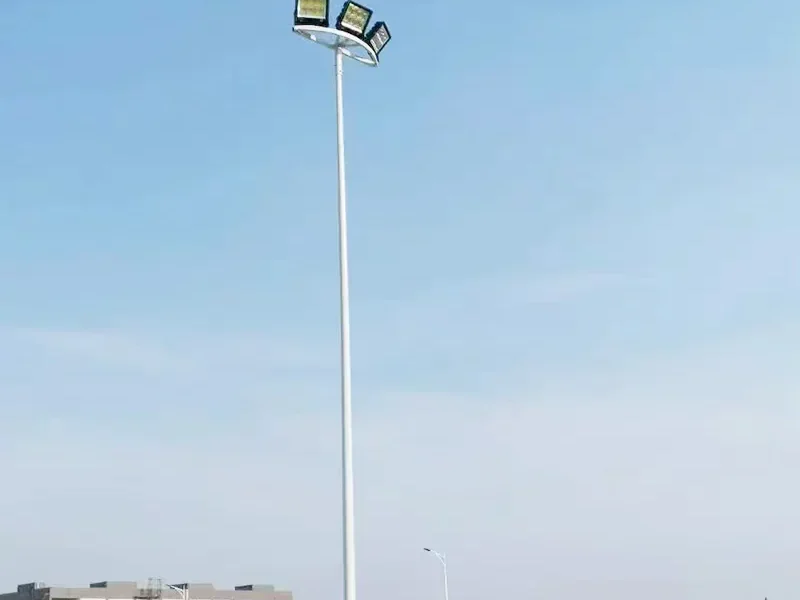
A 1000W LED flood light is a real engineering class and also one of the most abused labels in outdoor lighting. Search the term and most of what comes back is a 100W to 200W fixture sold on a claimed equivalence to an old metal halide lamp. A genuine unit at this power belongs on a 25–45 m mast over a port apron, a stadium, a stockyard or an open-pit bench, and it is specified from a photometric model rather than from a wattage list.
In our range this power class lives on SJTG610, the flagship platform, which is built in defined steps of 50, 100, 200, 300, 480, 800 and 1200W. A 1000W build sits between the two top steps and is reached by module count rather than being a separate catalogue rating. We would rather state that plainly here than print a number and leave it to be discovered later. What the platform brings is a matrix glass lens at up to 95% transmittance that resists yellowing and high temperature, an integrated grille structure for heat dissipation and mechanical strength, and a set of patented optical lenses so the distribution can be matched to the throw distance the site actually needs.
Every Measured Unit, Published
All units tested on a calibrated HPG1800 goniophotometer. We publish the strong results and the modest ones — the economy build reads lower than the flagship, and both numbers are real.
Where the 800 – 1200W Class Fits
Selection guidance for the top of the flood range — confirmed with a free DIALux study for your site.
25–45 m: high-mast crowns over ports, interchanges, stockyards and open-pit benches, and stadium poles at competition class. Below 20 m this class almost always over-lights and creates glare that no aiming can fix.
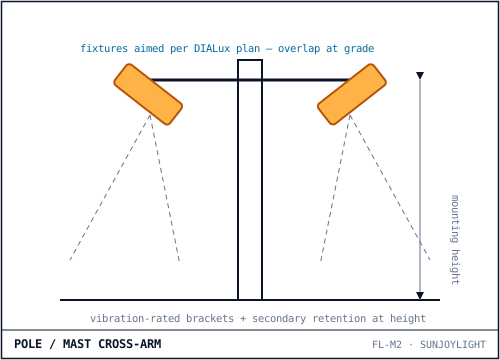
Spot and asymmetric optics for throw beyond 80 m; narrow beams to reach the coverage edge from the crown. A mast ring normally mixes distributions and each head gets its own aiming angle from the model.
Container terminals and port aprons, rail and logistics yards, stadium and large competition venues, open-pit mining benches, quarries, heavy plant areas.
Frequently. Below about 35 m, or wherever the layout has enough positions to work with, 800W with the correct optic reaches the same design level on lower connected load. Step to 1200W where mast positions are genuinely scarce and the throw is long.
SJTG610 — The Platform Behind a 1000W Build
| Series | Standard Power Steps | Design Highlights | |
|---|---|---|---|
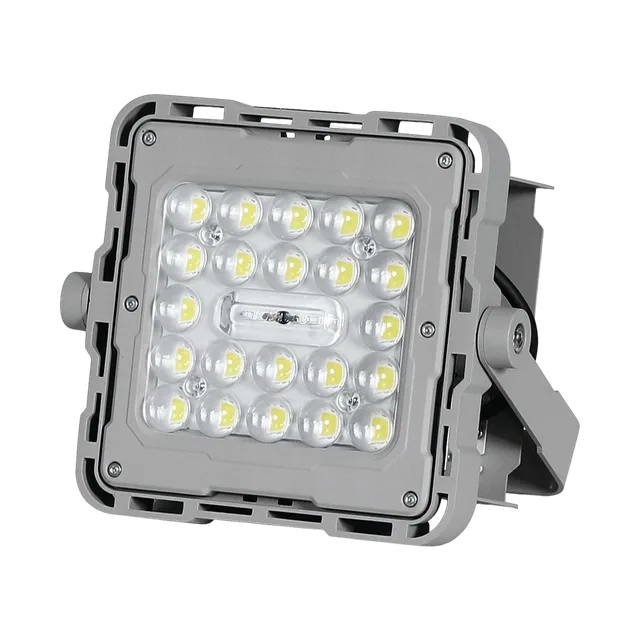 | SJTG610 | 50 / 100 / 200 / 300 / 480 / 800 / 1200W | Matrix glass lens up to 95% transmittance · integrated grille structure for heat dissipation · patented optical lenses |
Standard power steps from the factory catalog. 1000W is reached by module count between the 800W and 1200W steps and is quoted as a custom build. Full datasheet and IES/LDT files supplied with the quotation.
Where This Class Works
Three duties this wattage is specified for most often — and what changes in the specification for each.
High-mast rings over ports, yards and interchanges
Above roughly 30 m, fixture count per mast starts working against you: every extra head adds sail area at the crown and another aiming line to maintain. The 800–1200W class exists so a mast can be lit with fewer, better-aimed units — which is a structural and maintenance argument as much as a photometric one.
- 25–45 m mast crowns
- Fewer heads, lower crown sail area
- Aiming schedule supplied with the layout
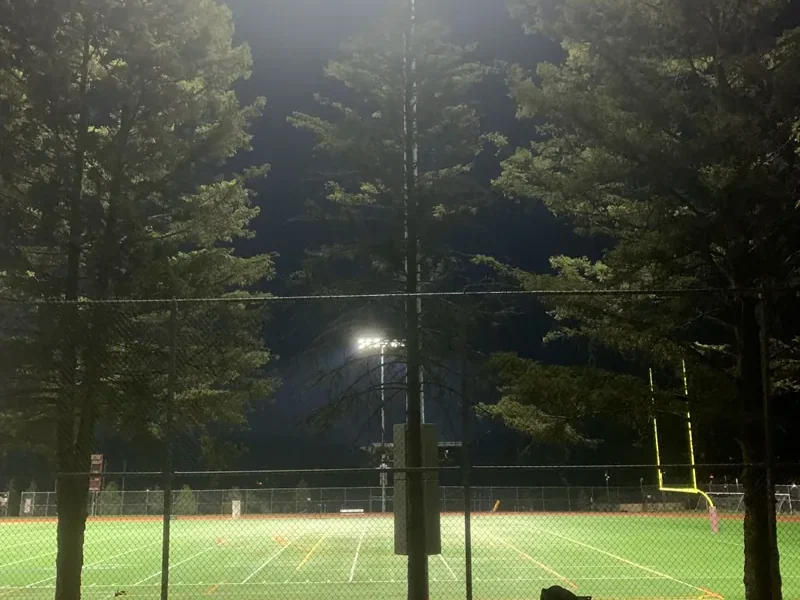
Stadiums and large competition venues
At competition class over a full pitch, the design has to deliver both horizontal level and uniformity from a small number of legal pole positions. That combination is what pushes a scheme into this power class — not a desire for a bigger number on the datasheet.
- Sized from the EN 12193 photometric study
- Narrow and asymmetric optics per position
- Flicker data available for broadcast duty

Open-pit mining, quarries and very large industrial areas
Surface mining benches, stockyards and heavy plant areas are lit from a handful of tall positions because the ground is worked and re-worked. Throw distance, not spread, is the governing requirement, and the fixture is chosen for how far it can put light rather than how much it emits.
- 80 m + throw with spot and asymmetric optics
- Vibration-rated mounting hardware
- Surge protection specified per project
How It Goes Up
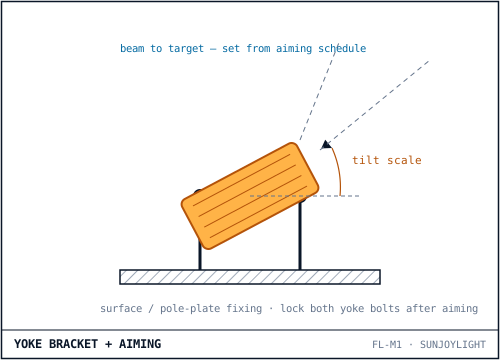
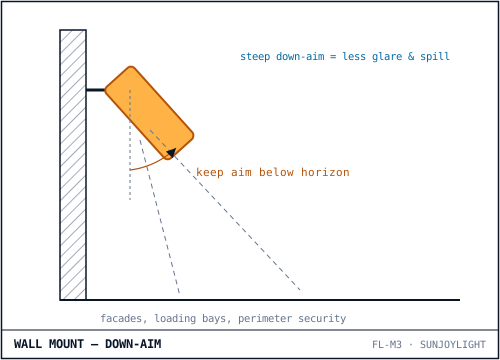
The mounting methods this fixture class is supplied for. Installation photographs from delivered projects are being catalogued and will be added alongside.
Every Order Ships With the Paperwork
The documents an engineer needs to verify the design and an importer needs to clear customs — supplied as standard, not on request.
IES / LDT files for the exact housing and optic quoted, so your designer models the fixture you are buying.
A free DIALux study from your dimensions — lux, uniformity and fixture count verified before you commit.
CE / FCC / CCC documentation with the type-test reports behind it, plus the Ex certificate where applicable.
Driver spares quoted with the order and an engineer contact who answers after the invoice is paid.
Straight Answers to the Questions Buyers Ask in Forums
What buyers report in sourcing forums and marketplace reviews — and how to check any supplier, including us.
The marketplace listings that dominate this search are typically 100W to 200W fixtures labelled by a claimed equivalence rather than by their actual input power. The arithmetic exposes it quickly: at the 120–160 lm/W band a real 1000W fixture is a two-person lift with a mast bracket, not something that ships in a padded envelope. Ask for input power in watts, weight, and the IES file — all three, and a genuine unit answers all three without hesitation.
The SJTG610 platform is built in defined steps: 50, 100, 200, 300, 480, 800 and 1200W. A 1000W build is reached by module count between the two top steps rather than being a separate catalogue item. We say so rather than printing 1000W on a page and leaving you to discover it at the drawing stage — and in most layouts the honest question is whether 800W with better optics beats 1000W with average ones.
A 1000W fixture with the wrong distribution puts light on ground nobody uses and glare in the eyes of everyone who does. From a 35 m crown the difference between a spot and a medium beam is the difference between reaching the far bench and lighting the base of the mast. Specify from the photometric model, and treat the wattage as an output of that model rather than an input to it.
Every head adds projected area at the highest point of the structure. Get the fixture weight and projected area into the structural check before the order, not after the mast is standing. This is a genuine argument for the higher power classes: fewer, larger heads frequently present less sail area than the many smaller ones they replace.
1000W LED Flood Light — Answered
How many lumens is a 1000W LED flood light?
Our range runs 120–160 lm/W at fixture level, which brackets a build at this power, but we do not publish a precise figure for a rating we have not measured. We hold and publish full goniophotometer reports for our smaller units — the tested 200W unit measured 35,309 lm at 175.4 lm/W — and the IES file for your exact configuration ships with the quotation. Any supplier who can produce an exact lumen number for every rating in a catalogue has usually calculated it rather than measured it, and at this power the gap between the two is large.
Do you make a 1000W LED flood light?
We build to it, and we would rather be precise about how. The SJTG610 platform runs in defined steps of 50, 100, 200, 300, 480, 800 and 1200W. A 1000W unit is a module-count build between the two top steps rather than a separate catalogue rating, and it is quoted as a custom configuration. Tell us the mast height, the area and the target level and the layout will say whether 800W, a 1000W build or 1200W is the right answer for the positions you actually have.
What does a 1000W LED flood light replace?
In practice this class replaces 2000W metal halide floods and, in older high-mast rings, banks of 1000W to 1500W HID units, at a fraction of the connected load and with no restrike delay. The equivalence table is only a starting point: verify the swap with the IES file at your actual mast height and aiming angles, because at 30 m and above the distribution decides whether the light lands where the old ring put it.
Is a 1000W flood light too bright for my site?
Below about 20 m mounting, almost certainly. This class is designed to throw light a long way from a high position; used low it over-lights the ground near the pole and produces glare that aiming cannot correct. If your masts are 10 to 20 m, the 200W to 480W classes will normally give a better result with better uniformity. We will say so rather than quote the larger fixture.
Do you provide photometric files before order?
Yes. IES/LDT files for the selected housing and optic are supplied with the quotation, and our engineers prepare a free DIALux layout from your site plan so the design is verified before any commitment. At this power that step is not optional in practice — the cost of the masts and the structural work far exceeds the fixtures, and it is decided by the photometric model.
Send Us the Space, Not Just the Wattage
Share the dimensions, mounting height and the level you need to hold. Our engineers return a lighting layout with fixture count, aiming and the photometric files behind it — before you commit to anything.
Floor plan or site dimensions, mounting height, target lux or the standard you must meet.
A DIALux study with fixture count, layout, aiming and IES files — at no cost.
Your engineer checks the numbers against the standard. Only then does a quotation matter.
Manufacturing in Changzhou since 1999 · Shipping to 50+ countries · CE / FCC / CCC
Tell us about your project.
Get a quote within 24 hours.
Share your application — environment, requirements, quantity. A real engineer responds with a tailored quote, IES files, and timeline within one business day.