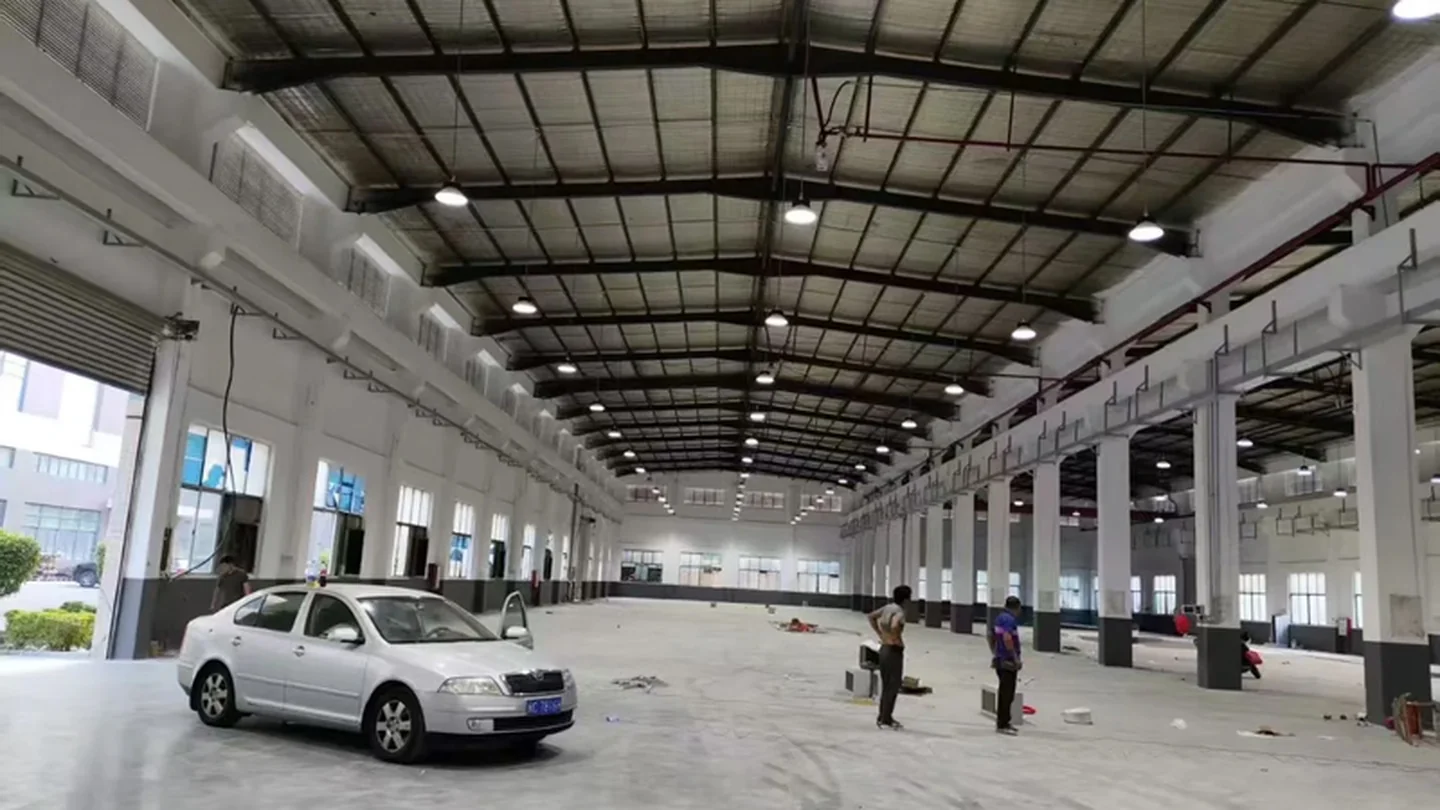
An LED high bay retrofit typically replaces a 400 W metal halide fixture with 150–200 W of LED, a 250 W HID with 100–120 W, and a 1000 W unit with 300–400 W — cutting lighting energy by half or more while improving color, uniformity, and restrike behavior. This guide explains where those equivalents come from, the light-quality gains most budgets ignore, and the audit-to-commissioning checklist that keeps a retrofit honest.
Key Takeaways
- Realistic LED equivalents: 250 W MH → 100–120 W LED; 400 W MH → 150–200 W; 1000 W MH → 300–400 W. Always count HID ballast watts (a “400 W” MH system draws ~455 W).
- Lumen-for-lumen swaps overshoot because LED is directional and holds its output; HID wastes 30–40% in the reflector and depreciates fast.
- The quality upgrade is as valuable as the energy cut: CRI ≥ 80 vs HPS’s ~25, instant restrike, and flicker-free drivers for camera areas.
- Decide one-for-one replacement vs photometric redesign before ordering; redesigns often cut the fixture count as well as the wattage.
- Specify dimming drivers (0–10V or DALI) on day one, even if sensors come later.
Realistic Wattage Equivalents
The most-asked retrofit question has a table for an answer:
| Legacy HID fixture | System watts (with ballast) | LED replacement | Typical LED output |
|---|---|---|---|
| 250 W metal halide | ≈ 280 W | 100 – 120 W | 15,000 – 19,000 lm |
| 400 W metal halide | ≈ 455 W | 150 – 200 W | 24,000 – 32,000 lm |
| 400 W HPS | ≈ 460 W | 150 – 180 W | 24,000 – 29,000 lm |
| 1000 W MH / HPS | ≈ 1,080 W | 300 – 400 W | 48,000 – 64,000 lm |
Two physical reasons the LED wattage lands far below a naive lumen-for-lumen calculation:
- Directionality. An HID arc tube radiates in every direction; the reflector loses 30–40% of that output before it ever leaves the fixture. An LED high bay emits downward through engineered lenses, so more of each lumen reaches the working plane. Delivered illuminance, not emitted flux, is what your floor experiences.
- Lumen maintenance. MH lamps depreciate 30–50% by mid-life, which means facilities were designed around, and dimmed by, tired lamps. LED fixtures with L70 ratings of 50,000+ hours hold their design level, verified through LM-80/TM-21 data rather than optimism.
Always compare system watts to system watts. HID ballast losses add 10–15% to the lamp’s nameplate; LED driver losses are already inside the fixture’s rated wattage. Skipping this step understates savings by exactly the ballast margin.
The energy math, in one worked line
A bay of 60 × 400 W MH fixtures (455 W system) burning 4,000 h/year consumes 109,200 kWh. Replaced one-for-one with 180 W LED: 43,200 kWh. The difference — roughly 66,000 kWh per year — comes with better light, and it scales linearly with operating hours. Facilities running two or three shifts see proportionally faster returns; we deliberately leave currency out of it, since tariffs vary, but the kWh arithmetic is portable everywhere.
The Light-Quality Upgrade Nobody Budgets For
Energy gets the retrofit approved; quality is what the workforce notices on day one.
- Color rendering. HPS sits near CRI 20–25: cable colors, safety markings, and product labels blur into orange monochrome. MH manages ~65. Industrial LED delivers CRI ≥ 80, which is the difference between reading a label and guessing at it.
- Color temperature choice. 4000 K neutral suits most industrial interiors; 5000 K raises contrast and alertness in QC and picking zones. Pick per area using our CCT glossary guidance — the option costs nothing at order time.
- Instant restrike. After a voltage dip, MH lamps go dark for 5–15 minutes while they cool and restrike. LED returns instantly. Around moving machinery and forklift traffic, that is a genuine safety property, not a convenience.
- Flicker. Magnetic-ballast HID flickers at twice mains frequency; on camera feeds and around rotating machinery this produces artifacts and stroboscopic risk. Specify low-ripple LED drivers for monitored and machining areas.
- Uniformity. Distributed SMD arrays behind engineered optics produce flatter light than point-source HID, closing the bright-pool/dark-band pattern old installations show between poles.
One-for-One Replacement or Photometric Redesign?
One-for-one replacement reuses existing mounting points and circuits. It is the fastest path and usually correct when the original layout met its targets and the space’s use has not changed. Choose LED optics that mimic the old distribution, and verify the new fixture’s weight sits within the old suspension rating (LED is almost always lighter).
A photometric redesign pays for itself when any of these are true:
- The area changed use since the original design: new racking, new tasks, new warehouse workflows.
- The old system under- or over-lit the space (measure before deciding — see the checklist below).
- Mounting heights vary widely across the building.
- You are consolidating fixture types across a manufacturing plant to simplify spares.
Redesigns frequently cut fixture count, not just wattage, because modern optics place light deliberately. The method — spacing-to-height ratios, the lumen method, aisle optics — is exactly the one in our high bay light spacing guide, applied with the candidate fixture’s IES file. Our LED high bay range publishes those files for every model at 100–1,200 W, in UFO and linear formats. For the two most-requested retrofit wattages, see the 200W UFO high bay (replacing 400W metal halide, 8–12 m ceilings) and the 400W LED high bay (replacing 1000W HID, 12 m+ halls).
Controls Multiply the Savings
HID could never dim gracefully or switch instantly; LED does both, which unlocks two strategies worth specifying into every retrofit:
- Occupancy zoning. Low-traffic aisles idle at 10–20% output on 0–10V or DALI dimming until sensors detect motion, then rise instantly. In warehouses with intermittent aisle traffic this often halves the already-halved consumption.
- Daylight harvesting. Fixtures near skylights and dock doors trim output against available daylight automatically.
The critical decision is timing: order dimmable drivers on day one even if sensors arrive in a later budget cycle. Swapping drivers later costs more than the dimming option ever did.
The 6-Step Retrofit Checklist
- Audit the existing system. Fixture type, lamp and system wattage, mounting height, circuit layout, and condition. Photograph representative bays.
- Measure the baseline. Lux readings on a grid at the working plane, day and night. You cannot prove improvement without a before.
- Set maintained targets per area — general storage, picking, packing each get their own number (tables in the spacing guide).
- Select equivalents by calculation, not marketing. “400 W equivalent” on a datasheet is a claim; an IES-file calculation at your mounting height is evidence. Check luminous efficacy at the fixture level and verify LM-79 backing.
- Verify electrical compatibility. Wide-input AC100–277 V drivers cover most sites; check surge protection needs on exposed feeders and confirm circuit loading changes with your electrician — LED loads are far lower, which sometimes permits circuit consolidation.
- Pilot one zone, measure, then roll out. A single bay retrofitted and measured against step 2 settles every argument before the full order ships. Send us your audit data and we return the fixture selection and DIALux verification for the pilot at no cost.
Don’t Forget Disposal
An HID retrofit generates hundreds of lamps and ballasts on its way out. Metal halide and HPS lamps contain mercury and belong in certified lamp-recycling streams, not general waste; magnetic ballasts from older installations may contain capacitors requiring controlled disposal, and everything electrical falls under WEEE-type obligations in most jurisdictions. Budget the disposal line item during the audit, collect the recycling certificates, and the retrofit’s environmental story is complete end-to-end rather than stopping at the kWh meter.
Frequently Asked Questions
What is the LED equivalent of a 400 W metal halide high bay? 150–200 W of quality LED, delivering 24,000–32,000 lm directionally. Confirm with a photometric calculation at your mounting height rather than trusting “equivalent” labels.
Can I reuse the existing wiring and mounting points? Usually yes for one-for-one swaps: LED high bays are lighter than HID gear-in-head fixtures and draw far less current. Have an electrician confirm circuit changes; the lower load sometimes allows consolidating circuits.
Is 5000 K brighter than 4000 K? Not in lumens. Cooler light appears more intense and can aid alertness, but measured lux is what your specification controls. Choose CCT by task area, not by the “brighter” impression.
How long do LED high bays actually last? Quality fixtures rate L70 ≥ 50,000 hours — about 11 years at 12 h/day — backed by LM-80 chip data extrapolated through TM-21 at realistic operating temperatures. Thermal design, not chip brand, is what makes the claim honest.
Should I retrofit lamps only (LED “corn cobs”) or whole fixtures? Whole fixtures. Retrofit lamps inside old reflectors inherit the old optical losses, often void the fixture’s certification, and run hot in enclosures never designed for them. The fixture-level retrofit is what delivers the numbers in this guide.
The Bottom Line
An LED high bay retrofit stands on three verified numbers: the true system watts of the legacy installation, the delivered lumens of the replacement at your mounting height, and the measured baseline lux you intend to match or improve. Get those three right — with the wattage-equivalents table as your starting point and an IES-based calculation as your proof — and the retrofit halves lighting energy while upgrading everything the workforce actually sees. Pilot one zone first, and let the measurements make the rollout decision for you.