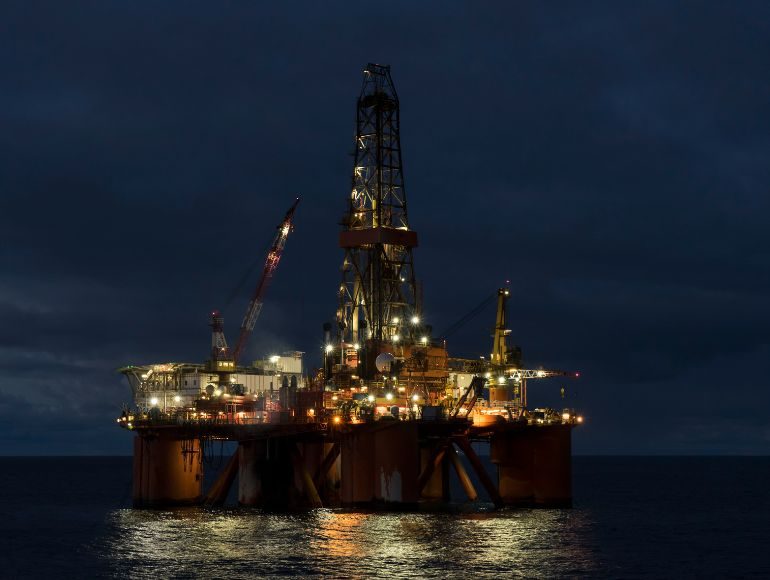
Almost nothing at sea fails because the LEDs wore out. Marine and offshore fixtures fail because a fastener rusted through, a gasket hardened and let salt water into the driver cavity, a bracket cracked from vibration, or the coating lifted at an edge and corrosion crept underneath.
That is the mental model worth carrying into any marine lighting specification: you are not buying light output, you are buying resistance to an environment that attacks metal, polymer and seals simultaneously, all day, for years.
This guide covers what the environment actually does, the specification that survives it, the lux targets by area, and the certification question that decides whether a fixture can legally go where you intend to put it.
Key Takeaways
- Salt aerosol travels on wind, not just spray. “Not in the splash zone” is not protection.
- 304 stainless pits in marine atmospheres. Specify 316 for every fastener, not just the visible ones.
- Vibration and shock are design inputs on vessels, cranes and platforms, not afterthoughts.
- IP66 is the floor, not IP65 — wind-driven salt spray behaves more like a jet than like rain.
- Class-society type approval is a separate question from IP rating and from explosion protection. Ask about it explicitly, and ask early.
What the Environment Actually Does
Four attack mechanisms run at once, and a fixture has to survive all of them.
Salt aerosol. Airborne chloride reaches far beyond the splash zone, carried by wind across decks, yards and quaysides. It settles on every surface, absorbs moisture from the air, and creates a persistent electrolyte film. That film is what drives corrosion on parts that never see a wave.
Galvanic coupling. Put a steel bracket against an aluminium housing in that electrolyte and you have built a battery. The less noble metal corrodes preferentially, often invisibly at the interface, until the joint fails. Isolate dissimilar metals or match them.
Vibration and shock. Engine rooms, deck machinery, crane structures and helideck surrounds all vibrate continuously. Vibration loosens fasteners, fatigues brackets, cracks solder joints and works gaskets out of their seats. On a building this is irrelevant; at sea it is a primary failure mode.
Thermal and humidity cycling. A sealed fixture heats when lit and cools when off, breathing humid, salt-laden air in and out through the gasket. The moisture condenses inside and cannot evaporate away. This is why fixtures that never leaked can still be found full of water — the mechanism is explained in the tri-proof selection guide.
The Specification That Survives It
Fasteners and small metal parts
This is where most marine fixtures die, and it is the cheapest thing to get right.
Specify 316 stainless, explicitly, for every fastener. Ordinary 304 stainless discolours and then pits in chloride environments. It looks like stainless on the invoice and behaves like a consumable on the deck. Note that “stainless steel” on a datasheet without a grade tells you nothing.
Check the parts nobody lists: hinge pins, clip springs, cable gland bodies, bracket bolts, earthing screws. A 316 housing bolt beside a 304 clip spring still fails at the clip.
Housing and coating
Marine-grade aluminium alloy with a proper coating system, or a non-metallic body where the application allows it. Two details matter more than the alloy name:
- Coating at edges and holes. Corrosion starts where the coating is thinnest, which is at machined edges, threads and drilled entries. Ask how those are treated.
- Coating damage in transit and installation. A scratched housing in a marine atmosphere is a corrosion initiation site. Specify touch-up procedure in the O&M documentation.
Ask for salt spray test evidence with a stated duration. A number of hours is a comparable figure; “salt-spray tested” without one is not.
Sealing
IP66 as the floor. IP65 is tested with a low-pressure 6.3 mm jet, while wind-driven salt spray and deck washdown deliver considerably more. Where hot high-pressure cleaning is used, IP69K becomes the relevant test.
Silicone gaskets across the full temperature range, cable glands rated for the actual cable diameter, and every unused entry closed with a certified blanking element. An open spare entry is a hole in the rating.
Vibration
Ask two questions that ordinary industrial datasheets do not answer:
- What vibration level has the fixture been tested to, and in which axes?
- How is the driver mounted inside the housing, and are the internal connections mechanically secured rather than relying on friction?
For crane-mounted and engine-room positions, specify anti-vibration mounts and locking fasteners as part of the assembly, not as a site improvisation.
Lux Targets by Area
Maintained values, aligned with general marine and offshore practice. Vessel class rules, flag-state requirements and the operator’s own standards can raise these, so confirm against the governing document for your project.
| Area | Maintained illuminance |
|---|---|
| Open deck, general circulation | 50 – 100 lx |
| Working deck, lashing, cargo handling | 100 – 200 lx |
| Crane and winch operating areas | 150 – 250 lx |
| Engine room, general | 150 – 200 lx |
| Engine room, control and gauge panels | 300 – 500 lx |
| Workshop and maintenance spaces | 300 – 500 lx |
| Process areas on platforms | 150 – 300 lx |
| Helideck surrounds | Per aviation requirement |
| Escape routes and muster stations | Per emergency lighting requirement |
| Accommodation corridors | 100 lx |
Two area-specific notes. Glare control matters more at sea than on land, because officers on watch depend on dark adaptation; deck lighting that spills toward the bridge or the water degrades navigation, a constraint covered in the port and terminal lighting guide. And escape route and muster station lighting is a regulated requirement, not a design preference — specify the emergency variant at order stage, because retrofitting a battery pack into a sealed marine fixture destroys its ingress rating.
Classified Areas Offshore
Offshore production facilities, tankers, bunkering berths and fuel handling areas contain zones where a flammable atmosphere may be present. In those zones the fixture must be certified for the zone, gas group and temperature class — this is determined by the site’s or vessel’s area classification document, not by preference.
Two errors are common enough to name:
A marine-grade IP66 floodlight is not an explosion-protected fixture. Sealing against salt water and preventing ignition of a flammable atmosphere are different engineering problems with different constructions. An IP rating makes no statement about ignition risk.
Corrosion resistance and explosion protection are both required in these areas, and they are separate specifications. A certified Ex fixture with 304 fasteners will still fail on an offshore platform; a beautifully corrosion-proofed fixture that is not certified cannot legally be installed there at all.
Our explosion-proof range is certified to GB/T 3836-2021 for the relevant zone and gas group, with 304 or 316 stainless external fittings depending on the specified exposure. Zone 1 vs Zone 2 lighting covers what actually changes between the zones, and the Ex marking decoder explains how to verify what a nameplate claims.
The Certification Question, Asked Properly
This is where marine projects most often go wrong at the procurement stage, so it is worth being precise about what is being asked.
Marine and offshore projects can involve several independent requirements:
- Electrical safety and EMC marks for the destination market.
- Ingress and corrosion evidence — IP rating and salt-spray data.
- Explosion protection certification where any part of the installation is classified.
- Marine type approval from a classification society, where the vessel’s or facility’s class rules require equipment on board to be type approved.
That last one is a distinct scheme with its own testing regime, and it is the item most often assumed rather than specified. If your project is governed by class-society rules, the requirement will name the society and the applicable rule set.
The practical instruction: tell us the destination market, the governing class or flag requirement, and the area classification at enquiry stage. We will confirm the certification route for that model and coordinate accredited testing as part of the project scope, rather than discovering the requirement after the fixtures ship. Where a requirement cannot be met on a given model, we would rather say so during quoting than at inspection.
Where Marine Fixtures Actually Get Installed
Vessel decks and superstructure. Floodlights for cargo work and mooring, plus general circulation lighting. Vibration, salt and washdown all present.
Engine rooms and machinery spaces. High ambient temperature, vibration, oil mist. Sealed linear and compact fixtures dominate, with higher levels at control panels. Our tri-proof range covers the sealed linear formats used here.
Offshore platforms. The full combination: salt, wind, vibration, classified areas and access that requires planning. Fixture reliability outranks efficacy because reaching a failed unit is expensive.
Quaysides, shipyards and dry docks. High-mast and pole-mounted floods over large areas, with the same corrosion exposure as the vessels they serve. The high mast lighting guide covers that geometry.
Fish farms, jetties and coastal infrastructure. Often overlooked in specification because they are small, and often the harshest exposure of all — permanently over salt water, rarely serviced.
The Specification Checklist
Before a marine or offshore lighting order is placed, the file should contain:
- The exposure described concretely — deck, splash zone, engine room, enclosed space, distance from open water.
- Fastener and small-parts grade, stated as 316 where salt is present.
- Housing alloy and coating system, including edge and thread treatment.
- Salt-spray evidence with a stated duration.
- IP rating — IP66 floor, IP69K where hot high-pressure cleaning applies.
- Vibration requirement and how the driver and internal connections are secured.
- Area classification document for any zone that may contain a flammable atmosphere.
- The governing certification requirement — destination market, class or flag rules, and whether marine type approval is required.
- Emergency lighting scope, specified at order stage.
- Access and maintenance plan — how a failed fixture will be reached, and the spares holding that implies.
The Bottom Line
Marine lighting rewards the specifier who treats corrosion, vibration and certification as three separate requirements and writes all three down. Almost any competent fixture will hit the lux target on commissioning day. What separates a ten-year installation from a two-year one is a 316 fastener instead of a 304, a gasket that still recovers in year five, a bracket that survives the vibration, and a certificate that matches what the class rules actually asked for.
Send us the exposure, the area classification and the governing certification requirement, and our engineers return a fixture specification with the corrosion and sealing rationale written down, plus the photometric layout behind the count. Where a requirement needs a route we have to arrange, we will tell you that during quoting. See the marine and offshore overview for the fixture families deployed across deck, machinery and classified areas.
FAQ
What makes a light fixture “marine grade”? There is no single legal definition, which is why the term is worth distrusting on its own. In practice it should mean: 316 stainless fasteners and small parts, a marine-grade aluminium alloy or non-metallic body with a coating system treated at edges and threads, silicone gaskets, IP66 or better sealing, and salt-spray evidence with a stated duration. Ask for those five items individually rather than accepting the label.
Is IP65 enough for marine and offshore use? Usually not. IP65 is tested with a low-pressure 6.3 mm water jet, while wind-driven salt spray and deck washdown deliver considerably more energy. IP66 should be the floor, and IP69K applies where hot high-pressure cleaning is used. Bear in mind that an IP rating covers ingress only and says nothing about corrosion resistance, which is a separate material specification.
Why does 316 stainless matter instead of 304? Because chloride is the specific thing 304 does not handle well. In a marine atmosphere 304 discolours and then pits, and pitting corrosion progresses invisibly until the part fails. 316 contains molybdenum, which substantially improves chloride resistance. Specify 316 for every fastener and small metal part, including hinge pins, clips, gland bodies and earthing screws, not just the visible bolts.
Do offshore platforms need explosion-proof lighting everywhere? No, and assuming so is expensive. Only the areas identified as classified in the facility’s area classification document require certified fixtures, and the zone, gas group and temperature class come from that document. Unclassified areas need marine-grade corrosion resistance but not explosion protection. Over-specifying across an entire platform multiplies cost without adding safety.
What is marine type approval, and do I need it? It is a certification scheme run by classification societies under which equipment intended for installation on a classed vessel or facility is type tested against that society’s rules. Whether you need it depends on the governing class or flag requirement for your project, which will name the society and rule set. It is separate from IP rating, from electrical safety marks and from explosion protection, so ask about it explicitly and early rather than assuming it is covered.
How do I stop condensation forming inside sealed marine fixtures? By letting the fixture breathe rather than sealing it harder. A sealed body draws humid, salt-laden air in as it cools after being switched off, and that moisture condenses inside and cannot evaporate out. A hydrophobic breather membrane equalises pressure while blocking liquid water. Ask whether the fixture has one and where it sits.
What lux level is required on a working deck? Around 100 to 200 lx maintained for lashing and cargo handling, 150 to 250 lx in crane and winch operating areas, and 50 to 100 lx for general deck circulation. Engine rooms run 150 to 200 lx generally with 300 to 500 lx at control and gauge panels. Confirm against the vessel’s class rules, flag-state requirements and the operator’s own standard, any of which can set higher figures.