100W UFO High Bay Light
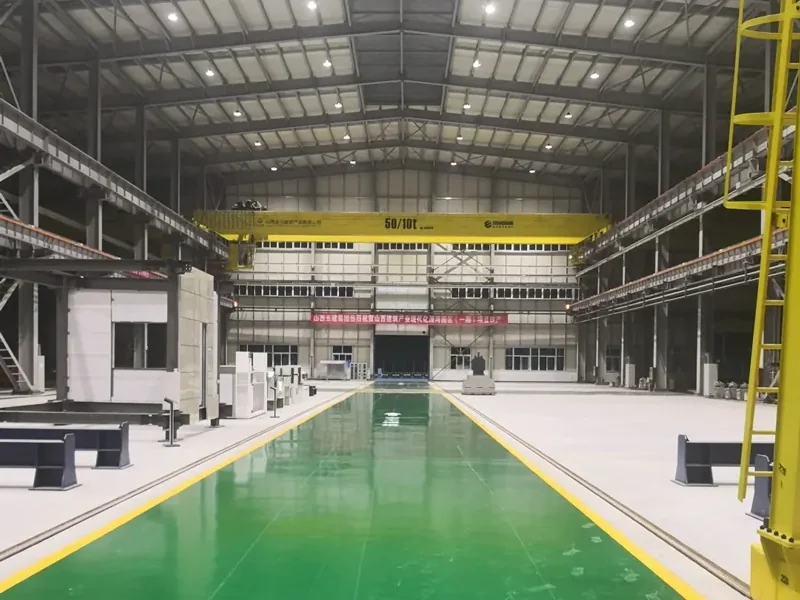
The 100W high bay is the entry point of serious industrial lighting — the class that covers workshops, stockrooms, packing halls and lower warehouse bays at 4–7 m mounting. At this height the fixture choice is less about raw output and more about distribution and build: a wide beam that fills the bay without cave-effect shadows, and a thermal design that survives years under a workshop roof.
Six SJGK housings carry a 100W variant, from the ultra-slim SJGK912 (93 mm tall, with a pressure-equalising respirator valve) to the classic fins-cooled SJGK901. All are IP65-sealed against dust, with hook, bracket and pendant mounting options.
Where 100W Fits
Guidance from the standard height-wattage ladder — confirmed by a free DIALux study of your floor plan.
4–7 m is the 100W sweet spot. Below 4 m, tri-proof battens usually light better; above 7 m, step to 150–200W.
Roughly 1 × mounting height between fixtures holds uniformity in general work areas — an 8 × 12 m workshop at 5 m typically takes 6 units.
Workshops, packing and assembly halls, stockrooms, garages, loading areas, retail back-of-house.
0-10V/DALI dimming for zoned control; CRI ≥ 80 for assembly and inspection work; beam options for open areas versus racking aisles.
SJGK Housings Available at 100W
| Series | Design Highlight | Dimensions (⌀ × H) | |
|---|---|---|---|
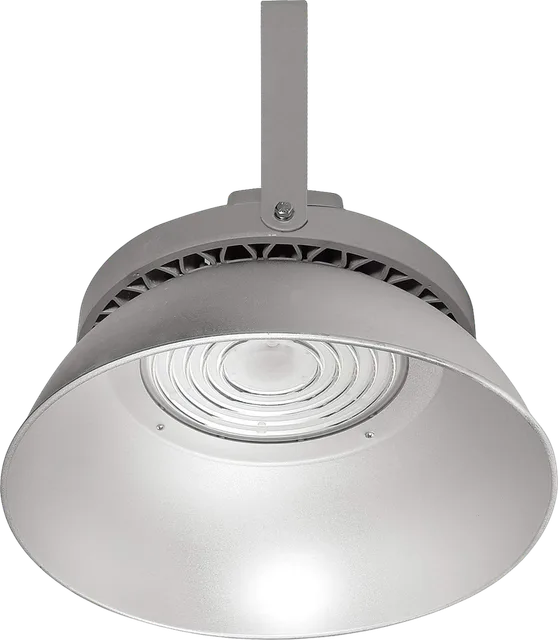 | SJGK901 | Die-cast classic, fins-cooled | φ480 × 300 |
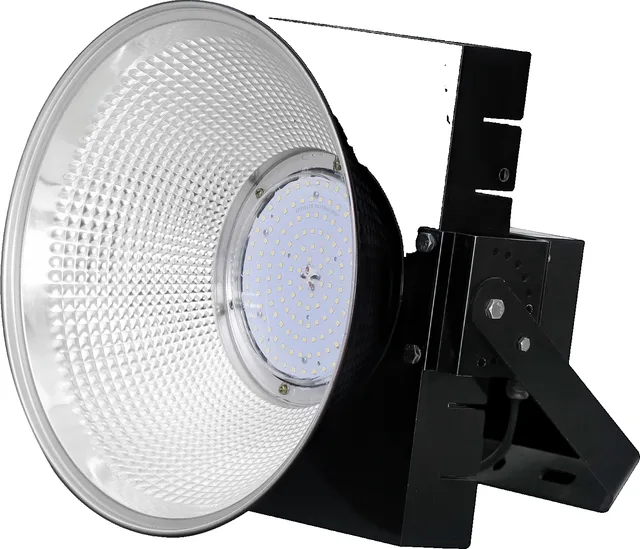 | SJGK902 | All-aluminum, air-duct heat dissipation | φ385 × 290 |
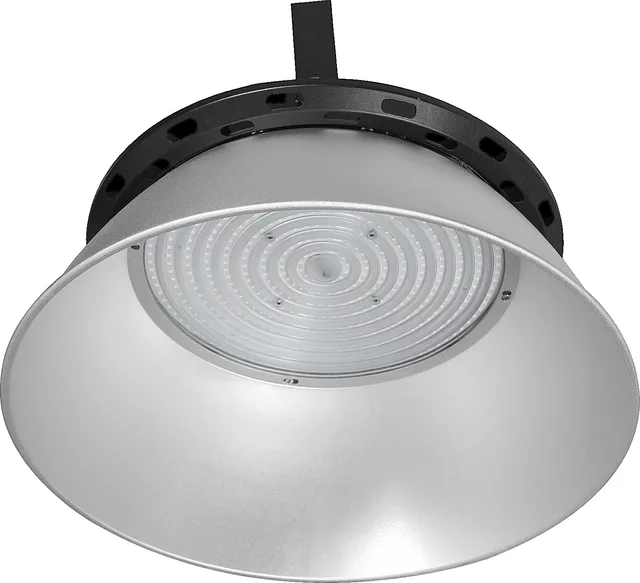 | SJGK906 | UFO with flame-retardant optical lens | φ253 × 111 |
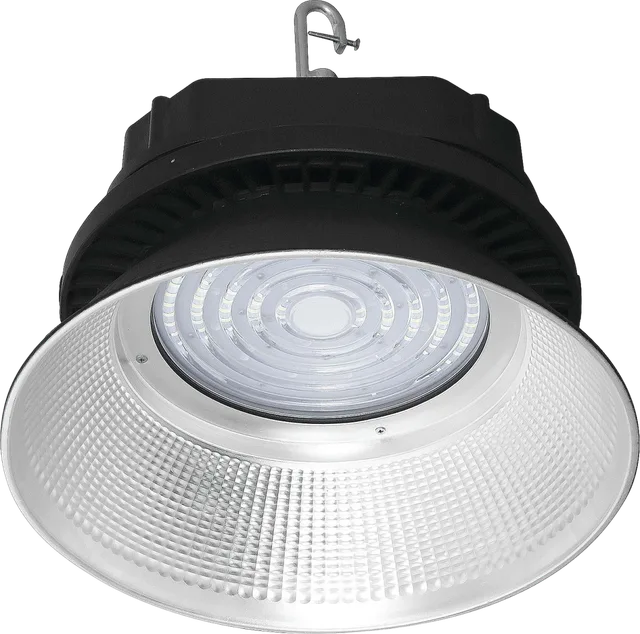 | SJGK908 | High-purity reflector, glare-free | φ400 × 265 |
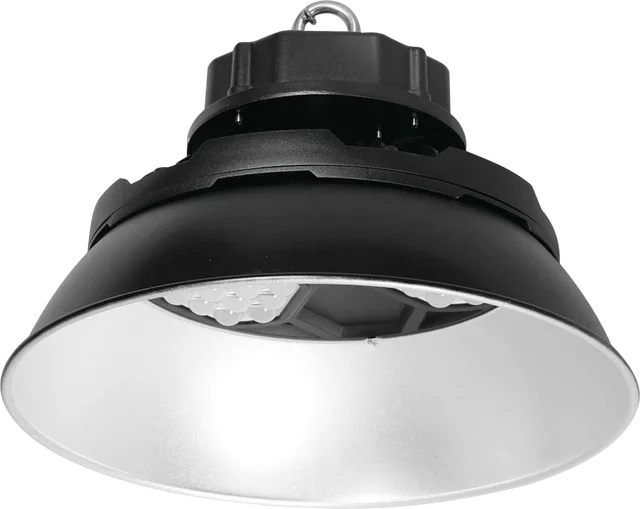 | SJGK910 | Matrix glass lens, 7070 chip | φ442 × 266 |
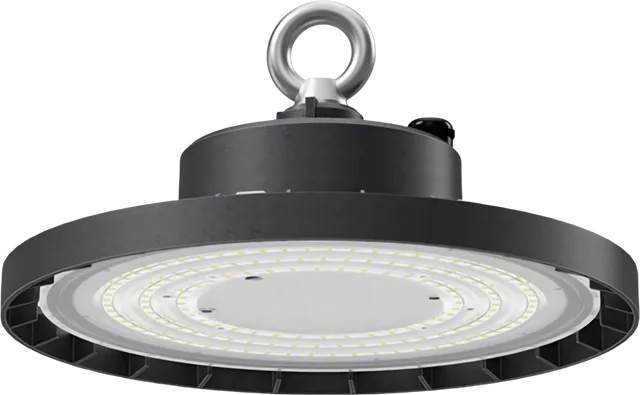 | SJGK912 | Ultra-slim UFO with respirator valve | φ273 × 93 |
Dimensions in mm from the factory catalog. All housings: aluminum body, IP65. Full datasheet and IES/LDT files on request.
Where This Class Works
Three duties this wattage is specified for most often — and what changes in the specification for each.
Workshops and assembly halls
At 4–7 m the 100W UFO is the workhorse: wide beam, even coverage, and a low enough mounting that glare control matters more than raw output. Spaced at roughly one fixture per mounting height, an 8 × 12 m workshop typically takes six units.
- 4–7 m mounting height band
- Spacing ≈ 1 × mounting height
- CRI ≥ 80 available for inspection work
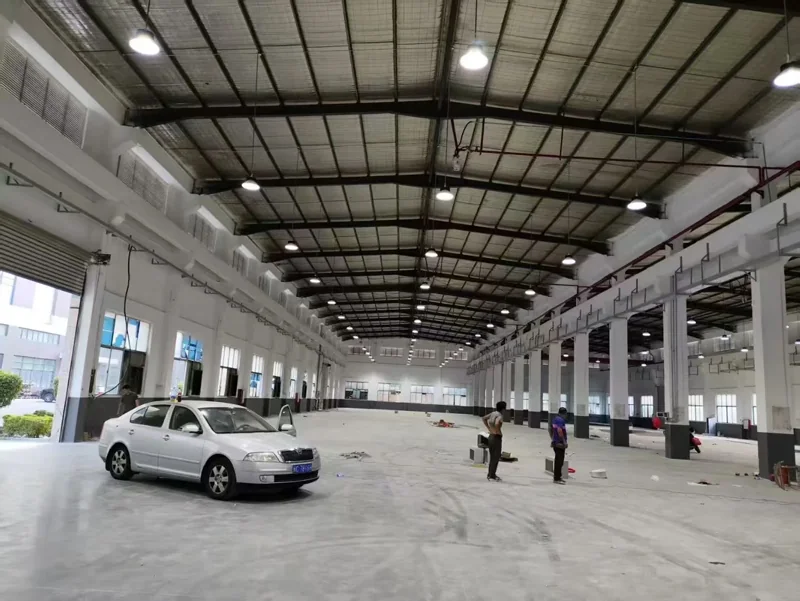
Stockrooms and light warehousing
Lower-bay storage does not need 200W fixtures — over-specifying at 5 m produces glare and pays for lumens that never reach a pick face. The 100W class holds general storage levels with a comfortable spacing grid.
- Right-sized for general storage lux
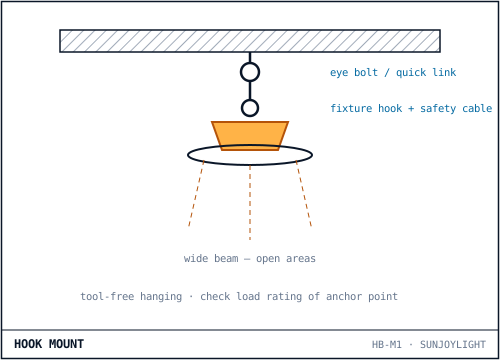
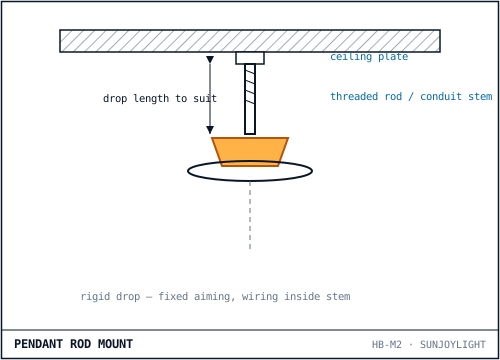
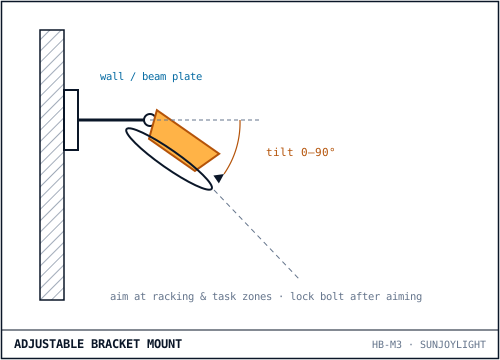
- Hook, bracket and pendant mounting
- Dimmable drivers for zoned control
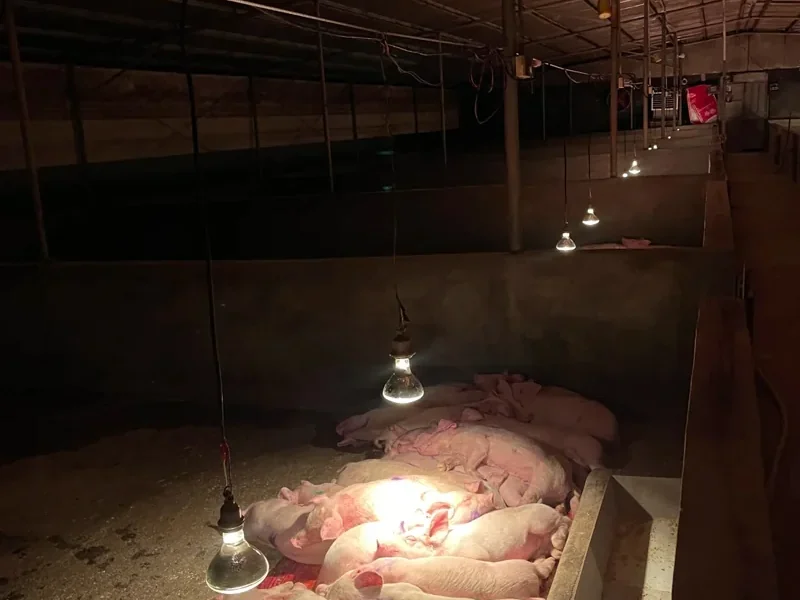
Barns, sheds and agricultural buildings
Farm buildings punish lighting: dust, humidity, ammonia and wash-down. Sealed bodies keep the optics and heat sink clear so output holds through the season, and corrosion-resistant construction survives the atmosphere between cycles.
- IP65 sealed against dust and wash-down
- Sealed body protects the heat sink
- Dimmable options for staged programmes
How It Goes Up
The mounting methods this fixture class is supplied for. Installation photographs from delivered projects are being catalogued and will be added alongside.
Every Order Ships With the Paperwork
The documents an engineer needs to verify the design and an importer needs to clear customs — supplied as standard, not on request.
IES / LDT files for the exact housing and optic quoted, so your designer models the fixture you are buying.
A free DIALux study from your dimensions — lux, uniformity and fixture count verified before you commit.
CE / FCC / CCC documentation with the type-test reports behind it, plus the Ex certificate where applicable.
Driver spares quoted with the order and an engineer contact who answers after the invoice is paid.
Straight Answers to the Questions Buyers Ask in Forums
What buyers report in sourcing forums and marketplace reviews — and how to check any supplier, including us.
Buyer threads regularly report 100W high bays measuring far below their listed lumens. Ask for LM-79-style test data and the IES file rather than trusting the listing — we supply photometric files with every quotation and publish measured data for the range's tested unit.
Around rotating machinery, a cheap driver's ripple creates a stroboscopic effect — a genuine workshop safety issue foremen complain about after the install. Ask for the driver's flicker/ripple data; quality drivers hold it to a few percent.
Dark upper walls and hot spots under fixtures mean the spacing-to-height ratio is wrong, not that you need more watts. Keep spacing near 1 × mounting height with wide beams — or send us the floor plan and we lay it out in DIALux free.
5-year cover on most ranges, 50,000 h L70 design life, and replacement drivers stocked. Whoever you buy from, get the driver-spares answer in the contract — the driver, not the LED, is what gets serviced.
100W UFO High Bay Light — Answered
What ceiling height suits a 100W UFO high bay?
4–7 m. Below about 4 m a linear tri-proof usually gives better coverage per fixture and less glare; above 7 m the light thins and 150–200W with the right beam becomes the economical choice. Our high bay spacing guide walks through the full ladder.
How many 100W high bays do I need?
Depends on target lux, height and layout. As a starting point, fixtures spaced at about 1 × mounting height hold uniformity in general work areas — a 200-lux workshop at 5 m lands near one fixture per 25–30 m². We confirm the exact count free with a DIALux model of your floor plan.
What does a 100W LED high bay replace?
Typically a 250W metal halide or a multi-tube fluorescent high bay, at well under half the energy. The LED's directional output and stable lumen maintenance mean the replacement usually improves floor lux as well as cost.
UFO or classic reflector body — which should I pick?
UFO bodies (SJGK906, SJGK912) are compact, sealed and fully LED-native — the default choice. Classic fins-cooled or reflector bodies (SJGK901, SJGK908) suit buyers standardising on a traditional form factor or specific optic behaviour. Performance-per-watt is comparable; the duty and mounting decide.
Send Us the Space, Not Just the Wattage
Share the dimensions, mounting height and the level you need to hold. Our engineers return a lighting layout with fixture count, aiming and the photometric files behind it — before you commit to anything.
Floor plan or site dimensions, mounting height, target lux or the standard you must meet.
A DIALux study with fixture count, layout, aiming and IES files — at no cost.
Your engineer checks the numbers against the standard. Only then does a quotation matter.
Manufacturing in Changzhou since 1999 · Shipping to 50+ countries · CE / FCC / CCC
Tell us about your project.
Get a quote within 24 hours.
Share your application — environment, requirements, quantity. A real engineer responds with a tailored quote, IES files, and timeline within one business day.