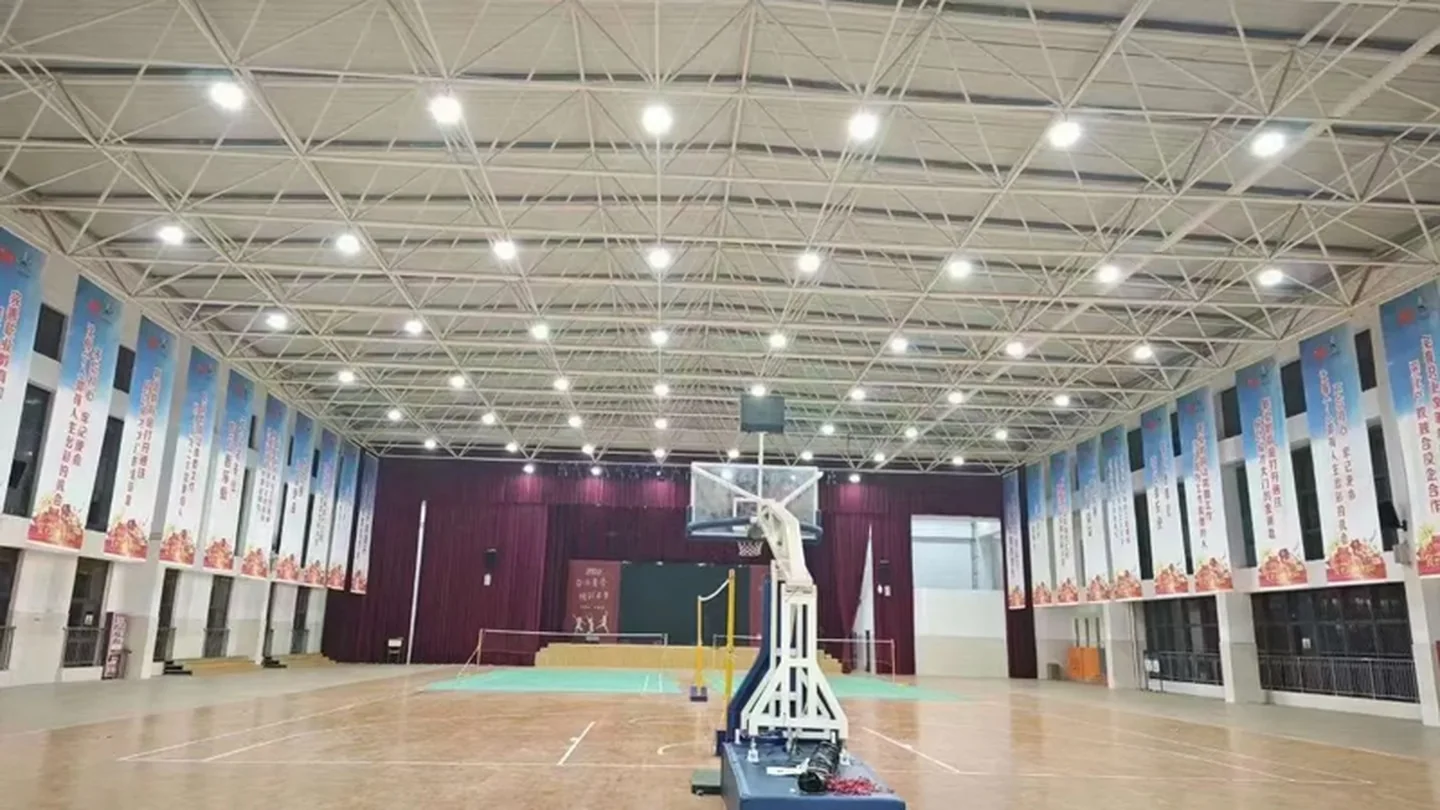
A sports hall is the hardest indoor space most facility managers will ever light. It needs the lux of a workshop, the glare control of an office, the flicker discipline of a TV studio, and fixtures that survive a badminton smash at ceiling height — all across a ceiling that may serve five different sports before lunch. The good news: EN 12193, the sports lighting standard, turns the whole problem into a lookup-and-verify exercise. This guide covers the lux levels by sport and class, the indoor-specific rules that outdoor guides skip, and the fixture and layout choices that make a multi-sport hall work.
Key Takeaways
- Indoor courts follow the same EN 12193 class logic as outdoor pitches: Class III training ≈ 200–300 lx, Class II club competition ≈ 500 lx, Class I top-level ≈ 750 lx, measured on the court. Outdoor pitches use lower levels for the same classes — see the football pitch lighting guide.
- Glare rules are stricter indoors — players look up at the ceiling constantly, so fixture placement relative to court lines matters as much as output.
- Flicker-free drivers are non-negotiable: fast sports plus cheap drivers produce visible stroboscopic trails on the ball.
- Fixtures over courts need impact protection (ball-proof construction, IK-rated lenses) and, ideally, positions outside the main sightlines.
- Multi-sport halls should be designed for the most demanding sport and switched/dimmed in zones for everything else.
The Lux Targets, Sport by Sport
EN 12193 grades indoor sports lighting by level of play, exactly as it does outdoors — but the indoor reference surface is the court, the background is a ceiling players stare into, and the numbers start higher than most owners expect:
| Sport (indoor) | Class III · training | Class II · club | Class I · competition |
|---|---|---|---|
| Badminton | 300 lx | 500 lx | 750 lx |
| Basketball / volleyball / handball | 200 lx | 500 lx | 750 lx |
| Futsal / indoor football | 200 lx | 500 lx | 750 lx |
| Tennis (indoor) | 300 lx | 500 lx | 750 lx |
| Table tennis | 300 lx | 500 lx | 750 lx |
| Multi-purpose school hall | 200–300 lx | 500 lx | — |
Uniformity floors run roughly 0.5 for training up to 0.7 for top classes — even light across the whole court, not pools under fixtures. These are maintained values: the design must still meet them after years of LED depreciation and dust, which is what the maintenance factor in the calculation is for. Televised events add vertical-illuminance and colour requirements on top; if a broadcast van will ever park outside your hall, say so before the design starts, not after.
What Makes Indoor Different: Glare, Flicker, Impact
Glare is a placement problem before it is a fixture problem. In badminton and volleyball, players track a fast object against the ceiling for whole rallies. A brilliant fixture on that sightline is a lost point and a design failure — EN 12193 caps glare ratings, but the practical fix is geometric: run fixture rows along the corridors between courts, use wide-beam optics with proper shielding or diffusion, and never hang a point source over the service or net lines. Indirect or micro-prismatic options go further for competition badminton halls.
Flicker turns fast sport into stop-motion. A driver with high ripple makes a 300 km/h shuttle or a spinning table-tennis ball visibly strobe — and it ruins any slow-motion phone or broadcast footage shot in the hall. Quality drivers hold flicker to a few percent; ask for the ripple data at full output and at the dimmed levels the hall will actually run for training. Missing data is an answer in itself.
Fixtures get hit. Footballs, basketballs and shuttles all reach the ceiling. Sports-hall fixtures need ball-impact-proof construction — protective grilles or IK-rated polycarbonate lenses, secured diffusers that cannot shatter over a court, and mounting hardware with secondary retention. This is written into most school and municipal specifications (DIN 18032-3 ball-throw testing is the common reference); confirm the fixture has the evidence rather than assuming an industrial body qualifies.
Fixture Choice and Layout by Hall Height
The fixture logic follows mounting height, exactly as in warehouse lighting — with the glare and impact rules layered on top:
- 6–8 m school halls: linear high bays or robust batten systems in continuous rows, wide beams, diffused optics. Rows along the hall’s long axis, in the corridors between badminton courts.
- 8–12 m club halls: LED high bays in the 100–200W band — the same UFO and reflector platforms used industrially, specified with impact protection, low-ripple drivers and often a wider-beam lens than warehouse duty.
- 12 m+ arenas: high-power fixtures such as the modular-fin SJGK905 platform (built for indoor courts, ballparks and arena duty) or aimed flood lights from catwalks and trusses, designed per EN 12193 Class I/II with vertical illuminance where cameras demand it.
A useful scale reference: a Class II hall at 500 lx maintained typically lands near one 150–200W high bay per 20–25 m² of court once uniformity is engineered — but the honest number always comes from the DIALux model of your hall, with the maintenance factor stated.
Zone the controls by court. A three-court hall rarely runs three matches at once. Dimmable drivers (0-10V or DALI) zoned per court let one court train at 300 lx while another sits dark — routinely halving the energy bill of an always-on hall and extending fixture life for free. Presets (“training / match / cleaning”) on a simple wall panel get used; complicated interfaces do not.
Procurement Checklist for a Sports Hall Project
- The photometric calculation to the sport, class and court layout — with maintained lux, uniformity, glare rating and the maintenance factor stated, built from IES/LDT files.
- Flicker data at full and dimmed output — percent flicker / flicker index, not the word “flicker-free” alone.
- Ball-impact evidence — impact-proof construction or grille per the specification’s test reference, plus secondary retention on every fixture over play.
- Driver and control spec — dimmable drivers zoned per court, with the control system named.
- The commissioning measurement — the lux grid measured after installation, on record, next to the calculation it must match.
Frequently Asked Questions
How many lux does a school sports hall need? For PE and community use, 200–300 lx maintained on the court is the common design level (EN 12193 Class III band); club competition steps to 500 lx. Multi-use halls are usually designed for the higher figure and dimmed for daily use.
How many lux for competition badminton or basketball? Class II club competition targets ≈ 500 lx for both; Class I top-level play targets ≈ 750 lx with tighter uniformity. Badminton training already starts at 300 lx — higher than most sports — because the shuttle is small and fast.
Can warehouse high bays be used in a sports hall? The platforms are the same, the specification is not. Sports duty adds ball-impact protection, stricter glare placement, low-ripple drivers and usually a wider or diffused optic. Specify the sports variant of the fixture rather than the warehouse default — the difference is small at purchase and decisive in use.
What colour temperature suits indoor sport? 4000–5000K with CRI ≥ 80 is the common band — neutral-to-cool white keeps the ball and lines crisp without the harshness of 6500K. Broadcast use adds its own colour requirements (TLCI), which the designer should know about up front.
Who verifies the design? The photometric calculation proves the design; a commissioning measurement on the EN 12193 grid proves the installation. Send your hall dimensions, sports and target class and we return the DIALux study with fixture counts, zoning and IES files — verified before you order.
The Bottom Line
Sports hall lighting is stadium discipline squeezed under a roof: the same EN 12193 classes and lux tables, plus three indoor-only rules — keep point sources off the players’ sightlines, keep ripple out of the drivers, and keep the fixtures ball-proof. Design for the most demanding sport, zone the controls per court, and demand the calculation and the commissioning measurement as a pair. A hall lit this way passes its class on day one and is still passing when the school, the club and the Tuesday badminton league have all forgotten who installed it.