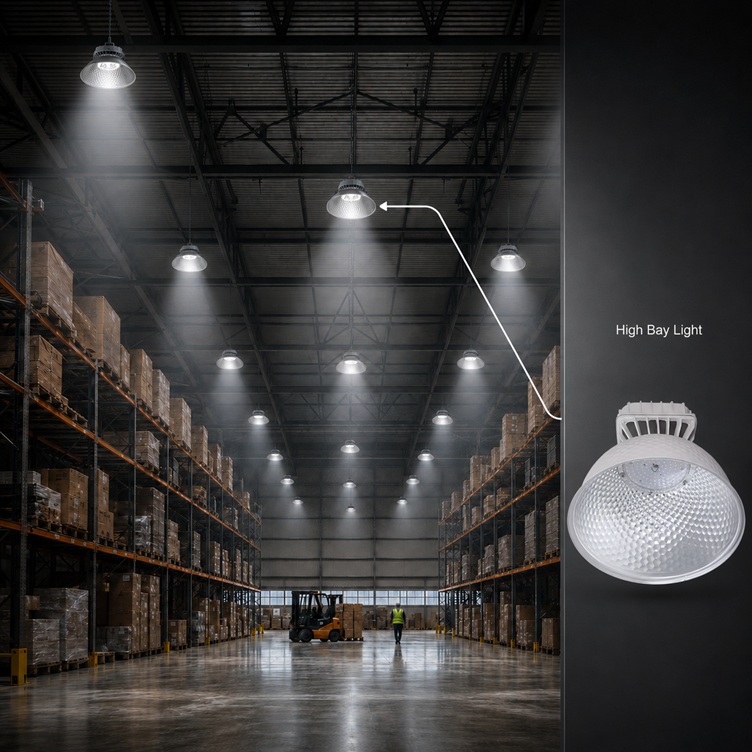
The honest answer arrives before the details: UFO high bays suit open floor area, linear high bays suit racking aisles and long narrow spaces. If your building is an open manufacturing floor, a gym or a distribution hall with clear span, UFOs almost always win on cost and installation time. If it is racked to 8 m with aisles that need light on the sides of the racks, linear fixtures running along those aisles will beat UFOs at the same connected load — sometimes by a wide margin.
Everything else in this comparison is the reasoning behind that sentence, plus the cases where it flips.
The reason the two are not interchangeable is geometric, not photometric. A UFO is a point source; it throws a circle. A linear fixture is a line source; it throws a stripe. Buildings are rarely organised as circles, and where a building is organised into long parallel corridors — which is what racking is — a stripe fits the room and a circle does not.
Key Takeaways
- UFO for open floor, linear for aisles. Building layout decides this before wattage or efficacy enters the conversation.
- Racking aisles need vertical illuminance on the rack face. A continuous linear row along the aisle delivers it; a grid of UFOs mostly lights the floor between racks.
- Above roughly 10 m mounting height, the UFO advantage grows — narrow-beam point optics carry distance better than any linear fixture.
- Linear fixtures cost more to install per lumen unless run as continuous rows, where a shared trunking makes them cheaper.
- Both families share the same failure mode: a driver cooked by a bad heat sink. Thermal design, not the shape, decides how long either lasts.
What Each One Actually Is
A UFO high bay is a round fixture — the name comes from the shape — with the LED board and driver stacked in a die-cast aluminium body and a reflector or lens setting the beam angle. It hangs from a single hook, pendant or bracket, and is available in beam angles from about 60° to 120°. Typical range in industrial use: 100 W to 300 W, with 200 W the workhorse for 8–10 m ceilings.
A linear high bay is a long body — usually 1.2 m or 1.5 m, sometimes joined into continuous runs — with LEDs distributed along its length behind a lens or a reflector pair. It hangs from two points, or clips into a trunking rail that carries the power for a whole row.
They are not two designs of the same fixture; they are two answers to different geometric questions. The UFO high bay and linear high bay glossary entries cover the construction detail.
The Racking Aisle Problem
This is the case that decides most warehouse projects, and it turns on a distinction that quotations rarely mention: horizontal versus vertical illuminance.
A lux figure quoted for a warehouse is almost always horizontal illuminance measured on the floor. But a picker does not read labels off the floor. They read them off the face of the rack, at heights from ankle to well above head height. That is vertical illuminance, and it is a different number produced by different geometry.
A grid of UFOs mounted above the racks throws light largely downward. Between the racks it reaches the floor without difficulty; onto the rack faces it arrives at a glancing angle, and the upper shelves shade the lower ones. The result is a scheme that measures well on paper and reads badly in the aisle — the classic “we hit 200 lux and staff still use head torches” complaint.
A continuous linear row running along the aisle sits above the gap and throws light down both rack faces along their whole length. Same lumens, radically better vertical illuminance, and no dark segments between fixtures because the row is continuous.
Practical rule: if the aisles are fixed and narrower than about 3 m, run linear rows along them. If the racking layout changes with the season — a common condition in third-party logistics — a UFO grid tolerates rearrangement better, because a grid does not care where the racks stand. That flexibility is a real advantage and worth paying for in a building whose layout genuinely moves.
Mounting Height
Height favours the point source, and the reason is optical control. A narrow-beam UFO concentrates output into a tight cone that carries distance efficiently. A linear fixture, spreading light along its length, has less scope to do this without becoming very deep.
| Mounting height | Better fit | Notes |
|---|---|---|
| Under 4 m | Neither — use tri-proof | High bay optics create hot spots this low |
| 4 – 6 m | Linear | Wide, even coverage; low glare in occupied space |
| 6 – 8 m | Either | Racking layout decides; mixing is common |
| 8 – 12 m | UFO (linear in aisles) | Point optics carry the distance efficiently |
| Over 12 m | UFO, narrow beam | 60° optics and higher wattages |
Below 4 m, neither family is right: the beams have not spread enough to overlap and you get scallops and shadows. That is tri-proof territory, and specifying a high bay there is a common and expensive mistake.
Spacing and Fixture Count
Spacing follows the same discipline for both, driven by the spacing-to-mounting-height (S/MH) ratio that the fixture’s optic allows — our high bay spacing guide works through the method with examples. What changes between the two families is how the count comes out.
- UFO grid. Spacing in both directions is limited by the beam angle. At 9 m mounting height with 90° optics, roughly 9–11 m spacing is typical, giving a clean square grid.
- Linear rows. Spacing between rows follows the same ratio, but along the row the fixtures are continuous or nearly so. Row spacing is normally set by the aisle pitch rather than by photometry, since the racks fix where the light can usefully go.
That difference has a budget consequence worth anticipating: a linear scheme laid over racking usually ends up with more fixtures at lower wattage each than the UFO scheme it replaces. Total connected load is often similar or slightly lower — but the fixture count, and therefore the installation labour, is higher unless the fixtures are run on shared trunking.
For the total lumens either scheme needs in the first place, the warehouse lumens per square metre tables give the arithmetic.
Installation and Wiring Cost
| Factor | UFO | Linear |
|---|---|---|
| Mounting points | One per fixture | Two per fixture, or a trunking rail |
| Wiring | Individual drop per fixture | Loop-in/loop-out, or a rail carrying the run |
| Fixture count for a given area | Lower | Higher |
| Labour per fixture | Low | Low individually, but more fixtures |
| Retrofit onto existing HID points | Direct — one hook, one point | Needs new mounting or trunking |
| Best case cost | Open floor, replacing existing point mounts | Continuous rows on shared trunking |
The retrofit line matters more than it looks. A building converting from 400 W metal halide already has one hook and one supply drop at each fixture position, which is exactly what a UFO needs — so a UFO retrofit is often a same-day swap with no new containment. Converting the same building to linear rows means new mounting and new wiring, and that cost has to be justified by a genuine lighting gain in the aisles. Our high bay retrofit guide covers the equivalence and the pitfalls of that conversion.
Where linear wins on installed cost is a continuous run on a trunking rail: the rail is installed once and carries power along the row, and the fixtures clip in. On a long production line or a wide-span aisle, that is faster and tidier than a matching count of individually wired fixtures.
Glare and Visual Comfort
A UFO concentrates a large amount of light into a small, round, very bright surface. Where people look up — assembly benches, quality inspection, sports halls, mezzanine offices — that source can be uncomfortable, and it is what unified glare rating tries to quantify.
A linear fixture spreads the same lumens across a much larger emitting surface, so its luminance is lower and it is generally more comfortable in occupied space. For a picking aisle where staff spend a full shift looking up at rack faces, that difference is worth real money in complaints avoided.
Both families can be fitted with diffusers or louvres to soften the source, at a cost of a few percent in efficiency. In gyms and sports halls the driver is usually impact protection instead — see the sports hall lighting guide for the ball-impact and glare requirements that apply there.
What Does Not Differ
Three things are decided by build quality rather than by shape, and they matter more to the ten-year cost than the UFO-versus-linear choice does:
Thermal design. LED junction temperature sets lumen depreciation and driver life for both. A well-finned heat sink with a real thermal path beats a thicker aluminium slab that looks solid and conducts poorly. This is the number-one cause of premature high bay failure, in both families.
Driver quality and surge protection. The driver fails long before the LEDs in most industrial installations. Specify the surge rating, and specify a driver whose ambient temperature rating covers your building’s summer ceiling temperature — which in a steel-roofed warehouse can be 15–20 °C above the floor.
Honest photometry. Ask for the IES file and check that the fixture lumens in it match the catalogue. A “chip lumens” number multiplied out from LED datasheets is not what leaves the fixture — the difference between the two is usually 10–20%, and it lands entirely on your lux calculation.
The Decision Table
| Your building | Choose | Why |
|---|---|---|
| Open manufacturing floor, 8–10 m | UFO | Grid coverage, lowest fixture count |
| Racked warehouse, fixed aisles under 3 m | Linear along aisles | Vertical illuminance on rack faces |
| 3PL warehouse with changing layouts | UFO | Grid tolerates rearrangement |
| Long production line or packing bench | Linear, continuous run | Even light along the working line |
| Retrofit from 400 W metal halide, open floor | UFO | Reuses existing hooks and drops |
| Gymnasium or sports hall | UFO with impact protection | Height plus ball-impact requirement |
| Ceiling under 4 m | Neither — tri-proof | High bay optics too narrow for the height |
| Mixed: open floor plus racked zones | Both | UFOs over the floor, linear over the aisles |
That last row is not a compromise; it is the correct answer for most large distribution buildings. Splitting the fixture type by zone typically costs less than forcing one family across the whole building, because each zone gets a fixture whose shape matches its geometry.
The Bottom Line
The UFO-versus-linear argument is settled by the floor plan, not by the spec sheet. Circles suit open area; stripes suit aisles. When you know where the racks stand, whether they will move, and how high the roof is, the choice makes itself — and the remaining specification effort belongs on thermal design, driver quality and verified photometry, which decide how long either fixture actually lasts.
Send us your floor plan with the racking layout and roof height, and our engineers return a DIALux layout with the fixture type, count and spacing — including where a mixed scheme costs less than a single family. Our LED high bay lights cover both formats across the same wattage range, so the recommendation is driven by your geometry rather than by what we happen to stock. For the two most common warehouse heights, see the 100W UFO high bay for 4-7 m ceilings and the 200W UFO high bay for 8-12 m, or the 400W LED high bay above 12 m.
FAQ
Is a UFO or a linear high bay better? Neither is better in general — they fit different geometries. UFO high bays suit open floor areas and higher ceilings because a point source with narrow optics carries distance efficiently. Linear high bays suit racking aisles, long narrow spaces and production lines because a line source matches the shape of the space and lights vertical surfaces far better.
Which is better for a racked warehouse? Linear fixtures running along the aisles, in most cases. Picking work depends on vertical illuminance on the rack faces, and a continuous row above the aisle delivers that along the full rack length. A UFO grid lights the floor between racks well but reaches the rack faces at a glancing angle. The exception is a warehouse whose racking layout changes often — a grid tolerates rearrangement better.
What mounting height suits each type? Linear works best from about 4 to 8 m; UFO from about 6 m upward, and it becomes the clear choice above 10 m with narrow-beam optics. Below 4 m, neither is right — that height calls for tri-proof or batten fixtures, since high bay optics produce hot spots and scalloping when mounted too low. That 4 m figure answers a form-factor question, and it is not the same boundary as the 6 m that defines the high bay category: low bay vs high bay separates the three questions hiding behind one number.
Is one cheaper to install? UFO usually, on a straight swap: one mounting point and one supply drop per fixture, which matches what an existing metal halide installation already provides. Linear becomes cheaper where fixtures run as a continuous row on a shared trunking rail, since the rail is installed once and carries power along the whole run.
Do linear high bays produce less glare? Generally yes. They spread the same lumens across a larger emitting surface, so source luminance is lower and the fixture is more comfortable to work under. That matters most where people look up for long periods — picking aisles, assembly benches, inspection stations. Diffusers and louvres can soften either type at a small efficiency cost.
Can I mix UFO and linear high bays in one building? Yes, and in large distribution buildings it is usually the cheapest correct answer: UFOs over open floor and staging areas, linear rows over the racked aisles. Keep the colour temperature and CRI consistent across both so the transition is not visible, and specify a single dimming protocol so the whole building runs on one control system.